
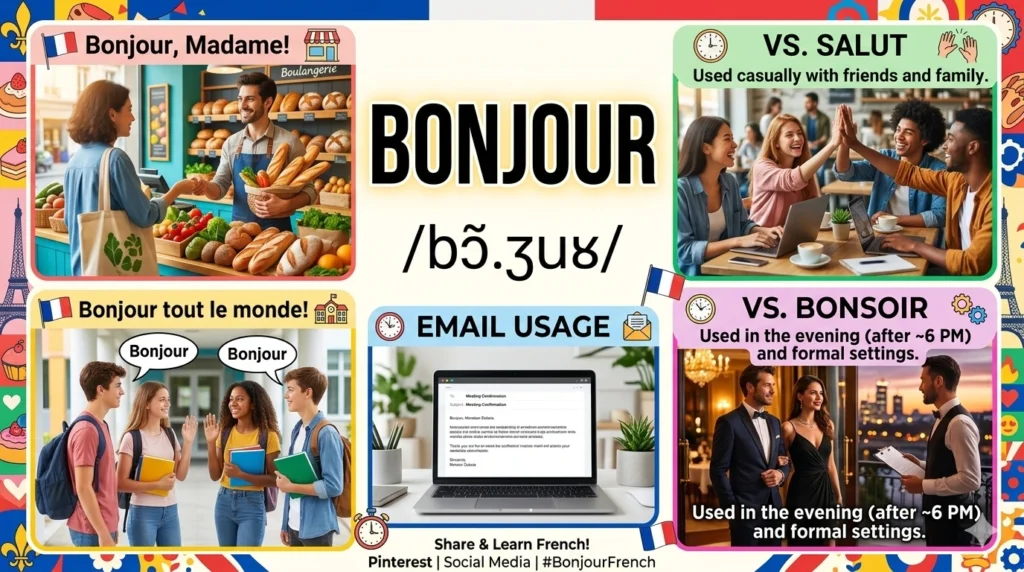
In French, “Bonjour” literally means “good day” or “hello”. It is the most common formal greeting used in French-speaking countries, appropriate for both casual and professional contexts.
Unlike informal greetings such as “Salut,” Bonjour conveys politeness and respect when addressing someone.
Bonjour is one of the most recognizable words in the French language. Even people who have never studied French have likely heard it in movies, songs, travel shows, or everyday conversations. At first glance, it simply means “hello.” However, the meaning of bonjour goes much deeper than a basic greeting. In French culture, it represents politeness, respect, social awareness, and the beginning of human connection.
In 2026, as global communication grows and more people interact across cultures online and in person, understanding simple yet meaningful words like bonjour becomes increasingly important. It is not just a translation of “hello,” but a cultural signal that shows good manners and friendliness. Whether you are visiting France, learning French, or communicating with French speakers online, saying bonjour correctly can create a positive first impression.
The word itself comes from two French parts: “bon,” meaning good, and “jour,” meaning day. Together they literally translate to “good day.” This small phrase carries centuries of tradition and remains a key part of everyday conversation in French-speaking regions around the world.
From greeting a shopkeeper in Paris to starting a professional email in Montreal, bonjour plays an essential role in social etiquette. Understanding its deeper meaning helps language learners appreciate not only the vocabulary but also the culture behind the language.
Whether you are learning French, traveling, or simply curious, understanding “Bonjour” is essential for effective communication and cultural etiquette.
Origin of Bonjour
The greeting Bonjour has roots in the French language dating back to the Middle Ages:
- Etymology: It is a combination of two words: “bon” meaning “good” and “jour” meaning “day.” Together, they form “good day.”
- Historical usage: Initially, it was a formal expression used in courts and among the nobility to wish someone a good day. Over centuries, it became a standard greeting among all French speakers.
- Popularity: Today, Bonjour is universally recognized, not just in France, but in French-speaking regions like Canada (Quebec), Belgium, Switzerland, and parts of Africa.
Fun fact: While “Bonjour” literally means “good day,” it is used to greet someone from morning until late afternoon. In the evening, French speakers typically switch to Bonsoir (“good evening”).
Usage of Bonjour in Everyday Life
Bonjour is versatile and can be adapted to multiple situations:
1. Formal Greetings
In workplaces, schools, or when meeting someone for the first time:
- Example:
Bonjour, Monsieur Dupont. Comment allez-vous ?
Translation: “Good day, Mr. Dupont. How are you?” - Tip: Always use Bonjour when addressing someone older or in a professional setting.
2. Casual Greetings
Among friends or family, Bonjour can still be used, but many people prefer Salut for an informal touch:
- Example:
Bonjour Marie ! Ça va ?
Translation: “Hello Marie! How’s it going?”
3. Written Communication
Bonjour is often used in emails, letters, and messages:
- Example in email:
Bonjour Madame,
Je vous écris pour confirmer notre rendez-vous.
Translation: “Good day Madam, I am writing to confirm our appointment.”
4. Cultural Etiquette
- Always say Bonjour when entering a shop or restaurant in France. Not doing so is considered impolite.
- French people value greetings highly; using Bonjour before any request shows respect.
Variations and Related Terms
| French Word | Meaning | Context/Usage |
|---|---|---|
| Salut | Hi / Bye | Informal, casual greetings |
| Bonsoir | Good evening | Used after late afternoon or evening |
| Coucou | Hey / Hi | Playful, used with children or close friends |
| Allô | Hello | Used for phone greetings |
| Bonne journée | Have a good day | Polite parting phrase |
Tip: Using the correct greeting depends on the time of day and your relationship with the person.
Examples of Bonjour in Different Contexts
Here are real-life examples showing how Bonjour is used:
| Situation | French Phrase | English Translation | Tone |
|---|---|---|---|
| Meeting a teacher | Bonjour, Madame Lefevre. | Good day, Mrs. Lefevre. | Formal, respectful |
| Greeting a friend | Bonjour Paul ! Comment ça va ? | Hello Paul! How are you? | Friendly, casual |
| Entering a shop | Bonjour ! Puis-je vous aider ? | Good day! May I help you? | Polite, professional |
| Starting an email | Bonjour Monsieur, | Good day Sir, | Formal, professional |
| Saying goodbye | Bonne journée ! | Have a good day! | Polite, neutral |
Friendly tip: Even when you know someone well, starting a conversation with Bonjour is appreciated in France.
Pronunciation of Bonjour
Proper pronunciation is crucial:
- Phonetic guide: /bɔ̃.ʒuʁ/
- Step-by-step:
- Bon → nasal “bohn”
- Jour → soft “zhoor” with a French ‘r’ sound
- Tip for beginners: Don’t over-pronounce the r; the nasal sounds are key to sounding natural.
Bonjour vs Salut
Many learners wonder about the difference between Bonjour and Salut:
| Word | Meaning | Tone & Usage | Appropriate Time |
|---|---|---|---|
| Bonjour | Good day / Hello | Formal, polite, respectful | Morning & afternoon |
| Salut | Hi / Bye | Informal, casual, friendly | Any time (among peers) |
- Rule of thumb: Use Bonjour first when meeting someone. After establishing familiarity, Salut is fine.
Cultural Insights: Why Bonjour Matters
In French culture, greetings are not optional. Saying Bonjour:
- Establishes politeness and respect
- Sets a positive tone for interactions
- Avoids social awkwardness or offense
Example: Entering a small shop in Paris without saying Bonjour may result in a cold or distant response from the staff. It’s a cultural norm that signals awareness and politeness.
Advanced Usage of Bonjour
Adding Politeness
- Bonjour Monsieur / Madame → Shows respect
- Bonjour à tous → “Good day to everyone” for group greetings
Combining with Questions
- Bonjour, comment allez-vous ? → “Hello, how are you?” (formal)
- Bonjour, ça va ? → “Hello, how’s it going?” (casual)
Written Greetings in Business
- Bonjour, [Name] → Standard email opening
- Bonjour à toute l’équipe → To address a team
Fun Facts About Bonjour
- Bonjour is recognized worldwide as a symbol of French politeness and culture.
- French children learn Bonjour before learning basic numbers or colors—it’s a cornerstone of etiquette.
- In Quebec, Bonjour is also used in combination with local expressions like “Bonjour, comment ça va la gang ?” (“Hello, how’s the group doing?”).
- Famous quotes often begin with Bonjour, signaling politeness and starting conversations respectfully.
Common Mistakes
- Skipping Bonjour in stores or workplaces → Seen as rude
- Using Salut in formal situations → Can appear too casual or disrespectful
- Incorrect pronunciation → Makes non-native speakers harder to understand
- Confusing Bonsoir with Bonjour → Use Bonsoir only after late afternoon
Pro tip: If unsure, always use Bonjour; it’s safer than informal greetings in French culture.
Practical Examples Table
| French Phrase | English Translation | Context |
|---|---|---|
| Bonjour, Madame Dupont | Good day, Mrs. Dupont | Formal greeting |
| Bonjour tout le monde | Hello everyone | Group greeting |
| Bonjour, ça va ? | Hello, how’s it going? | Casual conversation |
| Bonjour Monsieur, je vous écris | Good day Sir, I am writing | Professional email opening |
| Bonne journée ! | Have a good day! | Farewell phrase |
Tips for Mastering Bonjour
- Pronounce it correctly: /bɔ̃.ʒuʁ/
- Use it consistently in formal and casual contexts.
- Switch to Bonsoir in the evening.
- Pair it with comment ça va ? to show engagement.
- Respect cultural norms: always greet shopkeepers and strangers politely.
FAQs
What does Bonjour literally mean?
It literally means “good day” in French, used to greet someone politely.
Can I use Bonjour in the evening?
Typically, no. After late afternoon, use Bonsoir instead.
Is Salut the same as Bonjour?
No, Salut is informal and casual, while Bonjour is polite and formal.
How do you say Hello in French on the phone?
Use Allô, especially when answering a phone call.
Do I need to say Bonjour in shops in France?
Yes, it is considered polite to greet shopkeepers and staff with Bonjour.
What’s the difference between Bonjour and Bonne journée?
Bonjour is a greeting (“Hello”), Bonne journée is a farewell phrase meaning “Have a good day.”
Can I use Bonjour with friends?
Yes, but often people switch to Salut for casual conversations.
Why is Bonjour important in French culture?
It demonstrates politeness, respect, and awareness of social norms.
Is Bonjour used in writing emails?
Yes, it is standard for formal or semi-formal emails, often followed by a person’s name.
Conclusion
Bonjour is more than just a word—it’s a cultural key to French communication. From its historical origins to modern usage, it remains essential for anyone learning French or traveling to French-speaking regions.
Key takeaways:
- Bonjour = “Good day” or “Hello”
- Use it formally or politely in most contexts
- Salut is the casual alternative
- Switch to Bonsoir in the evening
- Cultural etiquette is important—Bonjour shows respect
Mastering Bonjour opens doors to polite, respectful, and confident communication in French. It’s a small word with a big impact.
Read More Related Articles:
- True Meaning of “Quiero” in Spanish and How It’s Used In 2026
- “Of” Mean When Someone Texts It: Detailed Explanation in 2026
- Low MCHC Mean: Understanding Your Blood Test Results In 2026

Luna Hartley is a content creator at TextSprout.com, where she specializes in explaining word meanings, modern phrases, and everyday language used in texts and online conversations. Her writing focuses on clarity and context, helping readers understand how words are actually used in real communication.