
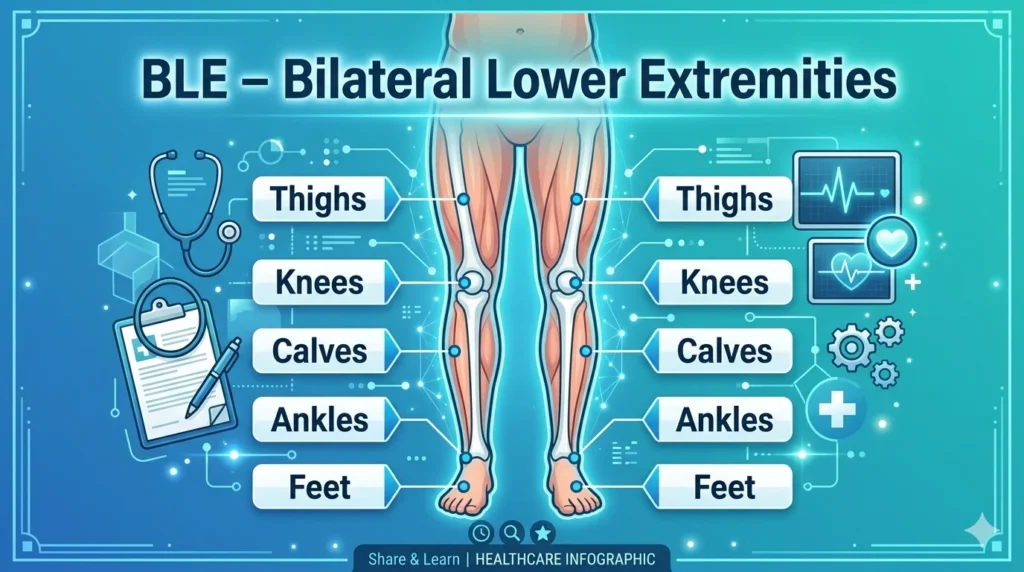
BLE in medical terms stands for “Bilateral Lower Extremities.”
It refers to both legs, including the thighs, knees, calves, ankles, and feet. Doctors commonly use the abbreviation BLE in medical documentation to describe symptoms, injuries, circulation issues, swelling, or neurological conditions affecting both legs at the same time.
For example, a medical note may say:
“Patient reports numbness in BLE for two weeks.”
This means the patient is experiencing numbness in both legs.
Medical records are full of abbreviations that can feel confusing to patients and even to new healthcare workers. One of those abbreviations is BLE, which often appears in hospital charts, diagnostic notes, and physical examination reports.
If you have ever read a doctor’s report and noticed something like “swelling in BLE” or “pain in BLE”, you might wonder what it means and why doctors use it instead of writing the full term.
Understanding these abbreviations can help patients better interpret their medical records and communicate more effectively with healthcare providers.
Understanding BLE in Medical Language
Medical professionals rely heavily on abbreviations to make documentation faster and more efficient. Writing full anatomical descriptions repeatedly can slow down charting during busy clinical hours.
BLE is part of a broader system of abbreviations used to describe body regions and symptoms.
Simple Breakdown of the Term
| Component | Meaning | Explanation |
|---|---|---|
| B | Bilateral | Affecting both sides of the body |
| LE | Lower Extremities | Legs from the hips down to the feet |
| BLE | Bilateral Lower Extremities | Both legs together |
So when doctors refer to BLE, they are simply referring to the patient’s two legs collectively.
Origin and Development of the Term
The abbreviation BLE developed from traditional medical shorthand used in clinical documentation.
Historically, physicians wrote notes by hand. Time was limited, especially in hospitals where doctors see many patients daily.
To save time, doctors shortened commonly used anatomical descriptions.
Examples include
- UE meaning upper extremity
- LE meaning lower extremity
- BUE meaning bilateral upper extremities
- BLE meaning bilateral lower extremities
Over time these abbreviations became standardized in medical charting, nursing documentation, and emergency medicine reports.
Today they appear in
- Electronic health records
- Radiology reports
- Physical examination notes
- Physical therapy evaluations
- Neurology assessments
When Doctors Use BLE in Medical Records
BLE appears most frequently when describing symptoms that affect both legs simultaneously.
Doctors may use the abbreviation when documenting conditions related to circulation, nerves, muscles, or swelling.
Here are some common situations where BLE might appear.
1. Swelling or Edema
Doctors often write:
“Edema noted in BLE.”
This means both legs show swelling, which can happen with conditions such as
- heart problems
- kidney disease
- fluid retention
- venous insufficiency
2. Pain or Weakness
Example note:
“Patient reports weakness in BLE.”
This may suggest
- nerve compression
- spinal cord problems
- muscle disorders
- neurological diseases
3. Numbness or Tingling
Medical chart example:
“Paresthesia in BLE.”
This means the patient feels pins and needles in both legs, often related to nerve issues.
4. Injury or Trauma
Doctors may write:
“Bruising observed in BLE following accident.”
This indicates both legs were affected by trauma.
Examples of BLE in Medical Documentation
Below are common medical chart examples showing how BLE is used in real clinical notes.
| Medical Note | Meaning | Context |
|---|---|---|
| Mild edema in BLE | Mild swelling in both legs | Fluid retention or circulation issue |
| Weakness in BLE | Loss of strength in both legs | Possible neurological condition |
| Pain radiating to BLE | Pain spreading into both legs | Often related to spine problems |
| Numbness in BLE | Reduced sensation in both legs | Could indicate nerve compression |
| Rash present on BLE | Skin irritation affecting both legs | Dermatological condition |
These short notes allow doctors and nurses to quickly communicate important observations.
Body Areas Included in BLE
BLE includes several anatomical parts of the legs.
| Body Region | Description |
|---|---|
| Thighs | Upper leg area between hips and knees |
| Knees | Joint connecting thigh and lower leg |
| Calves | Back portion of the lower leg |
| Ankles | Joint connecting leg and foot |
| Feet | Final portion of the lower extremity |
Any of these areas can be described as part of BLE symptoms.
For example, a patient may have swelling in the calves and ankles of BLE.
BLE in Different Medical Specialties
Different healthcare fields use the term in slightly different contexts.
Neurology
Neurologists use BLE to describe nerve symptoms affecting both legs.
Example
“Loss of sensation in BLE due to neuropathy.”
Cardiology
Cardiologists often note swelling in BLE when evaluating heart conditions.
Example
“Pitting edema in BLE suggesting fluid overload.”
Orthopedics
Orthopedic specialists may use BLE when assessing injuries or structural problems.
Example
“Muscle weakness noted in BLE during mobility test.”
Physical Therapy
Physical therapists frequently evaluate strength and mobility in BLE during rehabilitation.
Example
“Improved strength in BLE after therapy program.”
Comparison With Similar Medical Abbreviations
Medical abbreviations can sometimes look similar, which may confuse readers.
Here is a comparison table showing BLE alongside related terms.
| Abbreviation | Full Meaning | Body Area |
|---|---|---|
| BLE | Bilateral Lower Extremities | Both legs |
| BUE | Bilateral Upper Extremities | Both arms |
| LE | Lower Extremity | One leg |
| UE | Upper Extremity | One arm |
| RLE | Right Lower Extremity | Right leg |
| LLE | Left Lower Extremity | Left leg |
This system allows medical professionals to describe symptoms quickly and precisely.
For example
- Pain in RLE means pain only in the right leg
- Pain in BLE means pain in both legs
Tone and Context in Medical Usage
Unlike slang or texting abbreviations, BLE is purely clinical.
It carries no emotional tone or informal meaning.
However, the surrounding context of the sentence determines what it implies about a patient’s condition.
Neutral Example
“Strength normal in BLE.”
This indicates healthy leg function.
Concerning Example
“Severe weakness in BLE.”
This suggests a possible neurological or spinal issue.
Observational Example
“Redness observed in BLE.”
This simply documents a visible symptom.
Medical professionals rely on objective descriptions rather than emotional wording.
Alternate Meanings of BLE
While BLE almost always means bilateral lower extremities in medical contexts, the abbreviation can have other meanings outside healthcare.
Here are a few alternate uses.
| Field | Meaning |
|---|---|
| Technology | Bluetooth Low Energy |
| Engineering | Basic Logic Element |
| Education | Bachelor of Law and Economics |
| Medical context | Bilateral Lower Extremities |
Context usually makes the intended meaning obvious.
For example
A medical chart discussing swelling clearly refers to bilateral lower extremities, not Bluetooth technology.
Professional Alternatives to BLE
In patient-facing documents or educational materials, doctors sometimes avoid abbreviations to improve clarity.
Instead of writing BLE, they may say
- both legs
- the lower limbs
- bilateral legs
- lower extremities
Here is a quick comparison.
| Abbreviation | Plain Language Alternative |
|---|---|
| BLE | both legs |
| LE | leg |
| BUE | both arms |
| UE | arm |
Plain language helps patients better understand their medical reports.
Real World Example Scenario
Imagine a patient visiting a clinic with swelling in both legs.
A doctor’s note might read:
“Patient presents with moderate edema in BLE. No redness or warmth. Pulses intact.”
In simple language this means
The patient has moderate swelling in both legs, but circulation appears normal and there are no signs of infection.
Understanding these abbreviations can help patients interpret their medical records more confidently.
FAQs
What does BLE stand for in medical records?
BLE stands for bilateral lower extremities, meaning both legs. Doctors use it when documenting symptoms or conditions affecting the legs on both sides of the body.
What body parts are included in BLE?
BLE includes the entire lower limb area such as thighs, knees, calves, ankles, and feet.
Why do doctors use the abbreviation BLE?
Doctors use BLE to save time and maintain consistent documentation in medical charts and electronic health records.
Is BLE a serious medical term?
The abbreviation itself is not serious. It simply describes body location. The seriousness depends on the condition being described.
What is the difference between BLE and LE?
LE refers to a single lower extremity or leg, while BLE refers to both legs together.
Can BLE appear in physical therapy reports?
Yes. Physical therapists often use BLE when documenting strength, mobility, or rehabilitation progress in both legs.
Does BLE always refer to legs in medical notes?
Yes. In medical documentation BLE consistently refers to bilateral lower extremities.
Should patients worry if they see BLE in their medical chart?
Not necessarily. It only indicates the location of symptoms. The actual medical condition depends on the rest of the report.
Conclusion:
Medical abbreviations can look intimidating at first, but most are simply shorthand used for efficiency.
BLE is a straightforward example.
It refers to both legs collectively, allowing healthcare professionals to quickly document symptoms and observations.
Understanding this term helps patients read medical notes more confidently and communicate better with healthcare providers.
Whenever you see BLE in a report, remember that it simply identifies the location of a symptom or condition rather than the condition itself.
If any part of a medical report seems unclear, asking a doctor or nurse for clarification is always a good idea.
Clear communication leads to better healthcare outcomes and improved patient understanding.
Read More Related Articles:
- What Does POC Mean in Business? Proof of Concept and More In 2026
- What Does SLA Mean in Business: From Definition to Implementation In 2026
- What Does WP Mean in Gaming: How Players Use It in Chat In 2026

Ivy Madison is a content creator at TextSprout.com, specializing in word definitions, internet slang, acronyms, and text abbreviations. She delivers clear and engaging explanations, helping readers quickly understand modern digital language and trending terms.