
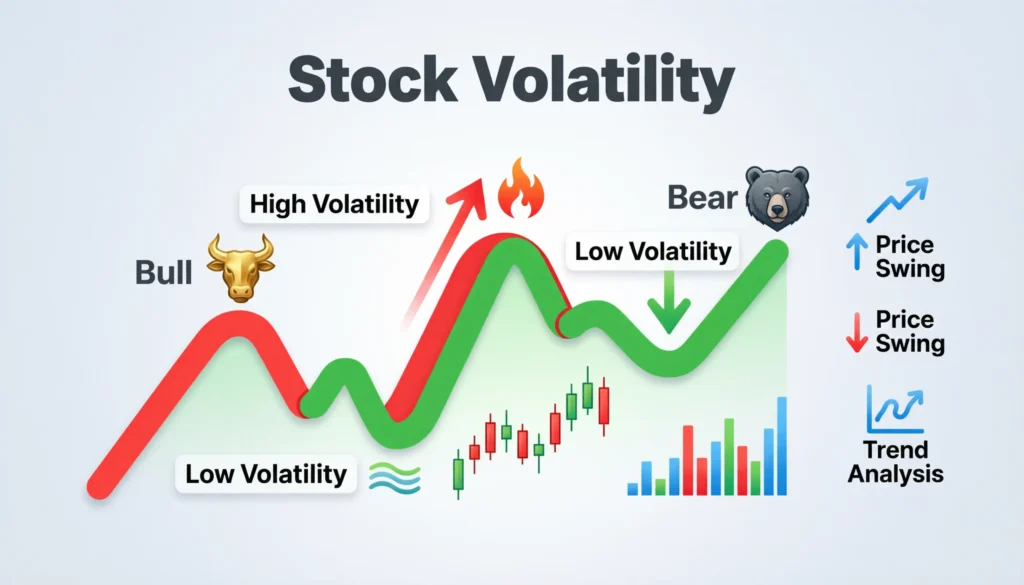
Volatile in stocks refers to the degree to which a stock’s price fluctuates over a short period of time.
In other words, a volatile stock experiences frequent and sometimes dramatic changes in price. A stock can rise significantly one day and fall sharply the next. Conversely, a stock with low volatility moves gradually and steadily, showing smaller gains and losses. Investors use volatility as a way to measure risk and uncertainty associated with a particular stock.
For example, if a stock jumps from one hundred dollars to one hundred ten dollars in a single day and then drops to ninety-eight dollars the next, it is considered highly volatile. A stock that moves only one or two dollars a week is far less volatile and often considered safer.
Investing in the stock market is a fascinating journey full of opportunities and challenges. One word you are likely to hear frequently, especially when following the news or talking to investors, is volatile. When someone says a stock is volatile, it can sound like a warning or an exciting opportunity depending on your perspective and investment goals. Understanding what volatility really means is essential for anyone looking to navigate the stock market with confidence.
Volatility is not inherently bad or good. It simply describes the ups and downs of stock prices over a period of time. Some investors love volatility because it opens the door to large potential gains, while others prefer more stable investments to reduce risk and avoid sleepless nights worrying about sudden price drops. By understanding volatility, you can make smarter decisions about which stocks to buy, hold, or sell.
Understanding Stock Volatility
Volatility is a cornerstone concept in investing. Essentially, it measures how unpredictable or variable a stock’s price is over time. High volatility does not automatically mean a stock is bad, and low volatility does not guarantee safety. It simply reflects the range of price movements.
Volatility can be influenced by many factors including company-specific events, industry developments, economic news, political decisions, and global events. Stocks in certain sectors, like technology or biotechnology, tend to be more volatile because their future performance is highly uncertain and often influenced by innovations, regulations, or market sentiment.
Types of Volatility
Investors usually think about volatility in two main ways: historical and implied.
Historical Volatility
Historical volatility looks at a stock’s past behavior. It examines how much the stock’s price changed over a specific period. Investors often calculate this using standard deviation or other statistical measures to see how far prices have strayed from their average.
For instance, if a stock’s price jumped wildly in the past month, it would be considered highly volatile historically. Historical volatility helps investors understand past risk and can inform decisions about future trading strategies.
Implied Volatility
Implied volatility is different. It is forward-looking and represents the market’s expectations of how volatile a stock might be in the future. This type of volatility is commonly used in options trading to determine the price of contracts.
High implied volatility indicates the market expects larger price swings, while low implied volatility suggests the market anticipates smaller, steadier price changes. Understanding implied volatility can help traders anticipate risk and identify potential opportunities in the market.
Causes of Stock Volatility
Volatility is driven by a combination of internal and external factors. The price of a stock does not move randomly; it responds to the flow of information, investor sentiment, and broader economic conditions.
Company Performance
A company’s earnings reports, product launches, leadership changes, and other internal developments can significantly affect its stock price. For example, if a company announces better-than-expected quarterly earnings, its stock might soar. Conversely, disappointing results could lead to sharp declines.
Market Sentiment
Investor emotions play a crucial role in stock volatility. Fear and greed can create rapid price swings. When news spreads about a potential crisis or economic opportunity, investors may rush to buy or sell, causing dramatic movements in stock prices.
Economic Events
Wider economic events, such as changes in interest rates, inflation reports, or unemployment data, can also influence stock volatility. For example, if the Federal Reserve raises interest rates, stocks may drop quickly due to investor concerns about slower economic growth.
Global Events
International events, including geopolitical tensions, trade negotiations, or natural disasters, can trigger volatility in global markets. For instance, oil prices might spike due to conflict in an oil-producing region, which could then impact energy stocks across the world.
Trading Volume
The number of shares being traded also affects volatility. Stocks with low trading volumes are often more volatile because even a small number of trades can have a significant impact on price. In contrast, highly traded stocks tend to have more stable prices.
Real-World Examples of Volatile Stocks
Some sectors naturally experience more volatility than others. Technology, biotechnology, and small-cap companies often see significant price swings because they are highly sensitive to innovation, regulatory changes, and market hype.
For example, Tesla has historically been very volatile. A single tweet from the CEO or a quarterly earnings report can send its stock soaring or plummeting by several percentage points in a single day.
In contrast, utility companies like Duke Energy or large consumer goods firms like Procter & Gamble are considered low-volatility stocks. Their business models are steady, demand is consistent, and their prices do not swing dramatically from day to day.
How Investors Measure Volatility
There are several tools and metrics investors use to understand a stock’s volatility.
Beta
Beta is a common metric that compares a stock’s price movements to the overall market. A beta greater than one indicates that the stock is more volatile than the market, while a beta less than one suggests it is less volatile. Investors often use beta to understand risk relative to the market.
Average True Range (ATR)
ATR measures the range of a stock’s price movements over a specific period. A higher ATR value indicates greater volatility. Traders often use ATR to determine appropriate stop-loss levels or assess potential profit opportunities.
Standard Deviation
Standard deviation is a statistical measure showing how much a stock’s price varies from its average. A high standard deviation indicates wide swings, while a low standard deviation reflects more stable prices.
Volatility and Investment Strategy
Understanding volatility is key to aligning your investment approach with your risk tolerance.
High-volatility stocks are often sought after by traders looking for short-term gains. These stocks can provide opportunities to profit from rapid price movements, but they can also lead to significant losses if the market moves against you.
Low-volatility stocks are usually preferred by long-term investors seeking stability and consistent returns. They may not provide explosive gains, but they are less likely to experience sharp declines, making them more predictable for retirement planning or wealth preservation.
Pros and Cons of Volatile Stocks
Investing in volatile stocks has both benefits and drawbacks.
On the positive side, volatile stocks offer the potential for high returns in a short period, particularly for active traders. They can respond quickly to market news, creating opportunities to buy low and sell high. Volatility also allows for sophisticated trading strategies, such as options trading, where large price swings can be profitable.
On the downside, volatile stocks carry higher risk. Prices can swing dramatically in either direction, leading to potential losses. Emotional stress is also a factor; watching your investments rise and fall sharply can be nerve-wracking, especially for those new to investing. Volatile stocks may not be suitable for conservative investors who prefer predictable growth and stability.
Related Terms and Concepts
Understanding volatility also involves comparing it to related investment concepts.
- Risk: Volatility is one component of risk. Risk encompasses the potential for financial loss, while volatility specifically measures price swings.
- Market Fluctuation: This refers to overall changes in the stock market. Volatility is often a reflection of how individual stocks or sectors respond to these fluctuations.
- Price Swing: This is the actual magnitude of price movement over a period of time. Large swings indicate high volatility.
- Beta: As mentioned earlier, beta is a measure of a stock’s volatility relative to the market.
By understanding these concepts, investors can make informed decisions and build portfolios that balance risk and reward according to their goals.
Misconceptions About Volatility
Many investors misunderstand volatility, thinking it is inherently bad. In reality, volatility is neutral—it merely describes movement. High volatility can lead to both large gains and large losses. Low volatility can provide stability, but it doesn’t guarantee profits or protect against unexpected events.
Another common misconception is that only small-cap or tech stocks are volatile. While these sectors often experience higher swings, any stock can become volatile if circumstances change, such as a regulatory decision, a product recall, or a sudden change in investor sentiment.
Finally, some investors assume volatility is permanent. However, stocks can move from high to low volatility over time, depending on their business maturity, market conditions, and investor confidence.
Professional Alternatives and Usage Tips
Instead of simply saying “this stock is volatile,” professionals often describe volatility more precisely. For example, they might say:
- “The stock has a beta of 1.5, indicating it is more volatile than the market.”
- “We expect significant price swings in the next quarter due to earnings reports.”
- “This stock exhibits short-term volatility but has long-term growth potential.”
Using precise language allows investors to understand risk levels clearly and make strategic decisions accordingly.
Investing with Volatility in Mind
Volatility should influence how you build and manage your portfolio. Here are some strategies:
- Diversification: Spread investments across multiple sectors and asset types to reduce risk. Combining high- and low-volatility stocks can balance potential gains and losses.
- Dollar-Cost Averaging: Investing a fixed amount regularly can help smooth out the effects of volatility.
- Stop-Loss Orders: Setting automatic sell orders at predetermined prices can protect against sudden drops in volatile stocks.
- Long-Term Perspective: Even volatile stocks may provide strong returns if held over several years. Avoid reacting to short-term price swings without assessing fundamentals.
FAQs
What does volatile mean in stocks?
Volatile refers to a stock’s price changing significantly in a short period. It measures the ups and downs rather than whether the stock is good or bad.
Are volatile stocks good for investing?
They can be profitable for traders seeking short-term gains but risky for long-term investors looking for stability.
How is volatility measured?
Through metrics like beta, standard deviation, and Average True Range.
What is a high-volatility stock?
A stock that frequently experiences large price swings compared to the overall market.
What is a low-volatility stock?
A stock with small, steady price movements that are less affected by market fluctuations.
Does volatility affect stock price permanently?
Not necessarily. Volatility describes short-term fluctuations, not long-term value.
Can I reduce risk with volatile stocks?
Yes, by diversifying, using stop-loss orders, or balancing your portfolio with low-volatility assets.
Are volatile stocks only found in certain sectors?
No, while tech, biotech, and small-cap stocks are often more volatile, any stock can experience volatility due to market events.
Conclusion
Volatility is one of the most important concepts in investing. It tells you how unpredictable a stock’s price is and allows you to assess the risk and potential reward associated with an investment. Highly volatile stocks can offer opportunities for fast gains but also carry higher risk, while low-volatility stocks provide stability and predictability.
By understanding volatility, learning how to measure it, and knowing how to incorporate it into your investment strategy, you can make smarter choices and feel more confident navigating the ups and downs of the stock market.
Volatility is neither inherently good nor bad. It is simply part of the financial landscape, offering both risk and opportunity to those who understand it.
Read More Related Articles:
- Inverse Means in Math: Numbers, Operations & Functions In 2026
- OP Meaning in Gaming – The Term Every Gamer Uses (2026)
- “Le” Means in Spanish: Why This Small Word Matters So Much In 2026

Luna Hartley is a content creator at TextSprout.com, where she specializes in explaining word meanings, modern phrases, and everyday language used in texts and online conversations. Her writing focuses on clarity and context, helping readers understand how words are actually used in real communication.