
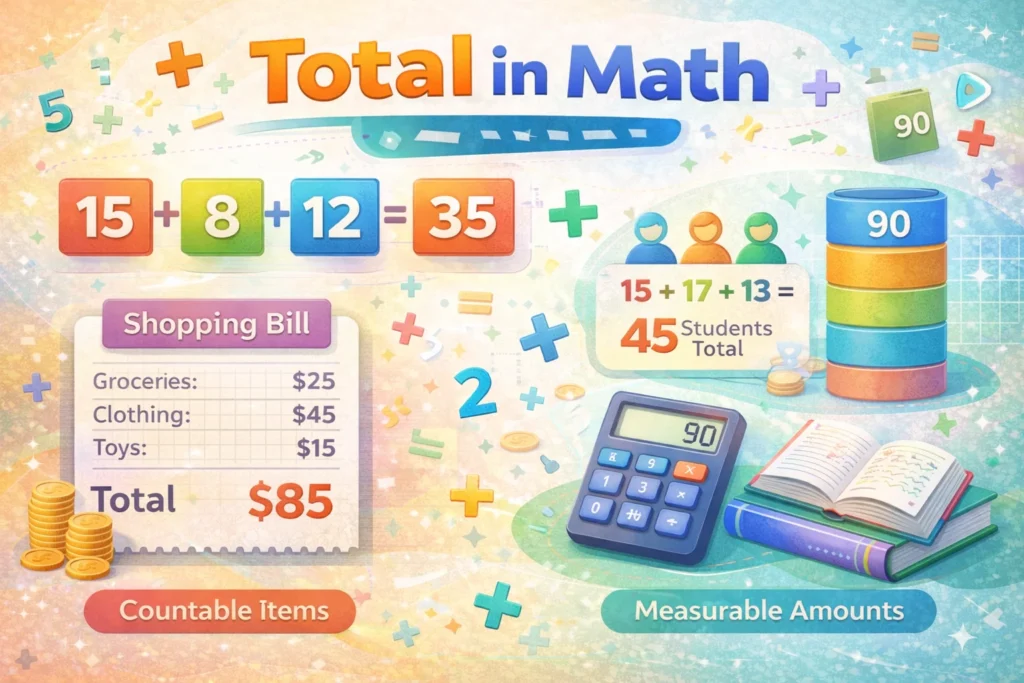
In mathematics, “total” refers to the sum or overall amount obtained by adding two or more numbers, quantities, or values together. It represents the complete count or cumulative result of a set of numbers.
In math, the word total shows up everywhere. From simple addition problems in elementary school to financial reports and statistical analysis, it represents something clear and important—the complete amount after everything has been added together.
When we talk about the total in math, we mean the final sum you get by combining two or more numbers or quantities. For example, if you have 3 apples and then add 4 more, the total number of apples is 7. It is the full amount, not just a part of it.
Understanding what total means helps build strong number sense. It teaches you how to combine values accurately, track results, and interpret data correctly. Whether you are solving equations, calculating expenses, or analyzing information, knowing how to find and understand the total is a fundamental math skill that supports more advanced concepts.
Let’s explore in detail.
Origin of the Term “Total” in Math
The word “total” comes from the Latin word “totalis”, meaning “entire” or “whole.” It entered English in the 16th century, primarily in the sense of completeness or entirety. Over time, mathematicians and educators began using it to describe the result of adding multiple quantities together, emphasizing the concept of a complete or final amount.
The popularity of the term has remained strong because it is simple, universal, and instantly understandable, making it ideal for educational settings, accounting, business, and everyday life.
Usage of Total in Math
The term “total” is widely used in addition problems, financial calculations, measurements, statistics, and more. It signals that you should combine individual values to get an overall sum.
Common Contexts
- Arithmetic and Basic Math:
Teachers often ask students, “Find the total of 12, 7, and 5.” Here, total = 12 + 7 + 5 = 24. - Finance and Accounting:
Businesses use “total” to indicate final amounts. For example, total revenue, total expenses, or total profit. - Measurements and Inventory:
When calculating supplies, distances, or quantities, total provides the overall count. - Statistics:
In datasets, total is the sum of all observations. For instance, total sales over a month = sum of daily sales.
Real-World Examples
- A family goes shopping. They buy apples ($3), bread ($2), and milk ($4). The total cost = $3 + $2 + $4 = $9 🛒
- A school counts students in three classes: 20, 22, and 18. The total number of students = 20 + 22 + 18 = 60.
- A company tracks website visits: 1,000 on Monday, 1,200 on Tuesday, and 1,500 on Wednesday. The total visits = 3,700.
Examples Table: Total in Simple Math
| Numbers Added | Calculation | Total |
|---|---|---|
| 5 + 8 | 5 + 8 | 13 |
| 12 + 7 + 5 | 12 + 7 + 5 | 24 |
| 100 + 200 + 50 | 100 + 200 + 50 | 350 |
| 1.5 + 2.3 + 4.2 | 1.5 + 2.3 + 4.2 | 8.0 |
Comparison With Related Terms
Understanding “total” becomes easier when compared with related math terms:
| Term | Meaning | Difference From Total |
|---|---|---|
| Sum | The result of addition | Sum is technically identical to total but often used in formulas or sequences. Total emphasizes completeness. |
| Average | Sum of values divided by their count | Average shows central tendency, not overall total. |
| Subtotal | Partial sum before additional amounts | Subtotal is not the final total; total includes all items. |
| Net | Amount after deductions or adjustments | Total is gross; net subtracts taxes, fees, or other reductions. |
💡 Tip: Use total when highlighting the complete amount, sum in mathematical operations, and subtotal in stepwise calculations.
Alternate Meanings of Total
While “total” primarily refers to addition, it can have other interpretations depending on context:
- Every or Complete:
Example: “The total number of countries visited is 35.” - Destruction or Failure (negative/dismissive tone):
Example: “The storm was total havoc!” ⚡ - Intense or Absolute:
Example: “She was in total shock.”
In mathematics, however, these alternate meanings are rarely applied.
Polite or Professional Alternatives
Depending on context, you can replace “total” with professional or formal terms:
- Aggregate – Common in finance and data analysis
- Sum – Mathematical or scientific contexts
- Overall amount – Useful in business reports
- Combined value – Neutral and formal alternative
Example: “The aggregate revenue for Q1 2026 was $1.2 million” is more professional than “The total revenue was $1.2 million.”
Practical Examples in Real Life
Scenario 1: School Expenses
| Item | Cost ($) |
|---|---|
| Books | 50 |
| Uniforms | 80 |
| Supplies | 20 |
| Transportation | 30 |
| Total | 180 |
This shows how “total” consolidates multiple figures into one final value.
Scenario 2: Grocery Shopping
| Item | Price ($) |
|---|---|
| Milk | 3.5 |
| Bread | 2 |
| Eggs | 4 |
| Cheese | 5 |
| Total | 14.5 |
Totals make budgeting clear and efficient.
Common Misunderstandings
- Confusing total with average:
Total is the sum, average is the sum divided by the number of items. - Mixing total with subtotal:
Subtotal = sum of part of the items; total = sum of all items. - Assuming total includes deductions:
Total is often gross. Net or adjusted total may differ after fees, taxes, or discounts.
FAQs
1. What does total mean in simple words?
Total means the complete amount you get when adding numbers together.
2. How do you calculate total?
Add all individual numbers or quantities together. For example, 5 + 10 + 3 = 18.
3. Is total the same as sum?
Yes, but sum is often used in formulas or steps, while total emphasizes completeness.
4. Can total be negative?
Yes, if adding negative numbers, the total can also be negative. Example: -5 + (-3) = -8.
5. What is the difference between total and subtotal?
Subtotal is partial sum, total is the final sum including all items.
6. How is total used in real life?
It is used in finances, shopping, statistics, and anywhere multiple values combine to a final number.
7. Can total include decimals or fractions?
Yes. Totals can be fractions, decimals, or whole numbers. Example: 1.5 + 2.7 = 4.2.
8. Are there other meanings of total?
Yes, outside math, it can mean complete, absolute, or total destruction, depending on context.
Conclusion
Understanding what total means in math is straightforward but crucial. It represents the entire sum of values, whether in school math problems, budgeting, statistics, or business calculations.
- Total = complete sum of numbers or quantities.
- Often used interchangeably with sum, but “total” emphasizes completeness.
- Always differentiate between subtotal, total, and average.
- Totals are versatile, applicable to money, measurements, data, and even negative or fractional numbers.
- Using professional alternatives like aggregate or combined value can elevate reports or presentations.
💡 Pro Tip: Whenever you are adding multiple items, double-check each number to ensure the total is accurate. Small errors can lead to big discrepancies in finance or data analysis.
Read More Related Articles:
- “De Nada” Meaning in Spanish: Real-World Examples In 2026
- What Does < Mean in Math? How to Use It in Equations and Inequalities (2026)
- “Que” Meaning Explained in English: More Than Just “That” In 2026

Ivy Madison is a content creator at TextSprout.com, specializing in word definitions, internet slang, acronyms, and text abbreviations. She delivers clear and engaging explanations, helping readers quickly understand modern digital language and trending terms.