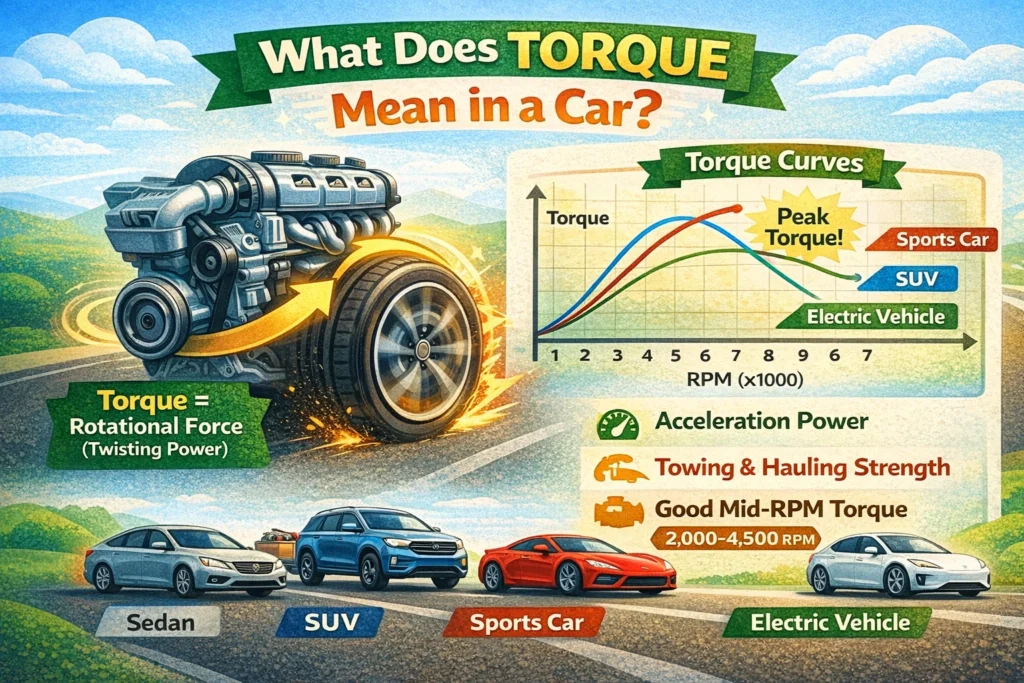
In a car, torque refers to the rotational force produced by the engine that turns the wheels. It is measured in Newton-meters (Nm) or foot-pounds (lb-ft) and determines how quickly a car can accelerate from a stop or climb steep hills.
For example, a car with 400 Nm of torque can move more forcefully than one with 200 Nm, all else being equal.
Torque is a fundamental factor in car performance, often discussed alongside horsepower. While horsepower relates to speed, torque determines pulling power and acceleration feel. Understanding torque helps drivers, car enthusiasts, and buyers make informed decisions about vehicles.
The Origin and Meaning of Torque
The word torque comes from the Latin word torquere, which means to twist. In physics, torque is the rotational equivalent of linear force.
- Physics Foundation: Torque is calculated as force × distance from the pivot point. In cars, the engine generates torque, which is transferred through the drivetrain to the wheels.
- Historical Context: Torque as a concept has been around since early mechanics studies in the 17th and 18th centuries, but its practical application in automobiles became critical after the invention of the internal combustion engine.
- Automotive Relevance: Torque is key in situations where strong pulling force is required, such as towing, hill climbing, and accelerating from low speeds.
Memory Trick: Think of torque as the “muscle” of the engine—it’s the twisting power that moves the car forward. 💪
How Torque Works in a Car
In cars, torque is generated by the engine and is affected by engine speed (RPM), engine size, and type of fuel. Torque influences the vehicle’s acceleration, towing ability, and drivability.
Key Points
- Torque is produced by the engine crankshaft.
- It is transferred through the transmission to the wheels.
- Higher torque at lower RPM results in better acceleration from a stop.
- Peak torque often occurs at mid-range RPM, while peak horsepower appears at higher RPM.
Example Table: Torque vs Horsepower
| Vehicle | Torque (Nm) | Horsepower (HP) | Notes |
|---|---|---|---|
| Sedan A | 250 Nm | 180 HP | Smooth city driving |
| SUV B | 400 Nm | 300 HP | Strong towing and off-road ability |
| Sports Car C | 450 Nm | 500 HP | High acceleration and top speed |
| Pickup D | 550 Nm | 350 HP | Heavy-duty towing and hauling |
Torque vs Horsepower: What’s the Difference?
Torque and horsepower are often mentioned together, but they are different concepts:
| Term | Definition | Car Impact |
|---|---|---|
| Torque | Rotational force (Nm or lb-ft) | Determines pulling power and acceleration |
| Horsepower | Rate of doing work (HP) | Determines top speed and sustained power |
| Relationship | Horsepower = Torque × RPM ÷ 5252 (in imperial units) | Both work together for overall performance |
Friendly Analogy: Torque is like your arm strength, while horsepower is how fast you can move that strength over time. A strong torque engine pulls heavy loads; high horsepower keeps the car fast at top speeds.
Examples of Torque in Real Cars
Everyday Driving
- City car: 200 Nm torque → smooth acceleration from stoplights.
- SUV: 400 Nm torque → easily climbs hills with passengers.
- Pickup truck: 550 Nm torque → can tow heavy trailers without strain.
Sports and Performance Cars
- Sports car with 500 Nm torque → rapid 0-60 mph times.
- Electric cars (like EVs) can provide instant torque, giving extremely quick acceleration even at low speeds. ⚡
Heavy Vehicles
- Trucks and buses require high torque at low RPM to move large loads.
- Torque in commercial vehicles ensures control and safety when hauling.
How Torque is Measured
- Units: Nm (Newton-meters) in metric systems, lb-ft (foot-pounds) in imperial systems.
- Measuring Tool: Dynamometer (engine or chassis dyno).
- Peak Torque vs Average Torque: Peak torque indicates the maximum twisting force the engine can produce, while average torque shows overall performance across RPM range.
Example Table: Torque Curves
| RPM | Engine Torque (Nm) | Engine Horsepower (HP) |
|---|---|---|
| 1000 | 150 | 20 |
| 2000 | 300 | 90 |
| 3000 | 400 | 150 |
| 4000 | 420 | 200 |
| 5000 | 410 | 220 |
This table shows how torque often peaks at mid-range RPM while horsepower continues to increase.
Real-World Applications of Torque
Torque plays a role in almost every driving scenario:
Acceleration
- Cars with higher torque accelerate faster from a stop.
- Example: Electric vehicles have nearly instant torque, providing a 0–60 mph time faster than many sports cars.
Towing and Hauling
- Trucks and SUVs rely on high torque to pull trailers or carry heavy loads.
- Example: A pickup with 550 Nm torque can tow 3,000 kg more comfortably than one with 300 Nm.
Hill Climbing
- Torque ensures the car maintains power when going uphill without downshifting excessively.
Off-Roading
- Vehicles with high torque at low RPM can navigate rough terrains and obstacles efficiently.
Torque for Electric Cars vs Combustion Engines
Electric vehicles (EVs) differ from traditional cars in how they deliver torque:
- Instant Torque: EV motors provide maximum torque immediately at 0 RPM.
- Smooth Power Delivery: No gear shifts are required for acceleration.
- Implication: EVs feel more responsive at low speeds than many combustion-engine vehicles.
Professional Alternatives or Explanations
In reports or manuals, “torque” might be explained as:
- Engine twisting force
- Rotational engine power
- Pulling or turning strength
- Example: “The engine produces 400 Nm of torque, enabling strong acceleration from standstill.”
Examples Table: Torque in Everyday Vehicles
| Vehicle Type | Torque (Nm) | Typical Use |
|---|---|---|
| Small Sedan | 200 Nm | Daily commuting, city driving |
| SUV | 400 Nm | Family trips, mild towing |
| Sports Car | 450–500 Nm | Fast acceleration, performance driving |
| Pickup Truck | 500–600 Nm | Heavy towing, construction, hauling |
| Electric Car | 300–700 Nm | Instant acceleration, efficient urban driving |
Tips for Understanding Torque
- Torque is about pulling power, not speed.
- Higher torque at lower RPM = better low-speed performance.
- Horsepower and torque work together to define a car’s overall performance.
- Compare torque with weight to understand acceleration potential.
- Electric cars feel faster due to immediate torque delivery.
Common Mistakes About Torque
- Confusing torque with horsepower (they are related but different).
- Assuming more torque always means faster top speed (it mostly affects acceleration).
- Ignoring torque curve—where torque is delivered matters as much as peak value.
- Not considering vehicle weight: high torque in a heavy car may feel less effective than in a light car.
FAQs
1. What does torque mean in a car?
It is the rotational force the engine produces to turn the wheels, measured in Nm or lb-ft.
2. How is torque different from horsepower?
Torque is pulling power; horsepower measures speed and work over time.
3. Which is more important, torque or horsepower?
It depends: torque matters for acceleration and towing; horsepower affects top speed and high-RPM performance.
4. How is torque measured?
Using a dynamometer, either at the engine or wheels, in units like Nm or lb-ft.
5. Can electric cars have more torque than gas cars?
Yes, EVs deliver maximum torque instantly, providing quick acceleration even at low speeds.
6. Why does torque matter for towing?
More torque allows vehicles to pull heavier loads without straining the engine.
7. Does more torque mean faster cars?
Not necessarily top speed, but higher torque improves acceleration and hill-climbing performance.
8. Can torque vary across RPM?
Yes, engines have a torque curve; peak torque is usually at mid-range RPM, not at idle or max RPM.
9. What is a torque curve?
A graph showing how an engine’s torque changes with RPM, useful for understanding performance.
10. How do car makers advertise torque?
Often by quoting peak torque value and RPM range to showcase engine strength.
Conclusion
Torque is the engine’s twisting force, crucial for acceleration, towing, hill climbing, and vehicle responsiveness. Understanding torque alongside horsepower allows drivers to better evaluate car performance and match vehicles to their needs.
- Torque is measured in Nm or lb-ft.
- Higher torque at low RPM improves acceleration and pulling power.
- Torque and horsepower complement each other to define overall performance.
- Electric vehicles provide instant torque for responsive driving.
Practical Tips:
- Consider torque when buying a car for towing or off-road use.
- Compare torque with vehicle weight for realistic acceleration expectations.
- Look at torque curves to understand how power is delivered across RPM.
Read More Related Articles:
- “De Nada” Meaning in Spanish: Real-World Examples In 2026
- Atonement Meaning in the Bible: Why It Matters (2026)
- Meaning of “Loco” in Spanish: From Shocking to Playful In 2026

Neon Samuel is a digital content creator at TextSprout.com, dedicated to decoding modern words, slang, and expressions. His writing helps readers quickly grasp meanings and understand how terms are used in real conversations across text and social platforms.