
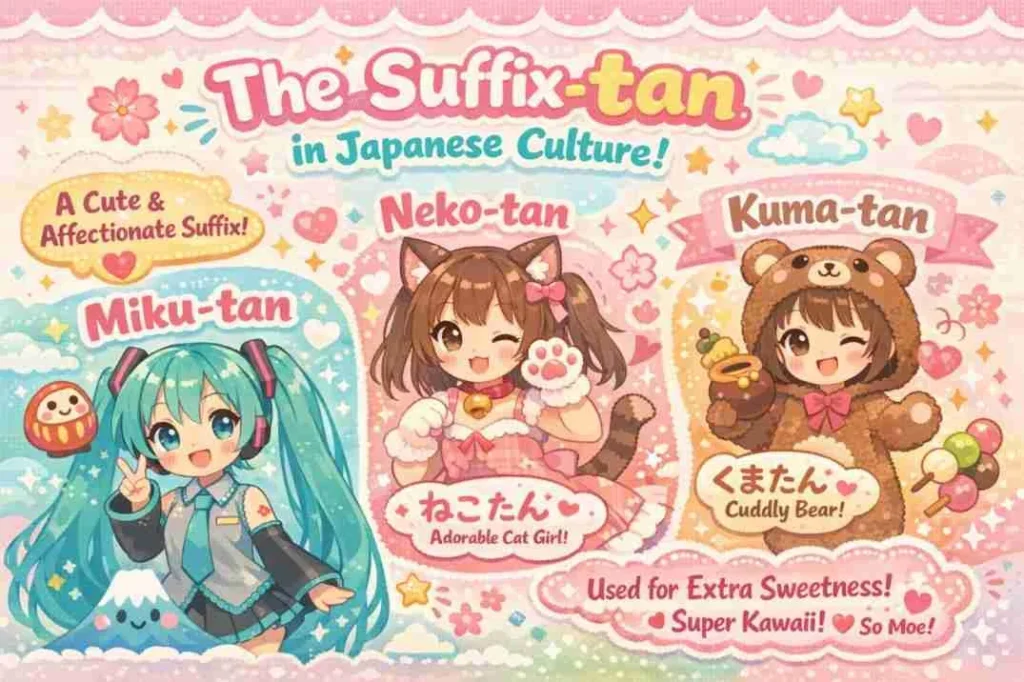
In Japanese, “-tan” is an affectionate or cute suffix used after a person’s name or a character, similar to “-chan,” but often implies extra cuteness, endearment, or familiarity.
Language is fascinating, and even small words or suffixes can carry rich meaning and nuance. One such example is “tan” in Japanese. If you’ve ever watched anime, read manga, or studied Japanese pop culture, you may have noticed the suffix “-tan” used after names. You might wonder what it means, why it’s used, and when it is appropriate. Understanding this term will help you interpret Japanese language, culture, and media more accurately.
It is commonly used in informal contexts, especially among friends, in media, and in fan communities. While not a formal honorific, it reflects warmth, affection, or playful intimacy toward the person or character being addressed.
Origin of “-tan”
The suffix “-tan” originated as a childlike mispronunciation of “-chan,” another informal Japanese honorific. In Japanese, children sometimes have difficulty pronouncing certain sounds, and “chan” could be pronounced as “tan” by young speakers. Over time, this became a stylistic choice in media and pop culture to create an extra layer of cuteness.
For example, a child might call someone named Miku as “Miku-tan” instead of “Miku-chan”. Fans, creators, and even adults sometimes use “-tan” intentionally to evoke innocence, charm, or playful affection.
How “-tan” Is Used
The use of -tan is primarily informal and often occurs in:
- Anime and manga – Characters may be addressed with -tan to emphasize cuteness.
- Fan communities – Fans use -tan to refer to favorite characters in a loving, playful way.
- Children’s speech – It can appear naturally in conversation among or by young children.
- Merchandise and branding – Sometimes “-tan” is used in product names, mascots, or marketing for cute appeal.
For example, in anime, a small, adorable animal character might be named “Piyo-tan” to make it sound cute and approachable.
Difference Between “-tan” and Other Honorifics
Japanese has a variety of honorifics that express different levels of respect, familiarity, or affection. Here’s how -tan compares:
| Honorific | Meaning/Use | Notes |
|---|---|---|
| -san | Neutral, polite | Standard honorific used in formal or casual situations |
| -chan | Cute, affectionate | Often for children, close friends, or pets |
| -kun | Familiar, male | Usually for boys or subordinates, casual |
| -sama | Very respectful | Used for someone of high status or customers |
| -tan | Extra cute, playful | Derived from -chan, informal and affectionate |
Unlike -san, which is polite and formal, or -sama, which is respectful, -tan emphasizes playfulness and cuteness.
Examples of “-tan” in Context
Understanding examples helps you see how -tan functions in everyday language or media.
- Character names: “Neko-tan” might refer to a cute cat character.
- Friendship context: A child might call their friend “Hana-tan” instead of “Hana-chan.”
- Fan usage: Fans might refer to their favorite idol as “Miku-tan” online to express affection.
- Merchandise: A plush toy could be branded as “Piyo-tan” to emphasize it is cute and collectible.
Notice how -tan does not convey formal respect but rather warmth, endearment, and charm.
Tone and Cultural Nuance
Using -tan can carry different connotations depending on context:
- Friendly tone – Among close friends, it expresses intimacy.
- Playful tone – In media or fan culture, it emphasizes cuteness or charm.
- Dismissive tone – Rarely, it can sound infantilizing if used inappropriately.
For instance, using -tan with a stranger in a professional setting would be considered odd or even rude. It is a suffix best reserved for casual, affectionate, or playful situations.
Variations and Related Suffixes
Japanese language is rich with suffixes, and -tan is related to others in interesting ways:
| Suffix | Use | Relation to -tan |
|---|---|---|
| -chan | Affection, familiar | The root of -tan; -tan is a playful extension |
| -kun | Casual, usually male | Different usage; -tan is cuter and gender-neutral |
| -sama | Very respectful | Formal, opposite of -tan in tone |
| -ne | Soft emphasis | -tan focuses on cuteness, -ne is for friendly confirmation |
By comparing these suffixes, you can see why -tan is considered lighthearted and playful rather than formal.
Gender and Age Considerations
One interesting aspect of -tan is its neutrality in gender. While -chan may sometimes feel more feminine or used for young girls, -tan can be applied to boys, girls, pets, or fictional characters without seeming inappropriate.
It is also more common among younger people, fans, and media creators, but adults who enjoy playful or nostalgic speech may use it too.
Pop Culture Influence
The suffix -tan is especially prominent in Japanese pop culture. Anime, manga, video games, and even mascots use -tan to create memorable, cute character names. Some famous examples include:
- Hatsune Miku-tan – A playful nickname for the popular virtual singer.
- Neko-tan – Commonly used for cat mascots or characters.
- Kuma-tan – Referring to bear characters or cute merchandise.
The use of -tan in pop culture has also crossed borders, with international fans adopting the suffix when discussing Japanese media online.
Alternate Meanings of “Tan”
While -tan is primarily a suffix, the word tan in English or other contexts can have different meanings. For example:
- Tan (English) – Refers to skin color after sun exposure or a light brown color.
- Tannin – In wine or tea, “tan” may appear as an abbreviation.
In Japanese, the -tan suffix should not be confused with these other meanings. Its usage is linguistic and cultural, emphasizing affection and cuteness rather than color or chemistry.
Using “-tan” Appropriately
If you want to use -tan correctly, keep these tips in mind:
- Use with names of friends, pets, or characters rather than strangers or superiors.
- Understand the playful, affectionate tone it conveys.
- Avoid using it in professional or formal settings.
- Combine with other cute language, like emoticons or soft speech, for full effect.
For example: “Chibi-tan is so cute today!” would be perfectly fine among friends or fans.
FAQs
What does -tan mean in Japanese?
It is an affectionate, playful suffix that adds extra cuteness to a name, similar to -chan.
Is -tan formal?
No, it is informal and used in casual or playful contexts.
Can adults use -tan?
Yes, but usually in informal, fun, or nostalgic contexts.
Is -tan only for girls?
No, it is gender-neutral and can be used for boys, girls, pets, or fictional characters.
Where is -tan commonly seen?
Anime, manga, fan communities, social media, and merchandise.
How is -tan pronounced?
It is pronounced as it looks: “tahn,” similar to the English “ton” without the n being nasalized.
Can -tan be used with strangers?
It is not recommended, as it may seem infantilizing or overly familiar.
What is the difference between -chan and -tan?
-chan is already cute and affectionate. -tan adds a playful, extra-cute nuance, often from childlike speech.
Conclusion
In Japanese, -tan is an affectionate, playful suffix that adds extra charm to names of people, pets, or characters. Originating as a childlike mispronunciation of -chan, it has become a staple of Japanese pop culture and fan communities. It conveys warmth, cuteness, and familiarity, making it perfect for informal or playful situations.
Whether you’re watching anime, reading manga, or chatting with Japanese-speaking friends, recognizing -tan will help you understand the tone and emotional context behind the words. By learning how and when to use it appropriately, you can appreciate the richness of Japanese language and culture, and maybe even add a touch of cuteness to your own expressions.
Read More Related Articles:
- What Is NSF in Banking? Non-Sufficient Funds Explained Simply (2026)
- Enmity Mean in the Bible: Powerful Biblical Word (2026)
- Fasting Meaning in the Bible: More Than Skipping Food (2026)

Luna Hartley is a content creator at TextSprout.com, where she specializes in explaining word meanings, modern phrases, and everyday language used in texts and online conversations. Her writing focuses on clarity and context, helping readers understand how words are actually used in real communication.