
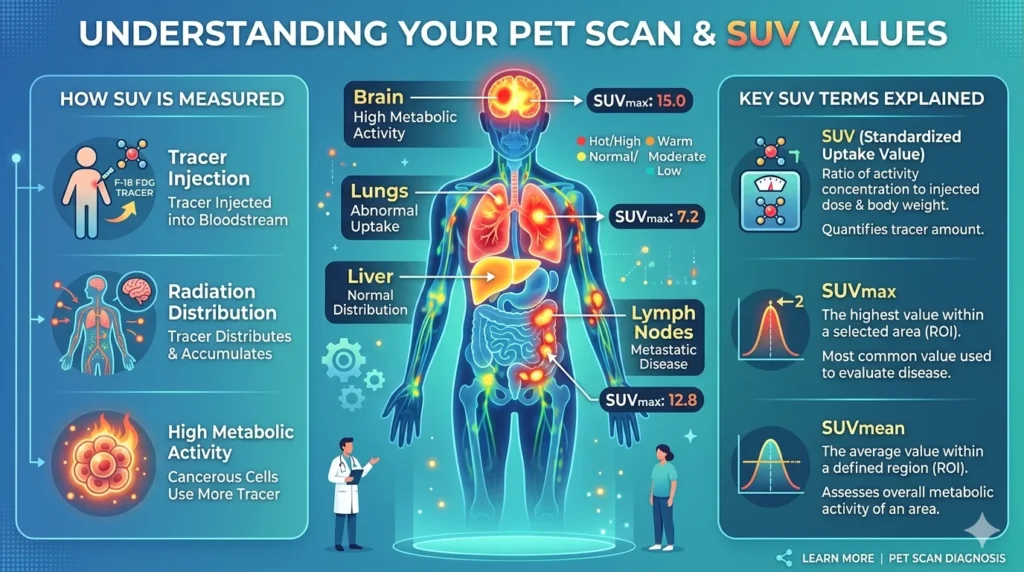
SUV in a PET scan stands for Standardized Uptake Value.
It is a measurement that shows how much radioactive tracer a particular tissue or organ absorbs during a PET scan.SUV is used by doctors to evaluate areas of high metabolic activity and helps in identifying potential tumors, inflammation, or other abnormal tissue activity. For example, if a small area in the lung absorbs more tracer than surrounding tissue and shows a high SUV, it may indicate a lesion that requires further evaluation.
A PET scan can feel like a complicated procedure, especially when you start reading the report and encounter medical terms like SUV. Many patients wonder what these numbers mean and how they affect their diagnosis. PET scans, or positron emission tomography scans, are unique because they do not just show the shape or structure of organs. Instead, they show how tissues are functioning by measuring the uptake of a radioactive tracer.
The SUV, or Standardized Uptake Value, is one of the most important numbers in this process. It helps doctors understand which areas of the body are more metabolically active than others. High metabolic activity is often associated with cancer, infection, or inflammation, while normal tissues have lower and more predictable SUV values.
Understanding SUV can be empowering for patients because it gives context to the PET scan results. It allows you to have a conversation with your doctor that is informed, focused, and meaningful. This guide will explain what SUV is, how it is measured, what it means in different contexts, and how it is interpreted by medical professionals.
What SUV Means in a PET Scan
The Standardized Uptake Value is a quantitative measurement used in PET scans. It tells doctors how much radioactive tracer a tissue absorbs compared to what would be expected based on the patient’s body weight and the dose of the tracer. PET scans commonly use a tracer called FDG, or fluorodeoxyglucose, which is a radioactive form of glucose. Because cancer cells and inflamed tissue often use more glucose than normal tissue, areas with higher SUV are often of clinical interest.
SUV provides an objective number that can guide doctors in diagnosis, monitoring, and treatment planning. It is not simply a yes or no marker of disease. A high SUV does not automatically mean cancer, and a low SUV does not automatically mean healthy tissue. It is a tool that needs to be interpreted in context.
How SUV Is Calculated
The calculation of SUV takes into account several factors. First, it measures how much tracer is absorbed by a specific area of tissue. Then, it considers the amount of tracer injected into the body, the patient’s body weight, and the decay of the radioactive material over time.
The formula ensures that the number reflects a standardized comparison, meaning it can be interpreted consistently across different patients and different scans. In practice, radiologists rarely need to calculate SUV manually because modern PET scan machines provide the values automatically, but understanding the concept helps patients comprehend what the numbers mean.
Different Types of SUV (PET Scan) – Comparison Table
| SUV Type | Definition | What It Measures | Main Use | Advantage | Limitation |
|---|---|---|---|---|---|
| SUVmax | Highest SUV value in a specific region | Peak metabolic activity in a single pixel or point | Detecting the most active or suspicious part of a lesion | Easy to identify and widely used in reports | May not represent the entire tissue accurately |
| SUVmean | Average SUV across a selected region | Overall metabolic activity of the tissue | Monitoring treatment response and general assessment | Provides a more balanced and comprehensive view | Can dilute small areas of high activity |
Quick Comparison Insight
| Feature | SUVmax | SUVmean |
|---|---|---|
| Focus | Single highest point | Entire region average |
| Detail Level | High sensitivity to hotspots | Broad overview |
| Clinical Role | Identifying suspicious areas | Tracking changes over time |
| Usage | Initial diagnosis emphasis | Follow-up and evaluation |
Typical SUV Values
SUV values vary depending on the organ, the type of tissue, and the clinical situation. Normal tissue has predictable ranges of SUV. For example, the liver typically has an SUV around 2 to 3, while the brain naturally has higher glucose uptake, so SUVs can range from 5 to 10 in normal areas.
Inflamed tissue or infection can have SUV values between 3 and 8, which overlaps with some cancerous tissues. Tumors often show higher SUV, but there is no absolute threshold. For example, a lesion with SUV 2.5 could be cancerous in one patient but benign in another.
Understanding SUV requires looking at the number in context with the size of the lesion, its location, and other diagnostic tests. It is one piece of the puzzle rather than a definitive answer on its own.
Factors That Affect SUV
Several factors can influence SUV readings. Patient-related factors such as blood sugar levels, recent activity, body weight, and hydration can all change how much tracer is absorbed. For example, high blood sugar can reduce FDG uptake, leading to a lower SUV than expected.
Technical factors also play a role. The time between tracer injection and scanning, the calibration of the PET scanner, and the size of the region being measured can all affect SUV. Biological factors, such as the type of tumor, inflammation, or organ metabolism, also impact SUV values.
Because of these variables, SUV must always be interpreted carefully. Doctors compare the numbers to normal tissue, previous scans, and other diagnostic tests before drawing conclusions.
How SUV Is Used in Clinical Practice
SUV has several important applications in medicine, particularly in oncology. It is a key tool for detecting cancer, staging tumors, monitoring treatment, and evaluating response to therapy.
For example, a patient with lymphoma may have a PET scan showing several lymph nodes with elevated SUV. The highest SUV in each node is measured, helping doctors determine which nodes are most concerning. After chemotherapy, a follow-up PET scan can show whether the SUV in those nodes has decreased, indicating that the treatment is effective.
SUV is also used to identify areas of infection or inflammation. In patients with unexplained fevers, PET scans can detect metabolically active areas that might indicate an abscess or other infectious processes.
Examples of SUV in Different Situations
| Situation | SUV Value | Interpretation |
|---|---|---|
| Small lung nodule | 1.5 | Likely benign, follow-up needed |
| Enlarged lymph node | 7.2 | Could be lymphoma or infection |
| Liver lesion | 2.0 | May be benign or malignant, requires further evaluation |
| Brain cortex | 8.5 | Normal for brain tissue due to naturally high glucose uptake |
| Inflammatory joint | 4.0 | Suggests active inflammation |
These examples illustrate how SUV provides a numerical guide for assessing tissue activity but cannot confirm diagnosis alone.
SUV and Cancer
In oncology, SUV is especially useful because tumors often have higher metabolic activity than surrounding tissue. PET scans allow doctors to identify suspicious areas that may not be visible on CT or MRI scans.
A high SUV can indicate aggressive tumor activity, but doctors interpret these values alongside the size of the tumor, its shape, location, and other imaging findings. Some slow-growing cancers may have low SUV, while some inflammatory conditions may show elevated SUV.
PET scans are also valuable for staging cancer. By measuring SUV in different parts of the body, doctors can determine whether cancer has spread and plan treatment accordingly. SUV can also monitor treatment effectiveness. A decreasing SUV over time may indicate that chemotherapy or radiation is successfully killing cancer cells.
SUV in Follow-Up and Monitoring
For patients undergoing treatment, SUV provides a way to track progress over time. Comparing SUVs from multiple scans helps doctors see how a tumor is responding.
For example, if a tumor initially has an SUV of 10 and decreases to 4 after treatment, this suggests a significant reduction in metabolic activity. If the SUV remains the same or increases, doctors may adjust treatment or consider additional interventions.
Tracking SUV over time is a non-invasive way to monitor disease and can reduce the need for repeated biopsies or more invasive procedures.
SUVmax vs SUVmean
Understanding the difference between SUVmax and SUVmean is important. SUVmax highlights the single point of highest activity in a tissue or lesion. It is often the most suspicious part of a tumor and is used to identify areas that may require biopsy.
SUVmean, on the other hand, provides an average of the entire lesion or region. It gives a broader picture and is useful for monitoring overall response to treatment. Both numbers together provide a more complete understanding of what is happening in the body.
Limitations of SUV
While SUV is a valuable tool, it is not perfect. High SUV does not automatically mean cancer, and low SUV does not automatically mean tissue is healthy. Some benign conditions, such as infections or inflammation, can elevate SUV. Small lesions may show falsely low SUV due to partial volume effects. Patient preparation, including fasting and blood sugar levels, can also affect SUV readings.
For these reasons, SUV is only one part of the diagnostic process. Doctors always interpret it alongside other imaging, laboratory tests, and clinical findings.
FAQs
What does SUV stand for in a PET scan
SUV stands for Standardized Uptake Value and reflects how much radioactive tracer tissue absorbs.
Is a high SUV always cancer
No. High SUV can result from infections, inflammation, or naturally active tissues like the brain or heart.
What is a normal SUV
Normal SUV varies by tissue. Liver tissue is usually around 2 to 3, brain tissue is higher around 5 to 10, and lungs are around 1 to 2.
What is SUVmax
SUVmax is the highest SUV value in a specific region and is often used to highlight the most metabolically active area.
What is SUVmean
SUVmean is the average SUV across a region and provides an overall picture of tissue activity.
Can SUV predict tumor aggressiveness
Higher SUV can suggest more aggressive tumor activity, but it cannot definitively determine aggressiveness alone.
Does blood sugar affect SUV
Yes. High blood sugar can reduce tracer uptake, affecting SUV readings. Patients usually fast before a PET scan to minimize this effect.
Can SUV track treatment progress
Yes. Comparing SUV values from scans over time helps doctors see how tumors or inflamed areas are responding to treatment.
Conclusion
SUV in a PET scan is a powerful measurement that helps doctors see how tissues in the body are functioning. By measuring the uptake of radioactive tracers, SUV provides insight into areas of high metabolic activity, which may indicate tumors, inflammation, or infection.
While SUV provides important quantitative information, it must be interpreted in context with other tests, clinical findings, and patient history. High or low values alone cannot confirm or rule out disease. Understanding SUV allows patients to engage in informed discussions with their healthcare team and understand how PET scans contribute to diagnosis and treatment planning.
Tracking SUV over time can also be a useful way to monitor treatment progress, evaluate responses, and make informed decisions about ongoing care. It remains one of the most valuable tools in modern medical imaging for assessing disease activity and guiding patient management.
Read More Related Articles:
- Arrow Mean in a Chemical Equation: Complete Student Guide In 2026
- What Does PK Mean in Betting? How Pick’em Lines Work in Sportsbooks In 2026
- Exclamation Point Mean in a Car: Don’t Ignore This Warning In 2026

Neon Samuel is a digital content creator at TextSprout.com, dedicated to decoding modern words, slang, and expressions. His writing helps readers quickly grasp meanings and understand how terms are used in real conversations across text and social platforms.