
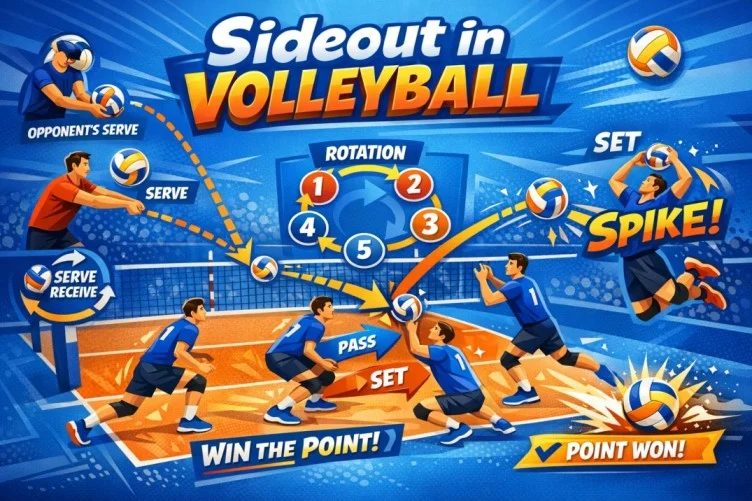
Sideout in volleyball occurs when the team that was receiving the serve wins the rally, allowing them to gain the right to serve.
In other words, if your team is on the receiving side and you win the play, your team earns the serve. This moment is called a sideout and is a critical part of the game’s scoring system, especially in traditional scoring formats.
Volleyball is an exciting sport full of fast-paced action, strategy, and teamwork. If you watch a volleyball game, whether live or on television, you might hear commentators say the term “sideout.” For new players, fans, or casual viewers, this term may seem confusing. Understanding what sideout means is essential for grasping how volleyball is scored, how teams switch between offense and defense, and how the flow of the game works.
Sideout is more than just a word used by referees or commentators. It is a key concept that influences strategy, momentum, and scoring in volleyball. Whether you are a beginner trying to learn the rules or an aspiring player looking to improve your game, understanding sideout can make a big difference in how you watch or play volleyball.
Sideout not only gives a team the chance to score points but also shifts the momentum, giving them a psychological advantage during a match.
The Origin of the Term Sideout
The term sideout comes from the early days of volleyball, when the game used the sideout scoring system. Originally, points could only be scored by the serving team. This meant that winning a rally while receiving the serve did not immediately give a point; instead, it gave the receiving team the opportunity to serve.
Because gaining the serve switched sides and gave a team a chance to score, the term “sideout” was coined. It literally meant that the team on the receiving side had earned the serve and had “sided out” the other team.
Over time, volleyball evolved, and many leagues adopted rally scoring, where points are awarded on every rally regardless of who serves. However, the concept of sideout still exists in training, strategy, and historical references, and it is particularly important in college volleyball, amateur leagues, and classic volleyball discussions.
How Sideout Works in Volleyball
Understanding sideout requires knowing a few basics about volleyball rules:
- Volleyball is played by two teams, each with six players.
- One team serves the ball to start the rally.
- Teams alternate hitting the ball over the net, with a maximum of three hits per side.
- A rally continues until the ball lands out of bounds, touches the floor, or a team commits a fault.
A sideout happens when the team that is receiving the serve wins the rally. This gives them the right to serve next. In sideout scoring systems, points could only be scored while serving, so earning a sideout was a critical first step to gaining points.
In modern rally scoring, sideouts still matter because they determine which team controls the serve, and controlling the serve can influence tactics and momentum.
Examples of Sideout in Action
Let’s consider a few practical examples to understand sideout more clearly:
- Example 1: Team A serves to Team B. Team B successfully returns the ball, and after a series of hits, Team B wins the rally. In a sideout system, Team B does not immediately score a point but gains the right to serve.
- Example 2: Team A serves to Team B. Team B makes an error and the ball lands in their court. Team A wins the rally, scores a point, and continues serving. No sideout occurs because Team A was already serving.
- Example 3: In a rally scoring game, Team B wins the rally while receiving the serve. They score a point and gain the serve, which also represents a sideout in traditional terminology.
These examples show how sideout is linked to serving rights, scoring opportunities, and tactical shifts.
Importance of Sideout in Volleyball Strategy
Sideout is not just a term for describing a rule. It has strategic significance in volleyball because controlling the serve often determines the flow of the game. Here’s why sideout matters:
1. Gaining Momentum
Winning a sideout can give a team a psychological boost. Taking control of the serve after defending a rally can shift momentum and energize players.
2. Scoring Opportunities
In traditional sideout scoring, a team can only score points while serving. Securing a sideout was essential for turning defensive plays into offensive opportunities. Even in modern rally scoring, controlling the serve allows a team to dictate play and increase their chances of scoring consecutively.
3. Tactical Advantages
Teams often design specific plays and serve-receive formations to maximize the chance of sideouts. Strong servers, coordinated blocking, and quick set plays are all aimed at converting reception into an effective sideout.
Common Misconceptions About Sideout
Because volleyball terminology can be confusing, it’s important to clarify a few common misconceptions:
- Sideout does not mean a point was scored. In traditional scoring, a sideout simply gives the team the serve. The point comes later if the serving team wins the rally.
- Sideout is not the same as winning a rally. While related, a rally win by the receiving team in sideout terms is called a sideout, whereas a rally win by the serving team results in points and continued service.
- Sideout only applies to the receiving team. It is not a term used when the serving team wins the rally, as they already control the serve.
Understanding these distinctions helps both players and spectators follow the game more accurately.
Sideout and Volleyball Scoring Systems
Volleyball has used multiple scoring systems over the years. Knowing how sideout fits into these systems is important:
Sideout Scoring System
- Only the serving team can score points.
- The receiving team must win a rally to earn the serve, called a sideout.
- Games typically went to 15 points with a minimum two-point lead to win.
Rally Scoring System
- Points are awarded on every rally, regardless of which team serves.
- Sideouts still occur because winning a rally while receiving the serve gives the team the next serve.
- Games usually go to 25 points with a two-point lead required to win.
Even though rally scoring is more common today, the concept of sideout is still critical for understanding serve rotation, momentum, and team strategy.
Tips for Converting Sideouts
Players often focus on specific skills to convert a sideout effectively:
- Serve Reception: Receiving the ball cleanly allows the team to set up offensive plays.
- Quick Sets and Attacks: Fast sets and smart spikes help turn defense into a successful sideout.
- Communication: Clear calls and coordination between teammates reduce errors and improve chances of winning the rally.
- Blocking and Positioning: Proper court positioning and strong blocks make it easier to win the rally when defending against a serve.
Teams that consistently convert sideouts are often more competitive and have better control of the game.
Sideout in Different Levels of Volleyball
Sideout is a term that is widely used across all levels of volleyball, from casual beach games to professional leagues:
- Youth Volleyball: Coaches teach sideouts to help players understand the connection between serve-receive and scoring opportunities.
- High School Volleyball: Sideout strategy is a key part of training, as young players learn to maintain composure and control the serve.
- College and Professional Volleyball: Sideouts are often analyzed in statistics, as converting sideouts effectively can determine the outcome of matches.
No matter the level, mastering sideouts is crucial for building a strong team strategy and winning matches.
Sideout Statistics and Analysis
In competitive volleyball, coaches and analysts track sideout percentages to evaluate performance:
- Sideout Percentage: The ratio of sideouts won to the total number of times a team received serve.
- High Sideout Percentage: Indicates a team’s ability to control the serve and maintain offensive opportunities.
- Low Sideout Percentage: Suggests weaknesses in serve-receive or defensive strategies that need improvement.
Tracking these statistics helps teams identify strengths, weaknesses, and areas for focused practice.
Related Terms and Concepts
Understanding sideout also involves familiarizing yourself with related volleyball concepts:
- Serve Receive: The team formation used to receive the opponent’s serve.
- Rally: The sequence of back-and-forth hits until the ball lands out of play.
- Rotation: The movement of players clockwise after gaining the serve.
- Spike and Block: Offensive and defensive moves that directly impact sideout chances.
Knowing these terms improves both understanding and performance in volleyball.
FAQs
What does sideout mean in volleyball?
Sideout occurs when the receiving team wins a rally, giving them the right to serve next.
Can a sideout score a point?
In traditional scoring, no. In modern rally scoring, the receiving team earns a point and gains the serve.
Why is sideout important?
Sideouts help control momentum, create scoring opportunities, and allow teams to dictate the game.
How do you get a sideout?
By winning a rally while receiving the serve. Strong reception, communication, and strategic attacks help achieve this.
Is sideout only in professional volleyball?
No, it applies at all levels from youth to professional play.
How is sideout tracked in statistics?
Coaches calculate the percentage of sideouts won to analyze team performance.
Does rally scoring eliminate sideouts?
Rally scoring awards points on every rally but sideouts still occur because the serving team changes after the receiving team wins a rally.
What skills help convert sideouts?
Serve reception, quick sets, spikes, teamwork, communication, and blocking are key skills for converting sideouts effectively.
Conclusion
Sideout is a fundamental concept in volleyball that represents winning the serve while on the receiving side. Understanding sideouts is crucial for players, coaches, and fans because it affects scoring, strategy, and game momentum.
Whether in traditional sideout scoring or modern rally scoring, mastering sideouts requires strong skills, communication, and teamwork. Teams that consistently convert sideouts effectively are often more competitive and have a better chance of winning matches.
Even for casual viewers, knowing what sideout means adds depth to watching volleyball, making every rally and change of serve more exciting and meaningful.
Read More Related Articles:
- What Does TMU Mean in Text: The Slang You’ve Probably Seen In 2026
- What Does SOW Mean in Business: Definition and Explanation
- What Does Merde Mean in French: Word You Hear Everywhere In 2026

Ivy Madison is a content creator at TextSprout.com, specializing in word definitions, internet slang, acronyms, and text abbreviations. She delivers clear and engaging explanations, helping readers quickly understand modern digital language and trending terms.