In cars, RPM stands for Revolutions Per Minute, which measures how many times the engine’s crankshaft completes a full rotation every minute.
It indicates engine speed, helping drivers understand performance and prevent damage from over-revving.
When you look at your car’s dashboard, one of the first things you notice is the tachometer, with numbers that rise and fall as you accelerate or decelerate. The term RPM is displayed prominently, but what does it actually mean? Understanding RPM is essential for safe driving, fuel efficiency, and vehicle maintenance.
Even if you’re not a car enthusiast, knowing what RPM represents can improve your driving experience and extend the life of your vehicle. Let’s explore RPM in detail, including its origin, real-world usage, examples, comparisons, and maintenance tips.
Origin of RPM in Automotive Engineering
The concept of RPM has roots in mechanical engineering and early engine design.
- Industrial Machinery: Long before cars, engines and machines were measured by how many revolutions their shafts completed per minute.
- Automotive Application: With the rise of internal combustion engines in the late 19th and early 20th centuries, RPM became a standard metric to monitor engine speed.
- Tachometers: Devices to measure RPM, called tachometers, became common in vehicles in the 1920s and 1930s, helping drivers optimize performance.
Today, RPM is universally recognized across all vehicles, from cars and motorcycles to trucks and boats. It’s a key indicator of engine health and driving efficiency.
What RPM Measures in a Car
RPM measures the engine speed — how fast the engine’s crankshaft rotates. It is not directly about the car’s speed but the engine’s internal activity.
- Higher RPM: Engine spins faster; usually associated with more power output but also higher fuel consumption.
- Lower RPM: Engine spins slower; typically more fuel-efficient but may struggle to produce high power.
Example:
If your car shows 3,000 RPM on the tachometer, it means the engine completes 3,000 full rotations every minute.
Why RPM Matters
- Engine Health: High RPM for extended periods can lead to engine wear or overheating.
- Fuel Efficiency: Lower RPM at cruising speeds improves gas mileage.
- Performance: Understanding RPM helps in shifting gears effectively, especially in manual transmissions.
- Driving Safety: Avoiding redline RPM prevents engine damage.
Common RPM Ranges in Cars
Car engines operate efficiently within specific RPM ranges, which vary based on the vehicle type:
Table: Typical RPM Ranges
| Engine Type | Idle RPM | Normal Driving RPM | Redline RPM | Notes |
|---|---|---|---|---|
| Gasoline Car | 600–900 | 1,500–3,000 | 6,000–7,500 | Most passenger cars |
| Diesel Car | 600–800 | 1,200–2,500 | 4,500–5,500 | Diesel engines prefer low RPM |
| Sports Car | 800–1,200 | 2,000–5,000 | 7,500–9,000 | High-performance engines |
| Hybrid Vehicle | 500–1,000 | 1,000–3,500 | 5,500–6,500 | Engine + electric motor |
Knowing these ranges helps you avoid over-revving and drives efficiently.
RPM in Manual vs. Automatic Cars
Manual Transmission
Drivers must shift gears based on RPM to optimize engine performance:
- Low RPM: Engine struggles; shift down to avoid stalling.
- Moderate RPM: Ideal range for smooth driving and fuel efficiency.
- High RPM: Shift up to prevent engine strain.
Automatic Transmission
Modern cars automatically manage RPM, but drivers can still monitor it to understand engine load and optimize driving habits.
How RPM Affects Fuel Efficiency and Engine Wear
Fuel Efficiency:
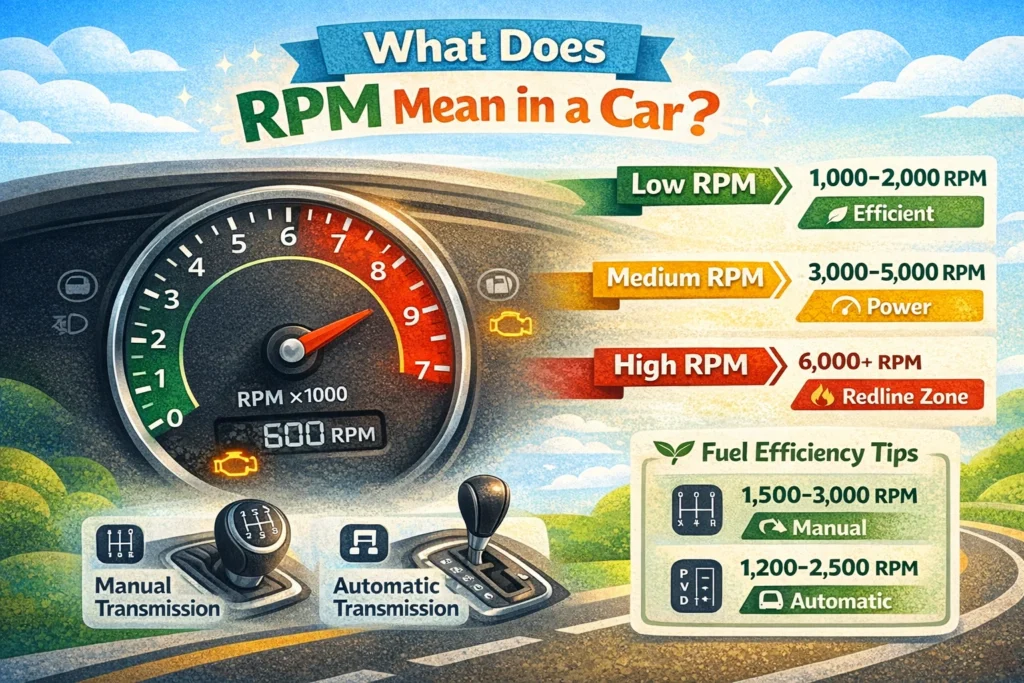
Engines consume more fuel at higher RPM because more air and fuel are required for rapid rotations. Efficient driving keeps RPM in the “sweet spot” (usually 1,500–3,000 RPM for most vehicles).
Engine Wear:
- Prolonged high RPM increases friction and heat, potentially reducing engine lifespan.
- Engines operate best under moderate RPM; regular maintenance ensures durability.
Example:
Cruising at 2,500 RPM on the highway often consumes less fuel than pushing the engine at 4,500 RPM, even if the speedometer reads the same.
How to Read the Tachometer
The tachometer shows RPM, usually with numbers multiplied by 1,000.
Example:
- Needle on 2 → 2,000 RPM
- Needle on 4.5 → 4,500 RPM
Redline:
A red zone on the tachometer indicates maximum safe engine speed. Crossing this can lead to serious engine damage.
Tip: Avoid “bouncing” in and out of the redline during aggressive driving.
Real-World Examples
- City Driving: Typically 1,500–3,000 RPM in normal traffic.
- Highway Driving: 2,000–3,000 RPM at cruising speeds for efficiency.
- Performance Driving: 5,000–7,500 RPM for sports cars during acceleration.
Even small adjustments to RPM can improve fuel efficiency and reduce maintenance costs over time.
Comparison with Related Car Terms
| Term | Definition | Difference from RPM |
|---|---|---|
| Speed (MPH/KPH) | Vehicle movement speed | RPM measures engine rotation, not actual vehicle speed |
| Torque | Rotational force engine produces | Torque and RPM together determine power output |
| Horsepower | Engine power | Calculated using RPM and torque (HP = Torque × RPM ÷ 5252) |
| Redline | Maximum safe RPM | Exceeding redline can cause engine damage |
Understanding RPM alongside these terms gives a complete picture of vehicle performance.
Tips for Maintaining Proper RPM
- Avoid Redline: Do not sustain RPM in the red zone.
- Shift Smoothly: In manual cars, shift before engine struggles.
- Use Cruise Control: Helps maintain optimal RPM on highways.
- Monitor Tachometer: Learn how RPM correlates with speed and fuel consumption.
- Engine Tuning: Regularly service the engine to ensure efficient RPM operation.
Alternate Meanings of RPM
While RPM primarily refers to revolutions per minute in cars, it can also mean:
- RPM in Industry: Revolutions per minute for machinery and motors.
- Software Term: Red Hat Package Manager in Linux computing.
- Music: Revolutions per minute for vinyl records.
Always rely on context to determine meaning.
FAQs
1. What does RPM mean in a car?
It measures how many times the engine’s crankshaft rotates per minute.
2. What is a good RPM for fuel efficiency?
Typically between 1,500–3,000 RPM for most passenger cars.
3. Can I drive at high RPM for long periods?
No, high RPM for extended periods can damage the engine.
4. What is redline RPM?
The maximum safe engine speed indicated on the tachometer.
5. Does RPM affect speed?
Indirectly. Higher RPM can increase speed, but gear ratio also determines actual vehicle speed.
6. How does RPM differ in manual vs automatic cars?
Manual cars require you to shift gears based on RPM; automatic cars adjust RPM automatically.
7. How do I know my engine is over-revving?
Needle entering the red zone on the tachometer or unusual engine noise signals over-revving.
8. Is RPM important for electric cars?
Electric motors have different characteristics but still use RPM to measure rotation speed.
Conclusion
RPM is more than just a number on the dashboard. It’s a vital indicator of engine performance, efficiency, and health. By understanding RPM, drivers can shift gears effectively, save fuel, and extend engine life.
- RPM = Revolutions Per Minute of the engine’s crankshaft.
- Monitor RPM for efficient driving and engine health.
- Keep RPM within safe limits; avoid the redline.
- Use RPM alongside speed, torque, and horsepower for complete vehicle understanding.
With this knowledge, your car becomes more than a machine; it’s a system you can control intelligently and efficiently.
Read More Related Articles:
- Inverse Means in Math: Numbers, Operations & Functions In 2026
- OP Meaning in Gaming – The Term Every Gamer Uses (2026)
- “Le” Means in Spanish: Why This Small Word Matters So Much In 2026

Luna Hartley is a content creator at TextSprout.com, where she specializes in explaining word meanings, modern phrases, and everyday language used in texts and online conversations. Her writing focuses on clarity and context, helping readers understand how words are actually used in real communication.