
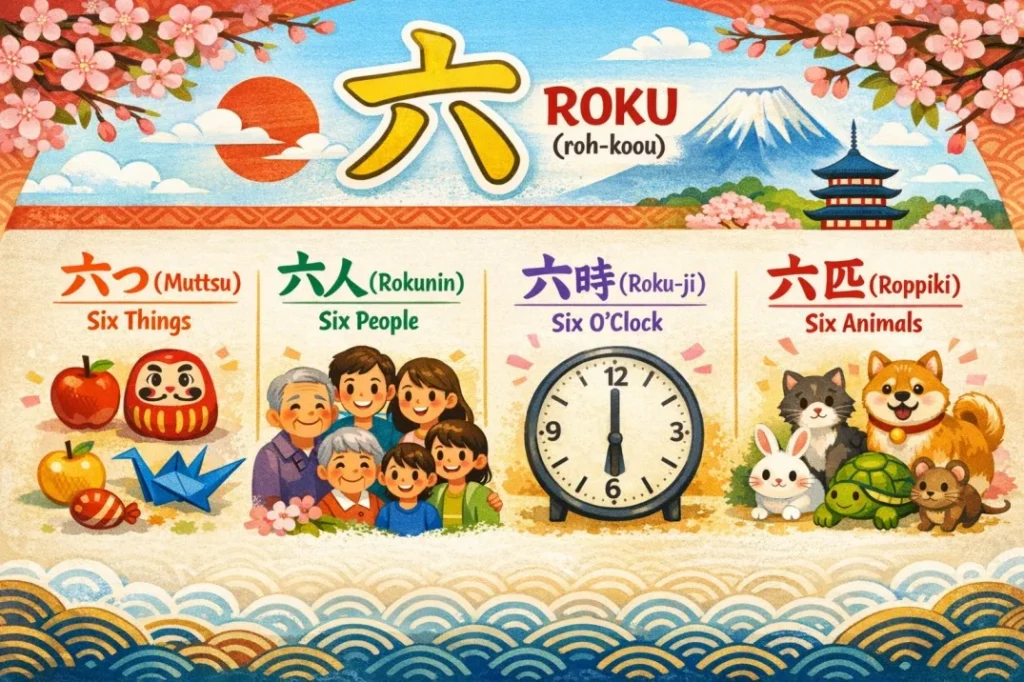
In Japanese, “roku” (六) is the number six. It is used in counting, telling time, numbering items, and even in cultural references. It is pronounced “roh-koo” and is one of the basic numbers in the Japanese numeric system.
For example:
- 六つ (muttsu) → Six things
- 六時 (roku-ji) → Six o’clock
- 六人 (roku-nin) → Six people
When learning Japanese, you may come across the word “roku.” For many beginners, it may seem like a simple number, but in reality, understanding roku opens the door to Japanese counting systems, cultural nuances, and language patterns. Whether you are learning Japanese for travel, conversation, or interest in Japanese culture, knowing what roku means and how it is used is essential.
Although roku primarily represents the number six, its influence goes beyond simple counting. It appears in idioms, cultural symbolism, and even product or brand names, making it a versatile and interesting word to understand.
The Basic Meaning of Roku
At its most fundamental level, roku is the Japanese word for six. It is written with the kanji 六 and is part of the traditional Japanese numbering system. Like other Japanese numbers, it is essential for daily life, whether you are counting objects, telling time, or giving your age.
Japanese numbers can be written in several ways depending on context:
- Kanji: 六
- Hiragana: ろく
- Romaji: roku
For instance, if you wanted to count six apples, you could say:
- りんご六つ (ringo muttsu) → Six apples
In Japanese, counting objects requires specific counters, so roku often combines with counters that match the type of object being counted.
Counting With Roku
Numbers in Japanese are rarely used alone. They combine with counters, which are specific words used depending on what you are counting. Here are some examples:
| Object | Counter | Example |
|---|---|---|
| People | にん (nin) | 六人 (roku-nin) → Six people |
| Small animals | ひき (hiki) | 六匹 (roku-hiki) → Six cats or dogs |
| Flat objects | まい (mai) | 六枚 (roku-mai) → Six sheets of paper or plates |
| Things in general | つ (tsu) | 六つ (muttsu) → Six general items |
| Machines or vehicles | だい (dai) | 六台 (roku-dai) → Six cars or computers |
This shows how roku is used flexibly with counters to indicate quantity in everyday life. Understanding the counters is essential to speak Japanese naturally, and roku appears in almost every counting scenario.
Telling Time With Roku
Roku is also used in telling time. In Japanese, hours are counted using ji (時) after the number.
Examples:
- 六時 (roku-ji) → Six o’clock
- 六時半 (roku-ji han) → Six thirty
- 六時十分 (roku-ji jippun) → Six ten
Because the Japanese language combines numbers with time indicators, roku is frequently used when discussing schedules, appointments, or daily routines.
Roku in Dates and Age
Numbers in Japanese also appear in dates and ages. For example:
- 六日 (muika) → Sixth day of the month
- 六歳 (roku-sai) → Six years old
Interestingly, the pronunciation may slightly change depending on context. For example, 六日 is read as muika, not roku-nichi, because of the historical development of the Japanese calendar and counting system.
This flexibility in pronunciation makes learning Japanese numbers exciting because the same number can be expressed differently depending on what is being counted.
Cultural Significance of Six in Japan
While roku is primarily a number, it also carries some cultural and symbolic meaning. In Japanese culture, numbers often have associations or superstitions.
- Six as lucky number: Six is sometimes considered lucky in Japan because it is an even number and symbolizes harmony or balance.
- Six in Japanese idioms: Numbers are often used in idiomatic expressions. While six is less prominent than numbers like four or seven, it still appears in some traditional sayings.
- Six-sided objects: Six-sided shapes like hexagons may be seen in Japanese design or architecture, symbolizing stability and symmetry.
Although roku does not carry the strong superstitions of the number four (shi), which sounds like “death,” it is still a common number in Japanese daily life, culture, and folklore.
Roku in Popular Culture
The word roku is also seen in brands, entertainment, and media. One well-known example outside of Japan is Roku, the streaming device company. While the company uses the Japanese word for “six” as its name, the reasoning is not deeply cultural but rather symbolic. The founders chose the name because it was short, memorable, and simple, while still conveying a subtle nod to Japanese language and minimalism.
In Japanese media, numbers often appear in titles, lyrics, or phrases. Roku can appear in anime, songs, or manga to indicate a group of six, an age, or an ordinal number.
Pronunciation and Writing of Roku
Roku is pronounced “roh-koo” with even emphasis on both syllables. The kanji 六 is simple and one of the first numbers taught in Japanese schools.
- Hiragana: ろく
- Katakana: ロク
- Kanji: 六
Learning to recognize and pronounce roku is a critical step in becoming comfortable with Japanese numbers. It appears frequently in conversation, signs, menus, timetables, and digital displays.
Idiomatic and Figurative Use
While roku is mostly literal, numbers in Japanese can appear figuratively. For example:
- 六感 (rokkan) → Sixth sense
- 六方 (roppo) → Six directions, often used figuratively to indicate completeness or coverage
- 六道 (rokudō) → Six realms of existence in Buddhist cosmology
These phrases show that roku is not limited to counting; it can also contribute to deeper cultural, religious, or philosophical meanings.
Learning Tips for Using Roku
- Always pair numbers with appropriate counters to sound natural. For example, 六匹 (roku-hiki) for animals, 六人 (roku-nin) for people.
- Pay attention to pronunciation variations in dates and age. 六日 is read as muika.
- Practice telling time using roku for hours. For example, 六時 (roku-ji) for six o’clock.
- Observe how roku appears in media, signage, and daily conversation to internalize its use.
- Learn common phrases and idioms with roku for more advanced understanding of Japanese culture.
FAQs
What does Roku mean in Japanese?
Roku means the number six. It is written as 六 and used in counting, time, dates, and idioms.
How do you pronounce Roku?
It is pronounced “roh-koo.”
Is Roku used in telling time?
Yes, 六時 (roku-ji) means six o’clock, and it can be combined with minutes for more precise times.
What are some counters that go with Roku?
Examples include 六人 (roku-nin) for six people, 六匹 (roku-hiki) for six animals, and 六枚 (roku-mai) for six flat objects.
Does Roku have cultural significance?
Yes. Six is generally considered harmonious and balanced in Japanese culture. It appears in idioms, religious contexts, and symbolic expressions.
Can Roku appear in popular culture?
Yes. It appears in brand names like Roku streaming devices, in anime, songs, and manga titles.
Is Roku only a number?
Primarily, yes, but it also appears in idiomatic and figurative expressions like 六感 (sixth sense) or 六道 (six realms).
Are there pronunciation changes with Roku?
Yes. In some cases, like dates, 六日 is pronounced muika instead of roku-nichi.
Conclusion
The word roku is a fundamental part of the Japanese language, representing the number six. While it may seem simple, it is versatile, appearing in everyday counting, telling time, dates, idiomatic expressions, and cultural references. Understanding roku helps learners navigate numbers, counters, and time in Japanese more effectively.
Beyond its literal meaning, roku also appears in figurative contexts, from sixth sense to six realms of existence in Buddhism. It is part of idiomatic expressions, media references, and even brand names, showing the cultural depth of Japanese numbers.
By mastering roku, you gain not only the ability to count to six but also a window into Japanese counting systems, culture, and everyday language. Recognizing its use in different contexts, from casual conversation to timekeeping, will enhance your fluency and understanding of Japanese.
Next time you hear roku, whether it is in a classroom, on a timetable, or in media, you will know it means six, but you will also appreciate the rich cultural and linguistic layers behind this simple word.
Read More Related Articles:
- What Does Deber Mean in Spanish: Grammar Guide In 2026
- What Does David Mean in Hebrew: Cultural Significance In 2026
- What Does Fulfillment Mean in Shipping: Complete Guide In 2026

Luna Hartley is a content creator at TextSprout.com, where she specializes in explaining word meanings, modern phrases, and everyday language used in texts and online conversations. Her writing focuses on clarity and context, helping readers understand how words are actually used in real communication.