
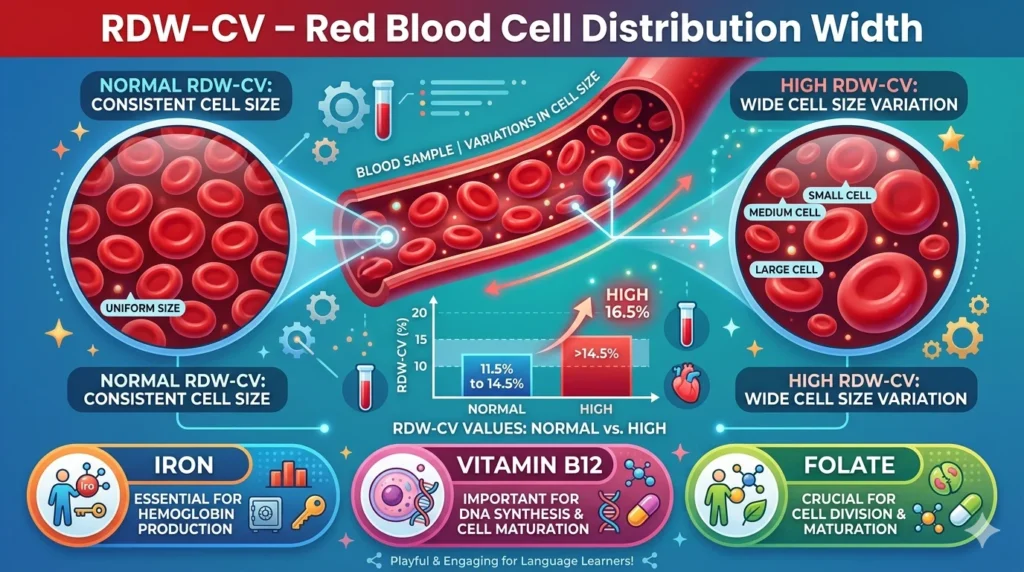
RDW-CV stands for Red Blood Cell Distribution Width – Coefficient of Variation.
It is a measurement that describes the variation in size of red blood cells in a blood sample. A higher RDW-CV indicates that your red blood cells differ more in size, while a lower RDW-CV suggests that the cells are more uniform.
If you have ever had a blood test, especially a complete blood count (CBC), you may have noticed an abbreviation like RDW-CV. For many people, seeing unfamiliar lab results can be confusing and sometimes even worrying. Understanding what RDW-CV means in a blood test, how it is measured, and what it might indicate about your health can help you read your lab reports with confidence and avoid unnecessary stress.
RDW-CV is one of several indicators in a blood test that gives insight into the health of your red blood cells. Your red blood cells are critical for carrying oxygen throughout your body, so any unusual changes in their size or structure can be a clue to underlying health conditions. While the term may seem technical, it is actually a useful marker that doctors rely on to assess your blood health and guide further investigations.
In simpler terms, RDW-CV is a way to measure whether your red blood cells are unusually large, unusually small, or a mix of different sizes. This variation can provide important information about your overall blood health and can point to potential deficiencies or disorders.
Understanding RDW-CV and Its Importance
Red blood cells are essential for transporting oxygen from your lungs to every tissue and organ in your body. Healthy red blood cells are usually about the same size, which allows them to flow efficiently through your blood vessels. When red blood cells vary in size, it can signal a condition called anisocytosis, which is often why doctors pay attention to RDW-CV.
The RDW-CV value is typically expressed as a percentage. Most laboratories consider 11.5% to 14.5% to be the normal range, though exact ranges can vary depending on the lab and the methods they use. Values above this range indicate increased variability in red blood cell size, while values below it suggest unusually uniform cells.
RDW-CV is particularly useful when evaluated alongside other red blood cell indices such as mean corpuscular volume (MCV), hemoglobin, and hematocrit. Together, these measurements can help identify specific types of anemia and other blood disorders.
How RDW-CV is Calculated
RDW-CV is calculated using a simple formula:
RDW-CV (%) = (Standard deviation of red blood cell volume ÷ Mean cell volume) × 100
The standard deviation measures how much the size of your red blood cells varies from the average, while the mean cell volume represents the average size of your red blood cells. By comparing the deviation to the average size, RDW-CV quantifies how uniform or varied your red blood cells are.
This percentage allows doctors to detect subtle changes in red blood cell size that may not be obvious by looking at other blood test results. Small changes in RDW-CV can provide early warning signs for conditions such as nutrient deficiencies or anemia before more obvious symptoms appear.
Causes of High RDW-CV
An elevated RDW-CV indicates that red blood cells vary widely in size. This can happen for several reasons, some of which are common and easily treatable, while others may require closer medical evaluation.
Nutrient Deficiencies
Iron, vitamin B12, and folate are essential for healthy red blood cell production. A deficiency in any of these nutrients can lead to abnormal red blood cell sizes. For example, iron deficiency typically produces smaller red blood cells, whereas vitamin B12 or folate deficiency can result in larger red blood cells. When these different sizes coexist in the bloodstream, RDW-CV increases.
Blood Disorders
Certain blood disorders can also cause an elevated RDW-CV. Conditions like anemia of chronic disease, sickle cell anemia, or thalassemia often produce red blood cells of varying sizes. In these cases, the variation is not just a lab anomaly; it reflects a disruption in normal red blood cell production or survival.
Recent Blood Loss
After significant blood loss, the bone marrow ramps up production of new red blood cells. These freshly produced cells can be a different size from the older ones, temporarily increasing RDW-CV. This can occur after surgery, trauma, or heavy menstrual bleeding.
Bone Marrow Disorders
Certain bone marrow conditions can lead to irregular production of red blood cells, contributing to a higher RDW-CV. In such cases, RDW-CV can help doctors detect early changes before other symptoms become apparent.
Causes of Low RDW-CV
A lower-than-normal RDW-CV is less common and often less clinically significant. A low value may simply indicate uniform red blood cell size, which is generally normal. However, extremely low RDW-CV values can occasionally be associated with rare inherited conditions affecting red blood cell production. Most healthy individuals fall within the normal RDW-CV range, so low values are usually not concerning.
RDW-CV vs RDW-SD
You may also notice RDW-SD on a blood test report. While both RDW-CV and RDW-SD measure the variation in red blood cell size, they do so in different ways.
| Measure | Meaning | Key Difference |
|---|---|---|
| RDW-CV | Coefficient of variation of red blood cell size | Expressed as a percentage relative to mean cell volume |
| RDW-SD | Standard deviation of red blood cell size | Expressed in femtoliters, an absolute measure of size variation |
In practice, doctors often look at both RDW-CV and RDW-SD together to get a complete picture of red blood cell variation. Using both measurements can improve the accuracy of diagnosing anemia types or other blood-related conditions.
How Doctors Use RDW-CV in Practice
RDW-CV is rarely interpreted in isolation. Doctors usually consider it alongside other complete blood count parameters such as:
- Hemoglobin (Hb) – the oxygen-carrying protein in red blood cells
- Hematocrit (Hct) – the percentage of blood volume made up of red blood cells
- Mean Corpuscular Volume (MCV) – the average size of red blood cells
Comparing RDW-CV with MCV can help doctors narrow down potential causes of anemia or other blood disorders. For example:
- High RDW-CV and low MCV may suggest iron deficiency anemia.
- High RDW-CV and high MCV may point to vitamin B12 or folate deficiency.
- Normal RDW-CV and low MCV may indicate thalassemia or anemia of chronic disease.
This approach allows doctors to tailor further testing and treatment to the specific cause of red blood cell abnormalities.
Symptoms That May Lead to RDW-CV Testing
RDW-CV is part of a standard CBC, so it may be measured during routine checkups or if you exhibit symptoms that suggest a blood disorder. Common signs that prompt a doctor to examine RDW-CV include:
- Fatigue or persistent tiredness
- Pale skin or paleness of the lips
- Shortness of breath
- Dizziness or lightheadedness
- Rapid or irregular heartbeat
Even if your symptoms are mild, RDW-CV can provide early clues about nutrient deficiencies or blood health issues, allowing timely intervention.
Lifestyle and Health Factors Affecting RDW-CV
Your lifestyle and overall health can influence RDW-CV values. Maintaining a balanced diet and managing chronic health conditions can help keep your red blood cells healthy and within a normal size range.
- Diet: Adequate intake of iron, vitamin B12, and folate supports normal red blood cell production.
- Chronic illness: Kidney disease, liver disease, or chronic inflammation can affect red blood cell size and production.
- Alcohol consumption: Excessive drinking can interfere with nutrient absorption, particularly folate, leading to abnormal red blood cell sizes.
- Pregnancy: Blood volume changes during pregnancy can temporarily affect RDW-CV.
Healthy lifestyle choices, including regular exercise, balanced nutrition, and management of chronic conditions, can support normal red blood cell production and prevent significant fluctuations in RDW-CV.
Interpreting RDW-CV Safely
It is important to remember that RDW-CV is only one part of the overall picture. An abnormal value does not automatically indicate a serious problem. Doctors always consider:
- Other blood test results
- Your medical history and symptoms
- Lifestyle and dietary factors
Sometimes, RDW-CV may be slightly outside the normal range without any underlying health problem. Minor fluctuations can occur naturally and do not always require treatment.
Practical Tips for Patients
Understanding RDW-CV can help you engage in meaningful discussions with your doctor. Here are some practical tips:
- Review RDW-CV in context with other blood parameters.
- If your RDW-CV is high, ask whether additional tests for iron, vitamin B12, or folate are recommended.
- Maintain a diet rich in iron, B12, and folate to support healthy red blood cells.
- Avoid unnecessary stress over minor deviations, as lab values can fluctuate naturally.
- Request your doctor explain the implications of RDW-CV alongside other test results, so you understand what actions, if any, are needed.
Real-World Examples
Consider a patient who comes in with fatigue and dizziness. A routine CBC shows low hemoglobin, low MCV, and high RDW-CV. This combination suggests iron deficiency anemia, which could be caused by dietary deficiency or blood loss. The doctor may recommend iron supplementation and dietary adjustments.
In another scenario, a patient has fatigue, high MCV, and high RDW-CV. This pattern points to vitamin B12 or folate deficiency, prompting further investigation and supplementation.
In both cases, RDW-CV provides a critical clue that helps doctors diagnose the type of anemia and develop an effective treatment plan.
FAQs
What does RDW-CV measure in a blood test?
It measures the variation in size of red blood cells. High values indicate greater variability, which can signal anemia or nutrient deficiencies.
Is a high RDW-CV dangerous?
Not directly. High RDW-CV is a marker that may indicate an underlying condition and usually requires further testing to determine the cause.
Can RDW-CV change over time?
Yes, it can fluctuate based on diet, illness, or treatment for anemia.
What is a normal RDW-CV range?
Typically 11.5% to 14.5%, though ranges vary by lab.
Does RDW-CV diagnose anemia?
Not on its own. It helps doctors narrow down potential causes of anemia and guide further testing.
Can low RDW-CV be a problem?
Rarely. Low RDW-CV usually indicates uniform red blood cell size and is often normal.
Is RDW-CV included in routine blood tests?
Yes, it is part of a standard complete blood count.
What foods help maintain a healthy RDW-CV?
Iron-rich foods like spinach, beans, eggs, meat, dairy, and foods containing folate and vitamin B12 can support healthy red blood cells.
Conclusion
RDW-CV is a valuable parameter in a complete blood count that provides insight into the size variation of red blood cells. While the term may seem technical, it is simply a marker doctors use to detect potential nutrient deficiencies, anemia, or other blood disorders.
An elevated RDW-CV may indicate iron, vitamin B12, or folate deficiency, recent blood loss, or chronic illness. A low RDW-CV is usually less concerning but should still be interpreted alongside other red blood cell indices.
Understanding RDW-CV can help you have informed discussions with your healthcare provider, make dietary or lifestyle adjustments, and address potential health issues before they become more serious.
Your red blood cells play a critical role in overall health, and RDW-CV is one of the tools that help doctors ensure your blood is functioning properly.
Read More Related Articles:
- WYO Meaning in Text: What It Says About the Conversation (2026)
- “Tengo” in Spanish Explained: More Than Just “I Have” In 2026
- “Tata” Means in Spanish: Grammar and Daily Speech In 2026

Ivy Madison is a content creator at TextSprout.com, specializing in word definitions, internet slang, acronyms, and text abbreviations. She delivers clear and engaging explanations, helping readers quickly understand modern digital language and trending terms.