
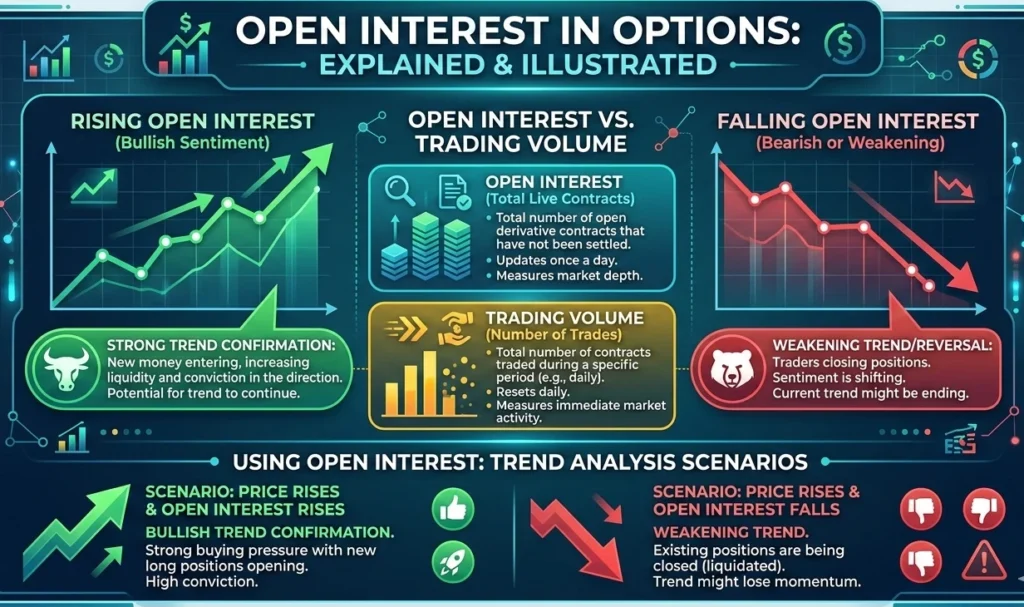
Open interest in options refers to the total number of outstanding (unsettled) option contracts that currently exist on a specific underlying asset and have not yet been exercised, closed, or expired.
It measures the number of active contracts providing insight into market liquidity, trader interest, and potential price direction. In short, open interest shows how many option positions are “open” at a given time.
Open interest is a key metric used by traders and investors to gauge market activity, strength of price movements, and potential future volatility. When open interest rises, it suggests new money entering the market. When it falls, participants may be closing out positions.
What Is Open Interest in Options and Why It Matters
Understanding open interest is essential for anyone trading options whether you’re a beginner trying to learn the basics or an experienced trader managing complex strategies.
Open interest answers these important questions:
- How active is this options contract?
- Are traders committing new capital or exiting positions?
- Is there strong liquidity so trades can be entered/exited easily?
Unlike volume, which counts how many contracts traded during a specific period, open interest shows how many contracts are currently active and that makes it especially useful for context and confirmation.
Origin and Popularity of Open Interest
Open interest is not a new idea it developed alongside futures and options markets in the 20th century. As derivatives trading expanded, exchanges needed a reliable way to measure how much “open money” existed at any point.
Historically, traders relied on volume alone, but volume doesn’t show whether positions remain open after trades settle. Open interest solved that gap.
Today, major exchanges like the Chicago Board Options Exchange (CBOE) and Intercontinental Exchange (ICE) publish open interest data for virtually every listed option. Traders, analysts, and automated systems all monitor it alongside price and volatility.
Open Interest vs. Volume: What’s the Difference?
Volume and open interest are often discussed together, but they represent very different things.
| Metric | What It Measures | Example |
|---|---|---|
| Volume | Number of contracts traded in a single session | 2,500 option contracts traded today |
| Open Interest | Total number of active contracts currently open | 10,000 outstanding options |
Key Differences Explained
Volume:
- Resets every trading day
- Tells how active the market was today
- Doesn’t show whether positions remain open or were closed
Open Interest:
- Changes only when contracts are opened or closed
- Shows cumulative interest over time
- Helps us interpret market sentiment
📌 Example: If volume is high but open interest stays flat, traders are mostly closing existing positions rather than opening new ones.
How Open Interest Changes
Open interest increases or decreases depending on how traders enter and exit positions.
When Open Interest Goes Up
Open interest increases when a trade creates a new contract meaning neither side is closing out an existing position. For example:
- Trader A buys to open
- Trader B sells to open
This adds one new open contract.
When Open Interest Goes Down
Open interest drops when a contract is closed:
- Trader A sells to close
- Trader B buys to close
Both sides exit, reducing open interest.
When Open Interest Isn’t Affected
Sometimes spreads or transfers between traders don’t change open interest.
Interpreting Open Interest: What It Tells Traders
Open interest is most useful when read in combination with price movement and volume.
Here’s how traders typically interpret it:
Price Up + Rising Open Interest
Bullish confirmation.
New money is entering long positions can signal strong upward trend.
Price Up + Falling Open Interest
Potential short covering or weak trend.
Existing positions are being closed rather than new money committed.
Price Down + Rising Open Interest
Bearish pressure.
New open positions betting on further declines.
Price Down + Falling Open Interest
Weak bearish conviction traders exiting instead of adding.
Why Traders Care About Open Interest
- Liquidity:
Higher open interest usually means tighter bid‑ask spreads and easier entry/exit. - Trend Strength:
Open interest can confirm how strong a trend is. - Volatility Context:
Sudden shifts in open interest may signal upcoming volatility. - Strategy Validation:
Helps validate directional and non‑directional option strategies.
Examples of Open Interest in Action
Let’s look at some specific examples to illustrate how open interest works in real contexts:
Example 1: Call Option on XYZ Stock
- XYZ stock is trading at $120
- May 125 Call has:
- Volume today: 3,500 contracts
- Open Interest: 15,000 contracts
Interpretation: High open interest suggests this strike is widely traded and liquid easy to trade and possibly strategically important.
Example 2: Put Option with Falling Open Interest
- ABC stock’s 50 put:
- Today volume: 1,000
- Open interest: dropped from 5,000 to 4,200
Interpretation: Many traders are closing positions, possibly taking profits or exiting bearish bets.
Table: What the Numbers Mean
| Open Interest Pattern | Likely Market Message | Trader Interpretation |
|---|---|---|
| Rising with rising price | Strong uptrend confirmation | Bullish bias |
| Rising with falling price | Strong downtrend | Bearish bias |
| Falling with rising price | Weak uptrend | Profit‑taking |
| Falling with falling price | Weak downtrend | Position exits |
Open Interest and Different Options Strategies
Open interest can be read differently depending on the strategy used:
Long Call/Put
A rising open interest when price moves in your direction can reinforce your thesis.
Example: Long call + rising price + rising open interest = strong bullish signal.
Spread Strategies
When you enter multi‑leg spreads (like iron condors or credit spreads), open interest can hint at how crowded or liquid those strikes are.
Straddles/Strangles
High open interest across both call and put strikes near a particular price might signal anticipated volatility.
Open Interest and Market Liquidity
Liquidity matters in options because it affects how easily you can transact without big price impacts.
Higher open interest usually means:
✔ Narrower bid‑ask spreads
✔ Easier price execution
✔ More counterparties available
Low open interest may cause:
✘ Wider spreads
✘ Difficulty managing risk
✘ Possible slippage
Open Interest and Expiration
As expiration approaches, open interest often declines as traders roll positions forward or close them out. This can cause volume spikes but declining open interest.
Expiration Week
- Typically sees high volume
- Open interest falls as positions settle
- This is normal and expected
How to Find Open Interest Data
Most broker platforms and charting services show open interest right next to price, volume, implied volatility, and Greeks. Traders can view this data on:
- Trading platforms
- Brokerage option chains
- Market analytics tools
Open Interest vs. Commitment of Traders (COT)
COT reports break down net positioning by institutions and traders. While not the same as open interest, COT can be used alongside it for broader sentiment.
Common Misconceptions About Open Interest
1. Open interest is not the same as volume
Volume resets daily, while open interest accumulates until positions close.
2. High open interest ≠ guaranteed direction
It indicates participation and liquidity not certainty of price moves.
3. Open interest doesn’t show long vs. short
It only shows total open contracts you need other tools to break down net positions.
Open Interest in Futures vs Options
Open interest works similarly for futures contracts: it tracks open positions that haven’t been closed or delivered. The interpretation logic remains consistent across both markets.
Best Practices for Traders Using Open Interest
✔ Confirm trends don’t use open interest alone
✔ Combine with price and volume signals
✔ Watch open interest before expiration cycles
✔ Use open interest to anticipate liquidity issues
✔ Combine with volatility indicators
Open Interest Examples with Visualized Scenarios
📈 Scenario 1: Bullish Confirmation
- Price of stock rising
- Open interest increasing
- Volume high
Signal: Trend likely supported
📉 Scenario 2: Bearish Confirmation
- Price dropping
- Open interest rising
- Volume increasing
Signal: Strong bearish pressure
🔄 Scenario 3: Weak Trend
- Price rising or falling
- Open interest falling
- Volume low
Signal: Trend lacking conviction
Advanced Use Cases of Open Interest
1. Identifying Support & Resistance Areas
High open interest near certain strikes may indicate psychological levels traders might defend these areas.
2. Block Trades and Positioning
Sudden jumps in open interest can signal institutional or large trader activity.
3. Open Interest and Implied Volatility
Open interest changes can sometimes lead volatility shifts useful for volatility trading strategies.
FAQs
Here’s an extended FAQ using real user query patterns:
1. What does open interest mean in options trading?
Open interest means the total number of active option contracts that haven’t been closed, exercised, or expired. It shows how many positions remain open at the end of a trading day.
2. Is high open interest good or bad?
High open interest usually signals strong liquidity and trader interest, making it easier to enter/exit trades. It’s not inherently “good” or “bad” context matters.
3. How does open interest affect pricing?
Greater open interest often coincides with tighter spreads and better pricing due to liquidity, but pricing is also shaped by implied volatility and supply/demand.
4. Can open interest predict future price movements?
Not reliably on its own but when combined with price direction and volume, it can support trend interpretation.
5. Why does open interest go down near expiration?
Because traders close or roll their positions as contracts approach expiry, reducing the number of active contracts.
6. Does open interest differentiate buyers and sellers?
No, it counts total open contracts without distinguishing whether traders are net long or short.
7. Where can I see open interest for options?
Open interest is visible in most option chains on broker platforms and market data services.
8. Does open interest matter for all option strategies?
Yes, but it’s most useful in strategies where liquidity and trend confirmation are important.
9. What is the relationship between open interest and implied volatility?
They aren’t directly causal, but shifts in open interest often accompany changes in volatility as trader sentiment evolves.
10. Can open interest help with risk management?
Yes, low liquidity (low open interest) can increase execution risk, while high open interest may support smoother exits.
Conclusion:
Open interest is one of the most important metrics in options trading it reveals how many contracts are active, how many traders have skin in the game, and how liquid a market truly is.
- Open interest shows active contracts, not daily trades
- It should always be read with price and volume
- Rising open interest often adds credibility to price movements
- Falling open interest signals closing activity
- It’s essential for liquidity assessment
Practical Tips
✔ Always check open interest before entering a trade
✔ Use it to gauge liquidity and trend strength
✔ Combine data points for smarter decisions
Whether you’re trading stock options, index options, or futures options, open interest is a tool every serious trader should understand and monitor.
Read More Related Articles:
- What Is NSF in Banking? Non-Sufficient Funds Explained Simply (2026)
- Enmity Mean in the Bible: Powerful Biblical Word (2026)
- Fasting Meaning in the Bible: More Than Skipping Food (2026)

Neon Samuel is a digital content creator at TextSprout.com, dedicated to decoding modern words, slang, and expressions. His writing helps readers quickly grasp meanings and understand how terms are used in real conversations across text and social platforms.