
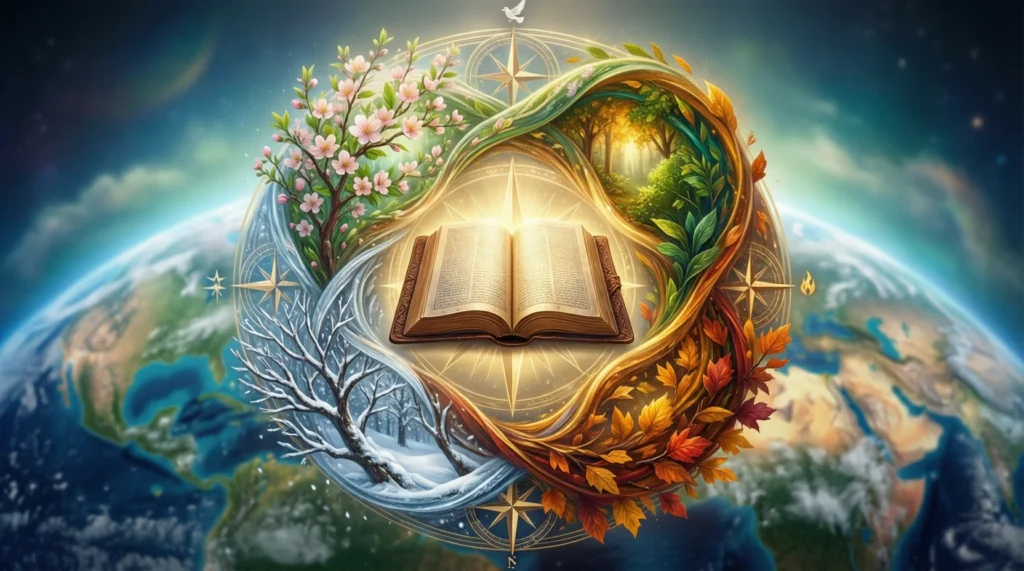
The number 4 in the Bible represents creation, completeness, stability, and the physical world. It is closely associated with God’s created order, including the four directions of the earth, the four seasons, and the completeness of the world God formed.
From the opening chapters of Genesis to prophetic visions in Revelation, the number 4 appears quietly yet powerfully. Scripture uses it to communicate order, balance, and the wholeness of God’s creation. Many readers notice this number recurring in descriptions of the earth, nature, and divine authority over the world.
This article explores what the number 4 means in the Bible, where it comes from, how it is used, and why it still matters for readers today.
Biblical Meaning of the Number 4
In biblical symbolism, numbers often carry deeper meaning beyond counting. The number 4 consistently points to the created world and completeness within God’s design.
Rather than focusing on heaven or eternity, four highlights the physical and earthly realm. It represents structure, foundation, and God’s orderly work in creation.
Core Symbolic Themes of the Number 4
- Creation and the physical world
- Completeness in earthly matters
- Stability and structure
- God’s authority over all the earth
This symbolism helps readers understand why four is often connected to nature, geography, and visible reality.
Origin of the Number 4 in Biblical Context
The biblical meaning of four begins in the earliest chapters of Scripture.
Creation Foundations
On the fourth day of creation, God made the sun, moon, and stars. These heavenly bodies were given authority over time, seasons, days, and years. This moment tied the number four to order, rhythm, and governance of the earth.
Genesis presents creation as intentional and balanced. The number four becomes a quiet marker of that balance.
Hebrew Cultural Understanding
In Hebrew thought, numbers were symbolic. The ancient Israelites associated four with the totality of the world because of:
- Four directions of the earth
- Four winds
- Four corners of the land
This worldview shaped how biblical writers used the number throughout Scripture.
Where the Number 4 Appears in the Bible
The Bible includes many examples where four carries symbolic weight.
Notable Biblical References
| Biblical Example | Scripture Reference | Meaning |
|---|---|---|
| Four rivers of Eden | Genesis 2:10–14 | Life flowing to the whole earth |
| Four directions | Isaiah 11:12 | God’s reach over all nations |
| Four living creatures | Ezekiel 1:5–10 | Divine authority over creation |
| Four winds | Jeremiah 49:36 | God’s control over global events |
| Four horsemen | Revelation 6:1–8 | Judgment affecting the whole world |
Each example reinforces the idea of universality and completeness within the earthly realm.
Spiritual Symbolism of the Number 4
Spiritually, four reflects God’s presence and power in the physical world.
While numbers like three and seven emphasize divine perfection, four grounds God’s work in visible reality.
Spiritual Lessons from the Number 4
- God is involved in daily life and creation
- The world operates under divine order
- Earthly events remain under God’s authority
This symbolism reassures believers that nothing in creation exists outside God’s care.
The Number 4 and God’s Creation
Creation is the clearest lens through which to understand the number four.
Creation-Based Associations
| Aspect of Creation | Connection to 4 |
|---|---|
| Seasons | Spring, summer, autumn, winter |
| Directions | North, south, east, west |
| Elements (ancient view) | Earth, air, fire, water |
| Natural cycles | Day, night, time, seasons |
These patterns reflect stability and rhythm. Scripture often uses four to point readers back to God’s design for the world.
Tone and Contextual Use of the Number 4 in Scripture
The number four generally carries a neutral to positive tone in the Bible.
It rarely implies warning on its own. Instead, its meaning depends on context.
Tone Examples
- Positive tone: Creation order and God’s provision
- Neutral tone: Descriptions of geography or nature
- Serious tone: Global judgment or correction
Even in prophetic books, four often signals completeness rather than fear.
Examples of the Number 4 with Context
Understanding tone helps readers interpret biblical symbolism accurately.
Friendly or Reassuring Context
God gathering people from the four corners of the earth emphasizes inclusion and care 🌍
Neutral Context
References to four rivers or four winds serve descriptive purposes without emotional weight.
Serious or Corrective Context
The four horsemen in Revelation symbolize worldwide consequences rather than personal punishment.
Comparison with Related Biblical Numbers
Biblical numbers work together to tell deeper stories.
Number 4 vs Other Key Numbers
| Number | Meaning | Key Difference |
|---|---|---|
| 3 | Divine perfection | Focuses on God’s nature |
| 4 | Creation and earth | Focuses on the world |
| 7 | Spiritual completion | Blends heaven and earth |
| 12 | God’s people | Represents divine organization |
Four consistently emphasizes the physical world rather than heaven.
Alternate Meanings of the Number 4
While the Bible gives four a stable meaning, other cultures interpret it differently.
Brief Cultural Comparisons
- In some Asian cultures, four is linked to death due to language similarities
- In modern numerology, four represents discipline and structure
- In biblical symbolism, four remains positive and grounded
Scripture does not associate four with misfortune.
Practical and Faith-Based Applications Today
Many believers notice the number four during Bible study or prayer.
How Christians Interpret It Today
- A reminder of God’s presence in everyday life
- Encouragement to trust God’s order
- Reflection on balance and stability
Seeing four can prompt gratitude for creation and God’s sustaining power.
Labeled Example Table: Biblical Patterns Involving the Number 4
| Pattern | Description | Spiritual Meaning |
|---|---|---|
| Four corners | Total land coverage | God’s universal rule |
| Four living creatures | Angelic beings | Authority over creation |
| Four seasons | Time and growth | God’s provision |
| Four rivers | Spread of life | Blessing to the world |
FAQs
What does the number 4 symbolize in the Bible?
It symbolizes creation, completeness, stability, and the physical world under God’s authority.
Is the number 4 good or bad in the Bible?
It is neutral to positive. Scripture uses it to show order rather than danger.
Why is the fourth day of creation important?
God created the sun, moon, and stars, establishing time and seasons for the earth.
What do the four living creatures represent?
They symbolize God’s sovereignty and presence throughout creation.
Are the four horsemen evil symbols?
They represent judgment affecting the whole world, not personal curses.
Does the number 4 mean anything in Christian numerology?
Yes, it reflects stability, discipline, and God’s order in the natural world.
Is seeing the number 4 a spiritual sign?
In biblical faith, meaning comes from Scripture rather than repeated sightings.
How is the number 4 different from the number 7?
Four focuses on earthly completeness, while seven emphasizes spiritual perfection.
Conclusion
The number 4 in the Bible speaks quietly but clearly. It reminds readers that God is deeply involved in the world He created. From the four seasons to the four directions, Scripture uses this number to highlight balance, structure, and divine order.
Rather than pointing to mystery or fear, four anchors faith in everyday reality. It shows that God’s hand is present in nature, history, and human life.
Understanding this symbolism can enrich Bible study and deepen appreciation for God’s design.
Read More Related Articles:
- Supplication Mean in the Bible: Deep Look at Prayer & Faith in 2026
- What Does “No Mames Wey” Mean in English? Cultural Significance (2026)
- Biblical Meaning of Adultery: Scriptural Teaching (2026)

Neon Samuel is a digital content creator at TextSprout.com, dedicated to decoding modern words, slang, and expressions. His writing helps readers quickly grasp meanings and understand how terms are used in real conversations across text and social platforms.