
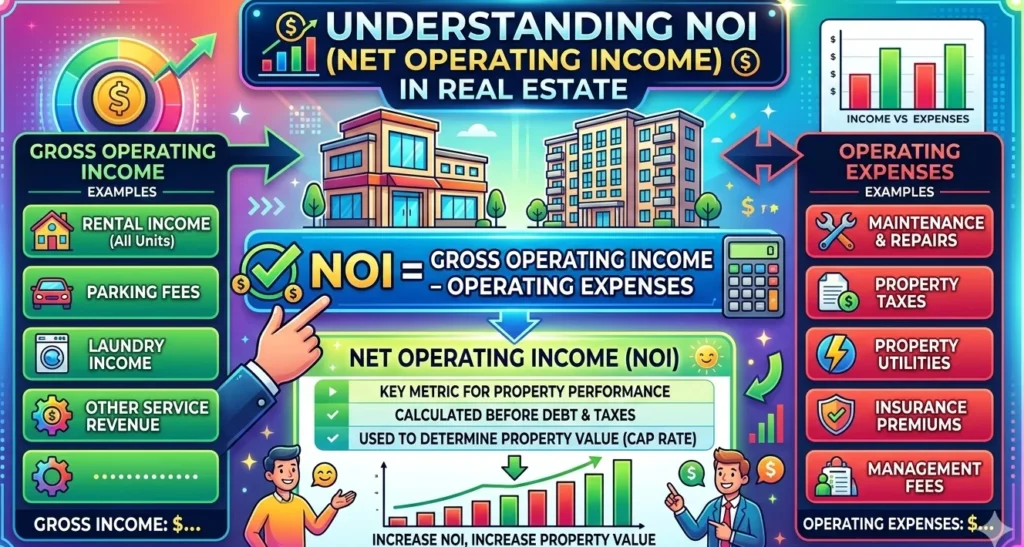
In real estate, NOI stands for Net Operating Income. It represents the total income generated by a property after deducting all operating expenses, but before accounting for taxes, mortgage payments, and depreciation.
NOI is a key metric that helps investors and property owners evaluate the profitability of an investment property.
Understanding NOI is critical for anyone involved in real estate investing, property management, or financial analysis. It helps determine whether a property is financially healthy, how much cash flow it generates, and its potential return on investment (ROI).
Origin and Popularity of NOI in Real Estate
The concept of Net Operating Income originated alongside modern commercial real estate practices in the early 20th century. As real estate investments became more professionalized, investors needed standardized ways to measure profitability across properties. NOI quickly became a standard because it provides a clear picture of operational performance without the complications of financing or taxes.
Over the decades, NOI has become one of the most widely used metrics in real estate analysis, particularly in:
- Commercial real estate (CRE) – office buildings, retail centers, and warehouses
- Residential income properties – apartments and multifamily units
- Investment analysis – comparing properties to determine the best ROI
By focusing on income after operating costs but before financing, NOI allows investors to compare properties on a level playing field.
What Does NOI Include and Exclude?
Understanding what counts as operating income and operating expenses is essential for accurate calculation.
Components of NOI:
Income included:
- Rental income from tenants 🏢
- Parking fees
- Service charges, laundry or vending revenue
- Other ancillary income (storage fees, pet fees)
Expenses deducted:
- Property management fees
- Insurance premiums
- Utilities paid by the owner
- Repairs and maintenance
- Property taxes
Excluded from NOI:
- Mortgage payments (principal and interest)
- Depreciation or amortization
- Income taxes
- Capital expenditures (major improvements or upgrades)
Example Table: NOI Components
| Component | Included in NOI? | Notes |
|---|---|---|
| Rental income | ✅ Yes | All rent collected from tenants |
| Property tax | ✅ Yes | Annual tax expense on property |
| Mortgage payment | ❌ No | Considered financing cost |
| Insurance | ✅ Yes | Property insurance costs |
| Depreciation | ❌ No | Accounting adjustment, not cash flow |
| Repairs & maintenance | ✅ Yes | Routine maintenance only |
| Capital improvements | ❌ No | Large renovations or upgrades |
How to Calculate NOI
The basic formula for NOI is simple:
NOI = Gross Operating Income – Operating Expenses
Step-by-Step Example:
- Gross Operating Income (GOI):
- Annual rent: $120,000
- Parking income: $5,000
- Laundry fees: $2,000
- Total GOI = $127,000
- Operating Expenses:
- Property management: $12,000
- Insurance: $3,000
- Utilities: $5,000
- Repairs & maintenance: $7,000
- Property taxes: $10,000
- Total Expenses = $37,000
- NOI Calculation:
- NOI = $127,000 – $37,000 = $90,000
This figure represents the income generated by the property after operational costs but before mortgage and taxes.
Why NOI Matters in Real Estate
NOI is a critical metric for investors because it helps determine:
- Property Valuation – Investors often use NOI to estimate property value using the Capitalization Rate (Cap Rate) formula: Property Value = NOI ÷ Cap Rate Example:
- NOI = $90,000
- Cap Rate = 6%
- Property Value = $90,000 ÷ 0.06 = $1,500,000
- Cash Flow Analysis – NOI shows potential cash flow before financing.
- Comparing Properties – Standardizing NOI across properties allows investors to compare profitability.
- Financing and Lending Decisions – Lenders often evaluate NOI to determine loan eligibility.
- Performance Benchmarking – Tracking NOI year-over-year reveals operational efficiency improvements or declining performance.
Real-Life Examples of NOI in Action
1 – Apartment Building:
- 10-unit building
- Annual rent per unit: $12,000 → Total: $120,000
- Operating expenses: $35,000
- NOI = $120,000 – $35,000 = $85,000
2 – Commercial Retail Property:
- Gross rent: $200,000
- Additional income (parking & signage): $20,000
- Operating expenses: $75,000
- NOI = $220,000 – $75,000 = $145,000
3 – Single-Family Rental Property:
- Monthly rent: $2,000 → Annual: $24,000
- Expenses: $6,000
- NOI = $24,000 – $6,000 = $18,000
These examples illustrate how NOI differs by property type, but the calculation method remains consistent.
Comparison of NOI with Related Terms
| Term | Difference from NOI | Example |
|---|---|---|
| Cash Flow | Cash flow includes debt payments and taxes; NOI does not | NOI = $90,000, Mortgage = $50,000 → Cash Flow = $40,000 |
| Cap Rate | Cap rate uses NOI to calculate property value | Cap Rate = NOI ÷ Property Value |
| Gross Income | Does not deduct expenses | Gross Income = $127,000; NOI = $90,000 |
| EBITDA | Business metric similar to NOI but broader | EBITDA includes other income and expenses beyond property operations |
| Profit | Net profit includes taxes, debt, and non-operating costs | NOI is pre-debt and pre-tax |
How NOI is Used by Investors
Investors rely on NOI for:
- Comparing Multiple Properties: NOI standardizes profitability across locations.
- Forecasting ROI: Knowing NOI allows calculation of cash-on-cash returns and cap rates.
- Budgeting for Maintenance: Higher expenses reduce NOI, highlighting areas needing efficiency.
- Negotiating Purchase Price: Buyers can offer price adjustments based on NOI trends.
Tips for Increasing NOI
Increasing NOI can make a property more profitable without purchasing additional assets. Some strategies include:
- Increase Rent – Raise rent within market standards.
- Add Revenue Streams – Include parking fees, vending, or laundry services.
- Reduce Operating Expenses – Use energy-efficient utilities or negotiate service contracts.
- Improve Occupancy – Reduce vacancies to maximize rental income.
- Maintenance Optimization – Preventative maintenance reduces long-term expenses.
Table: NOI Strategies and Impact
| Strategy | Expected Impact on NOI | Notes |
|---|---|---|
| Rent increase | Higher NOI | Must stay competitive |
| Additional services | Higher NOI | Laundry, parking, vending |
| Reduce utilities cost | Higher NOI | Efficient systems, smart meters |
| Occupancy improvement | Higher NOI | Better tenant retention |
| Preventive maintenance | Higher NOI | Less emergency repair cost |
Common Mistakes When Calculating NOI
- Including mortgage payments or financing costs – NOI should be pre-financing.
- Forgetting recurring operating expenses – Insurance, property management, and maintenance must be included.
- Counting capital improvements – Major renovations are capital expenses, not operating expenses.
- Confusing NOI with cash flow – Cash flow accounts for debt, NOI does not.
- Ignoring vacancy rates – Gross Operating Income should reflect realistic occupancy.
Example Table: NOI vs Cash Flow
| Metric | Calculation | Notes |
|---|---|---|
| NOI | Gross Income – Operating Expenses | Pre-debt, pre-tax, pre-depreciation |
| Cash Flow | NOI – Debt Payments – Taxes | Actual cash in hand |
| Impact Example | NOI = $100,000, Mortgage = $60,000 | Cash Flow = $40,000 |
Advanced NOI Concepts
- Adjusted NOI: Sometimes NOI is adjusted for unusual expenses or income to present a more realistic picture.
- Pro Forma NOI: Projected NOI used in financial forecasts or property acquisitions.
- Cap Rate Interaction: NOI divided by Cap Rate gives estimated property value for investors.
- NOI Growth Analysis: Tracking NOI year-over-year helps identify trends and operational efficiencies.
FAQs
1. What does NOI mean in real estate?
NOI stands for Net Operating Income, which is total income minus operating expenses, before mortgage payments and taxes.
2. How is NOI different from cash flow?
Cash flow considers debt and taxes; NOI does not. NOI shows property’s operational profitability.
3. Why is NOI important for investors?
NOI helps determine property value, assess profitability, compare investments, and forecast returns.
4. How do I calculate NOI?
NOI = Gross Operating Income – Operating Expenses. Include all operational income and deduct routine expenses.
5. Can NOI be negative?
Yes, if operating expenses exceed income, NOI can be negative, signaling a loss.
6. How does NOI affect property valuation?
Property Value = NOI ÷ Cap Rate. Higher NOI generally increases property value.
7. Does NOI include mortgage payments?
No, mortgage payments, principal, interest, and taxes are excluded.
8. Can NOI be used for residential properties?
Yes, NOI applies to apartments, single-family rentals, and other income-generating residential properties.
Conclusion
In real estate, NOI is an essential measure of property performance. Whether you are a seasoned investor or a first-time property buyer, understanding NOI allows you to:
- Evaluate property profitability
- Compare different investments
- Forecast returns and value accurately
- Make informed operational or purchase decisions
Key Takeaways:
- NOI = Gross Operating Income – Operating Expenses
- Excludes mortgage payments, taxes, and depreciation
- Crucial for calculating Cap Rate and property valuation
- Can be increased through higher rent, additional revenue, and expense optimization
Mastering NOI is a must for anyone serious about real estate investment and financial planning.
Read More Related Articles:
- What Does Te Amo Mean in English? Here’s the Truth (2026)
- What Does -3.5 Mean in a Point Spread? Betting Guide (2026)

Ivy Madison is a content creator at TextSprout.com, specializing in word definitions, internet slang, acronyms, and text abbreviations. She delivers clear and engaging explanations, helping readers quickly understand modern digital language and trending terms.