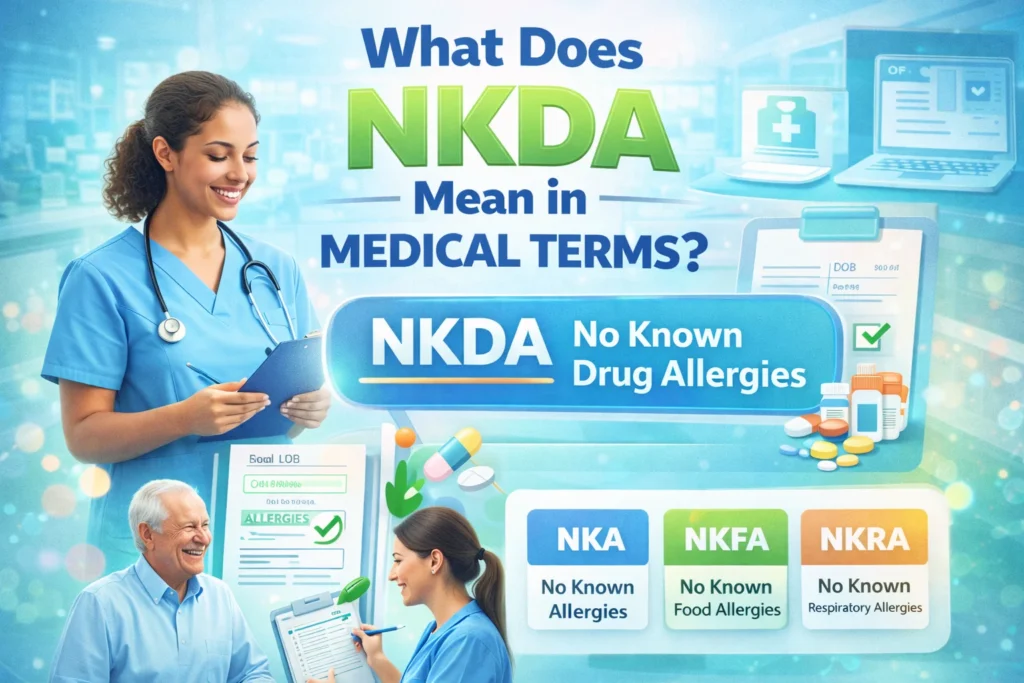
NKDA in medical terms stands for “No Known Drug Allergies.”
It is commonly documented in a patient’s medical history to indicate that, at the time of recording, the patient has not reported any allergies to medications.
Understanding abbreviations like NKDA is crucial for both healthcare providers and patients. Misinterpreting such terms can impact patient safety, treatment decisions, and communication between medical professionals.
Origin of NKDA
The abbreviation NKDA originated as part of standardized medical documentation practices. Healthcare professionals needed a concise way to record patient allergy information in charts, electronic health records (EHR), and prescription notes.
- The practice dates back to the late 20th century when handwritten charts were prevalent.
- Using abbreviations like NKDA saved space and reduced the risk of transcription errors.
- Today, it remains widely used in electronic health records due to its brevity and clarity.
Popularity in Medical Settings:
- Hospitals, clinics, and pharmacies frequently rely on NKDA.
- It is especially important in emergency settings, where quickly knowing a patient’s allergy status can save lives.
- Electronic records often auto-fill NKDA when no allergies are documented, ensuring consistent communication.
Real-World Usage of NKDA
NKDA is used in various medical documents, including:
- Patient intake forms
- Progress notes
- Prescription orders
- Electronic Health Records (EHRs)
- Emergency room charts
Example in context:
| Patient Name | Allergies | Notes |
|---|---|---|
| John Doe | NKDA | No reported drug reactions |
| Sarah Lee | Penicillin | Mild rash in past |
| Mike Brown | NKDA | Ready for surgery |
Friendly context:
A nurse may say, “John has NKDA, so we can proceed with standard antibiotics 😊.”
Neutral/Professional tone:
“Patient records indicate NKDA; no known adverse reactions to medications have been documented.”
Dismissive/Negative tone (rare):
“NKDA noted, but always verify before prescribing any new drug.”
How NKDA is Documented
NKDA is often recorded alongside other allergy-related abbreviations:
| Abbreviation | Meaning | Usage Example |
|---|---|---|
| NKDA | No Known Drug Allergies | Patient has NKDA; proceed with standard care |
| NKA | No Known Allergies | Often broader, including foods and environmental triggers |
| NKFA | No Known Food Allergies | Specifically documents food allergy history |
| NKRA | No Known Reaction to Anesthesia | Important for surgical planning |
💡 Tip: Some clinicians prefer writing the full phrase to avoid misinterpretation, especially for new staff or in multidisciplinary teams.
Comparison with Related Terms
Understanding NKDA in relation to similar abbreviations can prevent confusion:
- NKA (No Known Allergies): Broader than NKDA; includes foods, environmental, or chemical allergies.
- NKFA (No Known Food Allergies): Specific to diet-related allergic reactions.
- NKRA (No Known Reaction to Anesthesia): Critical for surgical or procedural contexts.
Table: Quick Comparison
| Abbreviation | Scope | Example |
|---|---|---|
| NKDA | Drugs only | Patient reports NKDA; no medications cause reactions |
| NKA | All allergies | NKA documented; no drugs, foods, or environmental allergies |
| NKFA | Foods only | NKFA noted; safe to consume hospital meals |
| NKRA | Anesthesia reactions | NKRA documented; patient cleared for general anesthesia |
This distinction is important when prescribing medications or performing procedures. Misunderstanding NKDA for NKA could lead to overlooking non-drug allergies.
Examples of NKDA in Practice
Healthcare professionals often encounter NKDA in real-life scenarios:
- Hospital Admission:
During intake, a nurse asks about allergies. If none are reported, “NKDA” is entered in the chart. - Prescriptions:
Pharmacists check the patient record for NKDA before dispensing medications. - Surgery Preparation:
Surgeons verify NKDA status to ensure no adverse reactions to anesthesia or antibiotics. - Telemedicine:
Virtual consultations include NKDA to ensure safe prescriptions without in-person verification.
Example Table: NKDA in Different Settings
| Setting | Documentation Example |
|---|---|
| Hospital | “Patient reports NKDA; no adverse reactions to medications.” |
| Clinic | “NKDA noted in EHR; routine checkup completed.” |
| Pharmacy | “Prescription approved; NKDA confirmed.” |
| Surgery | “NKDA verified before anesthesia administration.” |
Alternate Meanings of NKDA
While NKDA primarily refers to “No Known Drug Allergies,” it can have other less common meanings outside the medical context:
- NKDA in business or technical environments: Could represent abbreviations for organizations or projects (rarely encountered in healthcare).
- In medical shorthand, it is almost always understood as drug-related allergies.
💡 Professional Tip: Always clarify NKDA when switching between different departments or international settings.
Professional Alternatives to NKDA
Sometimes, medical professionals prefer fully spelled-out phrases:
- “No known drug allergies reported.”
- “Patient has not experienced any adverse drug reactions.”
- “Allergy history negative for medications.”
Advantages:
- Reduces ambiguity
- Improves readability for patients or multidisciplinary teams
- Enhances legal and documentation safety
FAQs
What does NKDA mean in medical charts?
NKDA means “No Known Drug Allergies” and is recorded in patient charts to indicate no reported reactions to medications.
Is NKDA the same as NKA?
Not exactly. NKDA refers specifically to drug allergies, while NKA refers to all known allergies, including drugs, foods, and environmental triggers.
Can NKDA change over time?
Yes. Allergies can develop, so a patient previously documented as NKDA may report reactions later. Regular updates are important.
Why is NKDA important in surgery?
It helps surgeons and anesthesiologists prevent adverse drug reactions during anesthesia and post-operative care.
What if a patient forgets an allergy?
Healthcare providers always verify NKDA status and cross-check with previous records and pharmacy data to prevent mistakes.
Are there legal implications for incorrect NKDA entries?
Yes. Incorrect documentation can lead to medical errors and potential liability, highlighting the importance of accurate records.
Can patients update their NKDA status themselves?
Patients should inform their healthcare providers immediately if they develop new drug allergies, so NKDA status can be updated.
Is NKDA used worldwide?
Yes, NKDA is recognized in most English-speaking countries, though local abbreviations may vary. Always verify terminology in international contexts.
Conclusion:
- NKDA is a concise and vital medical abbreviation for No Known Drug Allergies.
- It primarily applies to medications, not foods or environmental triggers.
- Misinterpretation can be risky, so documentation clarity is essential.
- Related terms include NKA, NKFA, and NKRA.
- Updating NKDA status regularly ensures patient safety and reduces medical errors.
💡 Pro Tips for Patients and Healthcare Providers:
- Always verify your allergy history during visits.
- Encourage full spelling when communicating across departments.
- Review your EHR or prescription records to ensure NKDA status is accurate.
Read More Related Articles:
- Meaning of a Yellow Card in Soccer: Laws and Consequences In 2026
- What Is the Meaning of “Ahora” in Spanish? Full Guide In 2026
- What Does RT Mean in Messages? Hidden Meanings Behind RT (2026)

Luna Hartley is a content creator at TextSprout.com, where she specializes in explaining word meanings, modern phrases, and everyday language used in texts and online conversations. Her writing focuses on clarity and context, helping readers understand how words are actually used in real communication.