
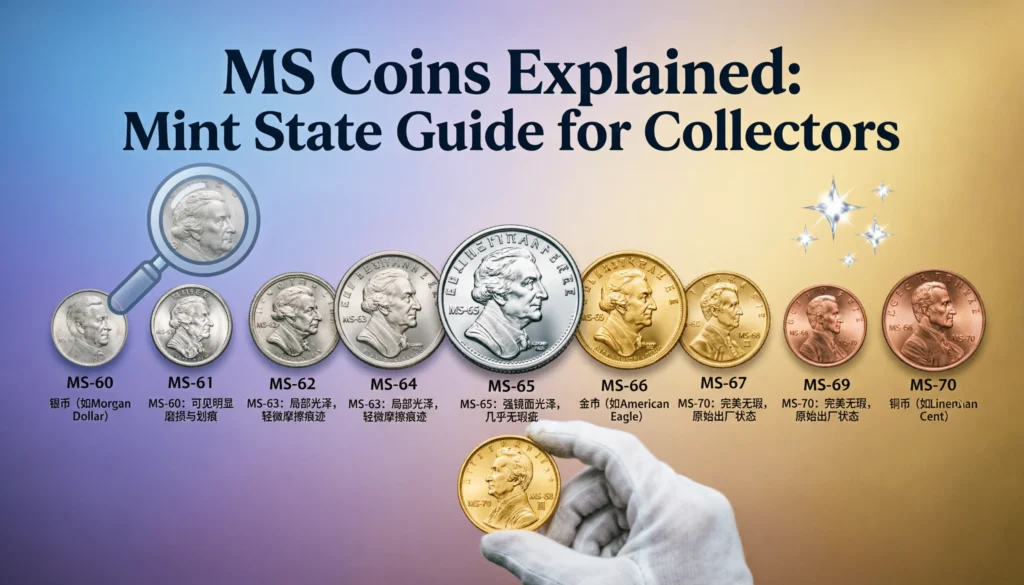
MS in coins stands for “Mint State.” It is a grading term used to describe coins that have never been circulated and retain their original condition as issued by the mint. Mint State coins are evaluated on a scale from MS-60 to MS-70, with higher numbers indicating better condition, fewer imperfections, and more appeal to collectors.
If you’re new to coin collecting, seeing abbreviations like MS, PF, or XF on coin listings can be confusing. Understanding these terms is essential for evaluating coin quality, value, and rarity.
If you’ve ever looked at a coin listing and noticed labels like MS60 or MS70, you might wonder what those letters and numbers really mean. For collectors and investors, understanding MS meaning in coins is essential because it directly impacts a coin’s value, condition, and overall rarity. Even small differences in grading can lead to huge changes in price, making this knowledge crucial in today’s coin market.
In simple terms, MS meaning in coins refers to “Mint State,” a grading category used to describe coins that have never been circulated and remain in pristine condition. These coins are evaluated on a scale that reflects their quality, surface condition, and visual appeal. In this guide, we’ll break down how MS grades work, why they matter, and how they influence pricing and collectibility in 2026.
Knowing what MS means can help collectors make smarter purchases, understand market values, and properly care for their coins. Let’s dive into the origin, usage, examples, comparisons, and practical tips for MS coins.
Origin of MS in Coin Grading
Coin grading started as a way to standardize coin quality in the collector market. Before formal grading, buyers and sellers relied on subjective descriptions like “very fine” or “uncirculated,” which caused inconsistencies.
- Mint State (MS) originated in the 1940s and 1950s when grading systems became more formalized.
- The Sheldon Coin Grading Scale introduced a 70-point system, where MS-70 represents a perfect coin with no visible flaws.
- MS grading quickly became the standard for uncirculated coins, helping collectors and investors evaluate authenticity and condition reliably.
Today, MS grades are universally recognized in U.S. coin collecting and are widely used by dealers, auction houses, and grading companies like PCGS and NGC.
Why MS Coins Are Important
Coins graded MS hold a special place in numismatics. Collectors and investors often prioritize MS coins for several reasons:
- They are uncirculated, meaning they have never been used as currency.
- They retain original mint luster, giving them aesthetic appeal.
- Higher MS coins typically have higher market value, especially for rare coins.
- MS coins are preferred for investment-grade collections because their quality is more predictable.
In short, if you’re seeking pristine coins for collection or investment, MS coins are the benchmark.
Understanding the MS Scale
MS coins are graded on a 1–70 scale, but in practice, only MS-60 to MS-70 are used. Here’s a quick overview:
| MS Grade | Description | Collector Notes |
|---|---|---|
| MS-60 | Uncirculated but may have contact marks or minor imperfections | Entry-level uncirculated coin |
| MS-63 | Average Mint State | Attractive coin with some minor marks |
| MS-65 | Choice Uncirculated | Eye-appealing, minimal flaws |
| MS-67 | Superb Uncirculated | High-quality coin with very few imperfections |
| MS-70 | Perfect Mint State | Flawless, with full mint luster |
Tip: Coins graded MS-65 or higher are highly sought after for investment or display purposes.
Real-Life Examples of MS Coins
Here are practical examples of how MS grading applies:
| Coin Type | MS Grade Example | Why MS Matters |
|---|---|---|
| 1921 Morgan Silver Dollar | MS-64 | Retains original luster, minor contact marks |
| 1943 Lincoln Cent | MS-66 | Almost perfect, collector-grade coin |
| 1986 American Silver Eagle | MS-70 | Perfect mint condition, highly collectible |
Tone Examples:
- Friendly: “I just got a 1943 Lincoln cent in MS-66, and it looks amazing 😍.”
- Neutral: “This coin is graded MS-63, meaning it’s uncirculated with minor imperfections.”
- Slightly dismissive: “MS-60? That’s uncirculated, but don’t expect perfection.”
MS vs Other Coin Grades
Understanding MS coins becomes clearer when compared with other common grading terms:
| Grade | Meaning | Typical Use |
|---|---|---|
| MS | Mint State | Never circulated, original condition |
| PF/PR | Proof | Specially struck coins for collectors, often shiny and detailed |
| AU | About Uncirculated | Light wear from minimal circulation |
| XF | Extremely Fine | Light wear, circulated |
| VG | Very Good | Noticeable wear, circulated |
While MS coins are uncirculated, AU and XF coins have seen limited use and are generally less valuable. Proof coins (PF/PR) are not meant for circulation and often have mirror-like finishes, making them different from standard MS coins.
Alternate Meanings of MS
Outside of coin collecting, MS can mean different things:
- Medical: Multiple Sclerosis
- Education: Master of Science
- Technology: Microsoft
- Messaging: “Message Sent” in casual texting
In the context of coins, however, MS always refers to Mint State.
Polite or Professional Alternatives
When discussing coins in a professional or polite context:
- Use “Mint State” instead of MS when clarity is needed.
- Specify the MS grade, e.g., “MS-65” to convey exact condition.
- Example: “This coin is a Mint State 66, making it a choice uncirculated specimen.”
These alternatives ensure clear communication with collectors, investors, or auction houses.
Practical Tips for Collecting MS Coins
- Check certification: Look for professional grading from PCGS or NGC.
- Understand the MS scale: Know the difference between MS-60 and MS-70.
- Handle carefully: Use gloves to preserve luster.
- Store properly: Coin holders, capsules, or albums prevent scratches.
- Compare prices: Rarity, demand, and MS grade affect value.
- Invest wisely: High MS grades usually have better long-term value.
FAQs
What does MS mean on a coin?
MS stands for Mint State, indicating a coin has never been circulated and retains its original condition.
Is MS better than AU coins?
Yes. MS coins are uncirculated, while AU (About Uncirculated) coins show slight wear.
What is the highest MS grade?
MS-70 is the highest, representing a perfect coin with no visible flaws.
Can MS coins lose value?
Yes. Market demand, rarity, and authenticity verification affect value, but condition-wise, MS coins maintain premium appeal.
Are all MS coins silver or gold?
No. MS coins can be made of any metal, including copper, nickel, silver, and gold.
How do I verify an MS coin’s grade?
Use certified grading services like PCGS, NGC, or consult an experienced coin dealer.
Does MS mean the same for ancient coins?
Not exactly. Ancient coins are graded differently; MS is usually reserved for modern coins.
Can I clean MS coins to make them look better?
No. Cleaning can reduce value. MS coins retain original mint luster, which is damaged by cleaning.
Conclusion
Understanding MS in coins is essential for any collector or investor. Mint State coins provide a clear measure of quality, aesthetic appeal, and potential value. From casual collectors to professional numismatists, knowing the MS grade helps you make informed buying decisions and maintain your collection properly.
Always check the coin’s certification, understand its MS grade, and handle it carefully to preserve its value. Mint State coins represent the pinnacle of uncirculated beauty and are a cornerstone of serious coin collecting.
Read More Related Articles:
- MB Mean in Text: Abbreviation Everyone’s Using In 2026
- GTG Mean in Text: Why People Use It Before Logging Off In 2026
- TLC Mean in Cars: From Care Tips to Taxi Regulations In 2026

Luna Hartley is a content creator at TextSprout.com, where she specializes in explaining word meanings, modern phrases, and everyday language used in texts and online conversations. Her writing focuses on clarity and context, helping readers understand how words are actually used in real communication.