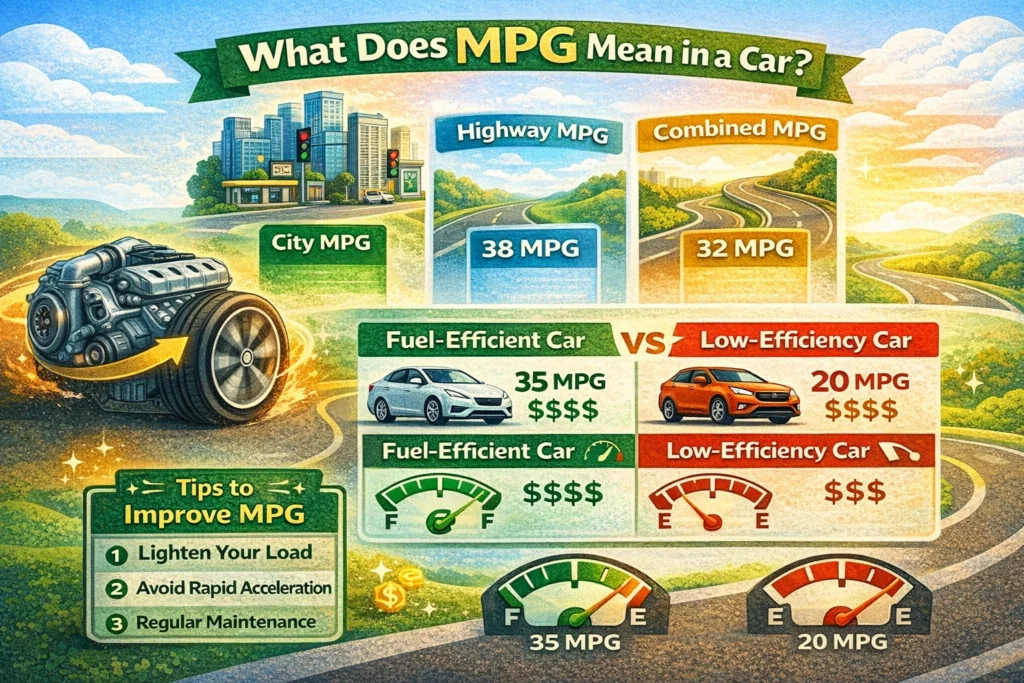
In automotive terms, MPG stands for Miles Per Gallon, which measures a vehicle’s fuel efficiency. It tells you how many miles a car can travel on one gallon of fuel. A higher MPG indicates better fuel economy and lower fuel costs.
Understanding MPG is crucial for choosing a car, calculating fuel expenses, and making environmentally friendly decisions. Whether you drive a compact car or an SUV, MPG helps quantify efficiency in a clear, comparable way.
Origin of MPG
The concept of miles per gallon emerged with the rise of automobiles in the early 20th century:
- Fuel efficiency measurement: As cars became widespread, consumers wanted a standardized way to compare fuel usage.
- MPG adoption: In the United States, the Environmental Protection Agency (EPA) standardized MPG ratings in the 1970s to help drivers understand fuel economy.
- Global perspective: Other countries use different metrics, such as L/100 km (liters per 100 kilometers), but the principle is the same: measure how far a car can go on a set amount of fuel.
Today, MPG remains a universal shorthand for fuel efficiency, essential for both drivers and environmental assessments.
Why MPG Matters
Understanding MPG has several practical benefits:
- Save money on fuel: Higher MPG means fewer gallons needed for the same distance.
- Environmental impact: More efficient cars produce fewer emissions per mile.
- Vehicle comparison: Helps compare sedans, SUVs, trucks, and hybrids objectively.
- Long-term planning: Fuel economy influences total cost of ownership.
How MPG is Calculated
MPG is calculated using the formula:MPG=Gallons of Fuel UsedMiles Driven
Example:
If a car travels 300 miles using 10 gallons of fuel:MPG=10300=30
This means the car can travel 30 miles per gallon of fuel.
Types of MPG
MPG can differ based on driving conditions and testing standards:
1. City MPG
- Measures fuel efficiency in stop-and-go traffic.
- Usually lower than highway MPG due to frequent braking and acceleration.
- Example: A car may have 22 MPG in the city.
2. Highway MPG
- Measures fuel efficiency on steady-speed highway driving.
- Typically higher than city MPG.
- Example: The same car may have 30 MPG on the highway.
3. Combined MPG
- A weighted average of city and highway MPG.
- Gives a realistic estimate of everyday fuel consumption.
- Example: 25 MPG combined.
| Car Model | City MPG | Highway MPG | Combined MPG |
|---|---|---|---|
| Sedan A | 22 | 30 | 25 |
| SUV B | 18 | 25 | 21 |
| Hybrid C | 50 | 55 | 52 |
Real-World Applications of MPG
Everyday Driving
- Knowing MPG helps drivers estimate fuel costs per month.
- Useful for road trips and calculating gas stops.
Environmental Awareness
- Cars with higher MPG produce less carbon dioxide (CO₂) per mile.
- Helps drivers make eco-conscious choices.
Car Buying Decisions
- Fuel-efficient cars save money over the vehicle’s lifetime.
- MPG ratings are a key factor in comparing gas, hybrid, and electric vehicles.
Example Calculation
- Driving 1,200 miles per month in a car with 30 MPG:
Gallons needed=301200=40 gallons
- If fuel costs $4/gallon: 40 × 4 = $160 per month.
Factors Affecting MPG
- Driving habits – Aggressive acceleration and braking reduce MPG.
- Vehicle weight – Heavier vehicles consume more fuel.
- Engine type – Smaller engines often have higher MPG; turbocharged engines may vary.
- Aerodynamics – Roof racks, spoilers, and modifications affect efficiency.
- Tire pressure – Underinflated tires increase rolling resistance, lowering MPG.
- Maintenance – Regular oil changes, air filter replacements, and spark plug maintenance improve MPG.
| Factor | Impact on MPG |
|---|---|
| Aggressive driving | Decreases significantly |
| Vehicle weight | Heavier = lower MPG |
| Tire pressure | Low pressure = lower MPG |
| Engine type | Small/efficient = higher MPG |
Comparing MPG With Other Metrics
| Metric | Definition | Comparison to MPG |
|---|---|---|
| L/100 km | Liters per 100 kilometers | Lower L/100 km = higher efficiency |
| km/L | Kilometers per liter | Similar to MPG, metric version |
| Fuel Economy | General term for efficiency | MPG is a specific measurement |
Pro tip: In Europe, drivers often use L/100 km, which is the inverse of MPG.
- Example: 30 MPG ≈ 7.84 L/100 km.
MPG vs Fuel Economy Labels
Modern vehicles display MPG on window stickers with city, highway, and combined values.
- Hybrid and electric vehicles may also include MPGe (Miles Per Gallon Equivalent), which measures energy efficiency using the equivalent energy content of gasoline.
- Understanding these labels ensures buyers make informed decisions.
| Label Type | Description |
|---|---|
| MPG | Miles per gallon, traditional gasoline/diesel |
| MPGe | Miles per gallon equivalent for electric vehicles |
| Combined MPG/MPGe | Weighted average of city and highway performance |
Common Misunderstandings About MPG
- MPG doesn’t predict real-world fuel exactly: Your driving style, road conditions, and vehicle load influence actual MPG.
- Higher MPG isn’t always cheaper: Premium fuel costs or maintenance may offset savings.
- MPG varies by season: Cold weather and air conditioning use can reduce efficiency.
- MPG ≠ speed: Driving slower doesn’t always maximize MPG; engines have optimal efficiency ranges.
Practical Tips to Improve MPG
- Drive smoothly and avoid rapid acceleration.
- Keep tires properly inflated.
- Reduce unnecessary weight and remove roof racks.
- Use cruise control on highways.
- Limit idling time.
- Follow manufacturer maintenance schedules.
- Choose fuel-efficient routes when possible.
Real-World MPG Examples Table
| Car Type | City MPG | Highway MPG | Combined MPG | Notes |
|---|---|---|---|---|
| Compact Sedan | 28 | 38 | 32 | Fuel-efficient commuter car |
| Midsize SUV | 20 | 28 | 23 | Moderate fuel efficiency |
| Full-size Truck | 15 | 21 | 17 | Lower MPG due to weight |
| Hybrid Sedan | 50 | 55 | 52 | Excellent fuel economy |
| Electric Vehicle | MPGe 120 | MPGe 112 | MPGe 115 | Measured in energy equivalent |
FAQs
What does MPG stand for in a car?
Miles Per Gallon, measuring fuel efficiency.
Is higher MPG better?
Yes, higher MPG means the car travels farther on the same fuel, saving money and reducing emissions.
What is the difference between city and highway MPG?
City MPG is measured in stop-and-go traffic, while highway MPG is measured at steady speeds.
Can driving habits affect MPG?
Yes, aggressive acceleration, heavy braking, and high speeds reduce MPG.
What is combined MPG?
A weighted average of city and highway MPG to reflect typical driving conditions.
How is MPG different from MPGe?
MPGe measures electric vehicles’ energy efficiency, using an equivalent amount of energy in gallons of gasoline.
Does vehicle weight affect MPG?
Heavier cars usually have lower MPG due to increased fuel consumption.
How can I improve my car’s MPG?
Drive smoothly, maintain tires, reduce weight, and follow regular maintenance.
Conclusion
MPG is a simple yet powerful measure of a car’s fuel efficiency. Whether you drive a compact car, SUV, hybrid, or electric vehicle, understanding MPG helps you:
- Save money on fuel
- Reduce environmental impact
- Compare vehicles accurately
- Plan trips efficiently
Key takeaways:
- Higher MPG = more miles per gallon, lower fuel cost
- City and highway MPG differ due to driving conditions
- Combined MPG provides a realistic efficiency estimate
- Driving habits, vehicle maintenance, and design influence MPG
Being aware of MPG helps you make smarter, eco-conscious choices on the road.
Read More Related Articles:
- Total Means in Math: How Everything Adds Up in the End In 2026
- What Does DS Mean in Volleyball? From Beginner to Pro (2026)
- Transitioning Mean in Hospice: A Gentle Guide for Families In 2026

Ivy Madison is a content creator at TextSprout.com, specializing in word definitions, internet slang, acronyms, and text abbreviations. She delivers clear and engaging explanations, helping readers quickly understand modern digital language and trending terms.