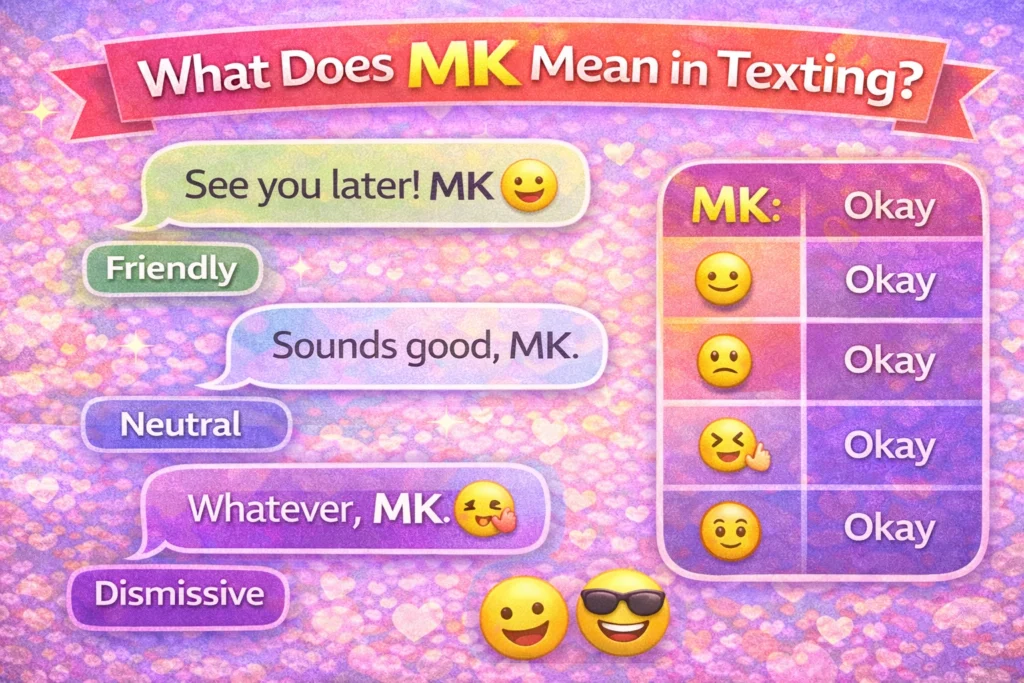
In texting and online messaging, “MK” is a short form or abbreviation that generally stands for “okay”. It is often used to acknowledge messages, indicate agreement, or signal understanding in a quick, casual way.
For example, if someone texts, “I’ll meet you at 7 pm,” replying with “MK” confirms you received the message and are okay with it.
Though simple, “MK” is one of the most commonly used shorthand expressions in chats, making conversations faster and more informal. It is widely used across messaging apps, social media, and even emails in casual contexts.
Origin and Popularity of “MK”
The abbreviation “MK” emerged in the early days of text messaging and instant messaging, around the late 1990s and early 2000s. As SMS limits restricted messages to 160 characters, users started shortening words to save space and time.
- “M” for “me” or “my” (in some cases)
- “K” for “okay” or “k”
Over time, “MK” became a shorthand version of “OK” or “Okay” with a slightly friendlier or softer tone than a single “K.”
Why It Became Popular
- Convenience: Faster to type than “okay.”
- Character-saving: Especially useful during SMS days with strict limits.
- Casual tone: Conveys acknowledgment without sounding overly formal.
- Cross-platform: Used in WhatsApp, Messenger, Snapchat, Instagram, Discord, and iMessage.
While “K” alone can sometimes feel abrupt or dismissive, “MK” is often perceived as friendlier and more neutral.
Usage of “MK” in Texting
In texting, “MK” can have multiple nuances depending on context and tone:
- Acknowledgment:
- Example: “I’ll send the documents tomorrow.” → “MK”
- Indicates that the message is received and understood.
- Agreement:
- Example: “Let’s meet at 6 pm for dinner.” → “MK”
- Shows consent or approval without extra words.
- Neutral Response:
- Sometimes used when the sender does not have much to add but wants to reply.
- Polite Closure:
- At the end of a conversation or after instructions:
- “Don’t forget to submit your homework.” → “MK”
- At the end of a conversation or after instructions:
- Tone Indicator:
- While often neutral or friendly, context matters. Depending on capitalization, emoji use, or punctuation, it can seem sarcastic, rushed, or dismissive.
- Example: “MK.” with a period may seem cold; “MK 😊” feels warm and friendly.
Examples of “MK” in Texting
Friendly Example:
Friend: “See you at the movies at 8!”
You: “MK! Can’t wait 🍿”
Neutral Example:
Colleague: “Please review the report before 5 pm.”
You: “MK, will do.”
Dismissive/Short Example:
Partner: “We need to talk about our weekend plans.”
You: “MK.”
- Could be interpreted as uninterested or dismissive.
Table: Tone Variations of “MK”
| Tone | Example | Interpretation |
|---|---|---|
| Friendly | MK 😊 | Positive acknowledgment |
| Neutral | MK | Simple acknowledgment or agreement |
| Rushed | MK! | Quick response, may indicate hurry |
| Dismissive | MK. | Could feel cold or uninterested |
| Polite | MK, thanks | Shows acknowledgment with gratitude |
Comparison With Related Texting Abbreviations
Several abbreviations are similar to “MK”, but each carries subtle differences:
| Abbreviation | Difference from MK | Example |
|---|---|---|
| OK / Okk / Okay | Standard acknowledgment, can be formal or neutral | “I’ll call you later.” → “OK” |
| K | Single-letter, can be abrupt or dismissive | “Meet me at 6.” → “K” |
| KK | Slightly friendlier than K, casual | “Got it, thanks!” → “KK” |
| Sure | Explicit agreement rather than shorthand | “Can you help me tomorrow?” → “Sure” |
| Yup / Yep | Casual, informal agreement | “We’re leaving now.” → “Yup” |
Tip: Use “MK” when you want a brief, polite acknowledgment that is slightly softer than “K” but faster than “Okay.”
Alternate Meanings of “MK”
While “MK” primarily means “okay” in texting, context can give it other meanings:
- Initials: Could represent someone’s name (e.g., “Mary King” → MK).
- Brands or Organizations:
- Michael Kors (fashion brand)
- Mortal Kombat (gaming context)
- Internet Slang or Gaming:
- Sometimes used to indicate “move/kick” in online games.
- Professional/Technical Abbreviations:
- MK in engineering, science, or finance could have unique definitions, though rarely used in casual texting.
Always consider context to determine whether “MK” is meant as “okay” or something else.
Tips for Using “MK” in Texting
- Mind the tone: Capitalization, punctuation, and emojis change perception.
- Avoid overuse: Too many “MK” responses may feel robotic or indifferent.
- Consider context: In professional messages, “OK” or “Noted” might be better than “MK.”
- Combine with other words: “MK, thanks” or “MK, see you later” feels warmer and polite.
- Use in casual chats: Works best with friends, family, and informal group chats.
Table: MK vs Similar Abbreviations in Texting
| Abbreviation | Tone | Usage Scenario | Pros | Cons |
|---|---|---|---|---|
| MK | Friendly/Neutral | Quick acknowledgment | Polite, short, widely understood | Can seem dismissive if used alone |
| K | Abrupt/Neutral | Quick reply | Very fast | May seem rude or uninterested |
| KK | Casual/Friendly | Informal chats | Soft, playful | Overused in some groups |
| OK | Neutral/Formal | Professional or casual | Universal understanding | Slightly longer to type |
| Yup / Yep | Casual/Agreeing | Informal, friendly | Quick, clear agreement | Not suitable for formal messages |
Real-World Examples of “MK” Usage
1. Messaging Friends:
- Friend: “Movie at 7?”
- You: “MK! I’ll bring popcorn.”
2. Group Chat Coordination:
- Team Lead: “Submit your tasks by 4 pm.”
- Members: “MK.” / “MK, got it.”
3. Parent-Child Texting:
- Parent: “Time to do homework.”
- Child: “MK, starting now.”
4. Casual Work Communication:
- Colleague: “Meeting rescheduled to 10 am.”
- You: “MK, noted.”
5. Dating or Social Messaging:
- Partner: “Dinner tonight?”
- You: “MK 😊”
Notice how the same abbreviation conveys slightly different emotions based on tone, punctuation, and emoji usage.
Common Misinterpretations
- Assuming MK is always friendly: Not necessarily; tone is key.
- Confusing MK with initials or brands: Context must clarify whether it’s a name, brand, or acknowledgment.
- Overusing MK: Too many MK replies can feel robotic, lazy, or uninterested.
Professional Alternatives for “MK”
When casual abbreviations are inappropriate, consider these:
- OK
- Understood
- Noted
- Got it
- Confirmed
These alternatives convey acknowledgment without risking misinterpretation in professional or sensitive contexts.
Table: MK Usage by Platform
| Platform | Common Use | Example | Notes |
|---|---|---|---|
| Acknowledgment & agreement | “MK, I’ll be there.” | Most common | |
| Instagram DM | Quick response | “MK 😊” | Friendly, casual |
| Messenger | Neutral response | “MK” | Can be perceived as rushed if used alone |
| Discord / Gaming | Casual acknowledgment | “MK, ready for match” | Often paired with gaming terms or emojis |
| SMS | Traditional shorthand | “MK” | From early SMS days |
FAQs
1. What does MK mean in texting?
MK usually stands for “okay” and is used to acknowledge, agree, or confirm a message.
2. Is MK the same as K?
Similar, but MK is slightly friendlier. K can seem abrupt or dismissive.
3. Can MK be rude?
Yes, depending on context, punctuation, or tone. A plain “MK.” can feel cold.
4. Should I use MK in professional chats?
Not recommended. Use “OK,” “Noted,” or “Understood” instead.
5. Does MK have other meanings?
Yes, it could represent initials, brands (Michael Kors), games (Mortal Kombat), or technical abbreviations.
6. How do emojis affect MK?
Emojis soften the tone. For example, “MK 😊” feels friendly, while “MK” alone may seem neutral or indifferent.
7. Can MK be used in emails?
Rarely. It’s very casual and best suited for informal texting or chat apps.
8. How is MK different from KK or Yup?
KK is playful, casual, and friendly. Yup indicates agreement, often used in informal situations. MK sits between polite and casual acknowledgment.
Conclusion
In texting, “MK” is a simple yet versatile abbreviation for “okay.” It allows users to respond quickly, acknowledge messages, and signal agreement in a friendly, casual, or neutral tone.
Key Takeaways:
- MK stands for “okay” in most texting scenarios.
- Tone and context affect interpretation—can be friendly, neutral, or dismissive.
- Similar abbreviations include K, KK, Yup, and OK.
- Emojis, punctuation, and context matter for clarity.
- Professional alternatives include OK, Noted, or Understood.
By understanding MK, users can communicate more effectively in casual chats while avoiding misunderstandings.
Read More Related Articles:
- What Does “TS” Mean in Text? Modern Slang Breakdown (2026)
- What Does K Means in Texts: Not Just Lazy Typing (2026)
- What Does Vanilla Mean in Slang? Modern Slang Guide (2026)

Luna Hartley is a content creator at TextSprout.com, where she specializes in explaining word meanings, modern phrases, and everyday language used in texts and online conversations. Her writing focuses on clarity and context, helping readers understand how words are actually used in real communication.