
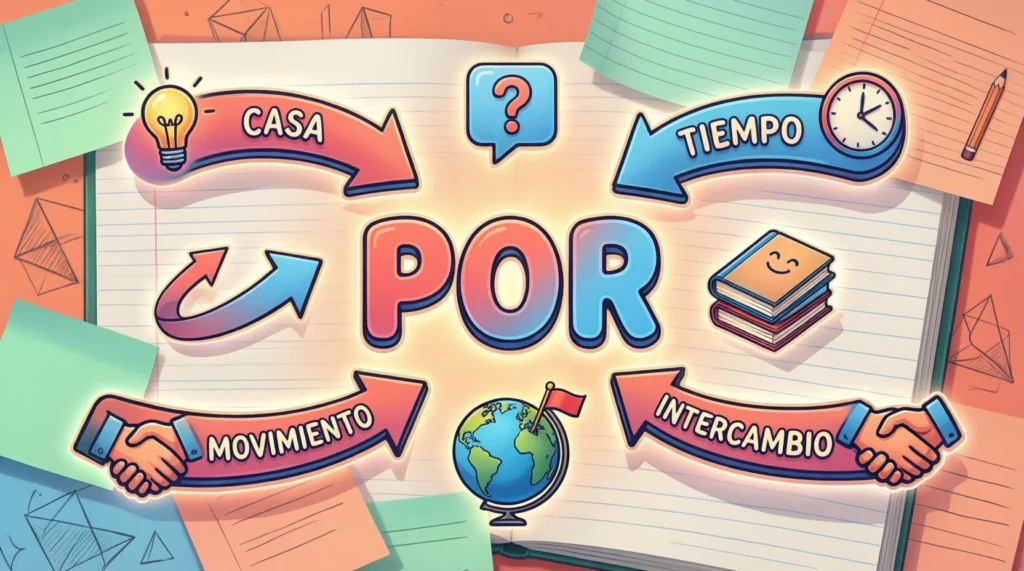
Por is a Spanish preposition most commonly translated as for, by, through, because of, or in exchange for, depending on context.
It is used to express cause, reason, movement through space or time, exchange, duration, and motivation.
Por is one of the most commonly used — and most confusing — words in Spanish.
If you’ve ever wondered why Spanish speakers use por in so many different situations, you’re not alone.
This small word carries big meaning, and understanding it can instantly improve how natural your Spanish sounds.
Unlike English, Spanish relies heavily on context, and por changes meaning based on how it’s used in a sentence.
Why Por Is So Important in Spanish
Few Spanish words appear as frequently as por.
You’ll hear it in casual conversations, professional settings, songs, movies, and even legal documents.
Native speakers use por instinctively, while learners often hesitate between por and para.
Understanding por is essential because:
- It explains why something happens
- It shows how long something lasts
- It expresses movement and exchange
- It adds emotional depth to everyday speech
Mastering por helps your Spanish sound fluent rather than translated.
Origin and Linguistic Background of Por
The word por comes from Latin pro, meaning for or on behalf of.
Over time, Spanish expanded its usage to cover cause, passage, substitution, and duration.
That’s why por can feel overwhelming.
It isn’t random — it evolved to fill multiple communicative needs.
Because Spanish is spoken across many countries, por has stayed remarkably consistent worldwide, unlike slang terms that vary by region.
Core Meanings and Uses of Por in Spanish
Rather than memorizing translations, it’s more effective to understand por by function.
Below are the most common ways por is used in real Spanish.
1. Por to Express Cause or Reason
One of the most frequent uses of por is explaining why something happened.
Examples:
- Lo hice por ti.
I did it because of you. - Gracias por venir.
Thanks for coming.
Tone note:
This usage is neutral to warm and very common in polite speech.
2. Por to Show Movement or Location Through Space
When something moves through, along, or around a place, por is the correct choice.
Examples:
- Caminamos por el parque.
We walked through the park. - El gato pasó por la ventana.
The cat went through the window.
This use feels natural and descriptive, often appearing in storytelling.
3. Por to Indicate Duration of Time
If you want to say how long something lasts, por steps in.
Examples:
- Estudié español por dos años.
I studied Spanish for two years. - Viví allí por mucho tiempo.
I lived there for a long time.
Important note:
Por focuses on the length of time, not the deadline.
4. Por to Mean “In Exchange For”
This use appears in shopping, negotiations, and daily transactions.
Examples:
- Te doy cinco dólares por el libro.
I’ll give you five dollars for the book. - Cambió su coche por una bicicleta.
He traded his car for a bicycle.
Tone:
Neutral and practical, common in spoken and written Spanish.
5. Por to Express Motivation or Purpose
Sometimes por highlights what drives an action emotionally.
Examples:
- Luchó por su familia.
He fought for his family. - Lo hizo por amor.
She did it for love ❤️
This use adds emotional weight and sincerity to sentences.
Everyday Examples of Por in Context
Below is a table showing por used in real-life situations with tone explanations.
Table 1: Common Por Examples With Tone
| Spanish Sentence | English Meaning | Tone |
|---|---|---|
| Gracias por ayudarme. | Thanks for helping me | Friendly |
| Fue castigado por mentir. | He was punished for lying | Neutral |
| Todo salió mal por tu culpa. | Everything went wrong because of you | Negative |
| Pasamos por tu casa. | We passed by your house | Neutral |
| Lo hice por respeto. | I did it out of respect | Polite |
Por vs Para: The Most Common Comparison
No discussion of por is complete without comparing it to para.
These two words cause the most confusion for Spanish learners.
Simple Rule to Remember
- Por focuses on reason, cause, duration, and movement
- Para focuses on purpose, destination, and deadlines
Table 2: Por vs Para Comparison
| Situation | Use Por | Use Para |
|---|---|---|
| Reason or cause | ✔ | ✘ |
| Length of time | ✔ | ✘ |
| Deadline | ✘ | ✔ |
| Destination | ✘ | ✔ |
| Exchange | ✔ | ✘ |
| Goal or purpose | ✘ | ✔ |
Examples side by side:
- Trabajo por dinero.
I work for money. - Trabajo para ganar experiencia.
I work to gain experience.
Same verb, different meaning.
Fixed Expressions and Common Phrases Using Por
Spanish uses por in many set phrases you’ll hear constantly.
Table 3: Popular Expressions With Por
| Expression | Meaning |
|---|---|
| Por favor | Please |
| Por supuesto | Of course |
| Por ahora | For now |
| Por ejemplo | For example |
| Por fin | Finally |
| Por lo menos | At least |
Learning these expressions makes your Spanish sound natural immediately.
Alternate or Less Common Meanings of Por
While rare, por can also mean:
- On behalf of
Hablo por ella.
I speak on her behalf. - Per unit or rate
Dos veces por semana.
Two times per week. - Passive voice agent
El libro fue escrito por García.
The book was written by García.
These meanings appear more in formal or written Spanish.
Polite and Professional Alternatives to Por
In formal writing or business Spanish, por may be replaced with clearer phrases depending on tone.
Examples:
- Debido a instead of por when explaining cause
- A causa de for legal or professional writing
- En nombre de for representation
Using these alternatives adds precision without sounding casual.
Usage Tips to Avoid Common Mistakes
Here’s how to use por with confidence.
- Think why, not what for
- Use por with thank you expressions
- Choose por for time duration, not deadlines
- Remember movement means por, destination means para
If unsure, rephrase the sentence in English using “because of” or “through.”
If it fits, por is usually correct.
FAQs
What does por literally mean in Spanish?
Por does not have a single literal meaning. It changes based on context and often translates as for, by, through, or because of.
Is por formal or informal?
Por is neutral and works in casual, professional, and academic Spanish.
How do I know when to use por instead of para?
Use por when focusing on cause, reason, exchange, movement, or duration rather than a goal.
Can por mean because?
Yes. Por often expresses cause and can translate as because of.
Is por favor the same as please?
Yes. Por favor is the standard way to say please in Spanish.
Does por change in different Spanish-speaking countries?
No. Its meaning and usage remain consistent across regions.
Can por be used with emotions?
Absolutely. It often expresses motivation or emotional reasons behind actions.
Is por difficult for beginners?
It can be confusing at first, but regular exposure makes it intuitive over time.
Conclusion
Por may look small, but it carries enormous meaning.
It explains reasons, movement, time, emotion, and exchange in just two letters.
Instead of translating word-for-word, focus on why something happens.
Listen for how native speakers use por naturally.
Practice with real examples, not grammar charts alone.
Once por clicks, your Spanish becomes smoother, clearer, and far more confident.
Read More Related Articles:
- HU Meaning in Text: Simple Guide with Examples You Can’t Miss (2026)
- OP Meaning in Gaming – The Term Every Gamer Uses (2026)
- KK Mean in Texting: Why It Can Sound Passive-Aggressive (2026)

Neon Samuel is a digital content creator at TextSprout.com, dedicated to decoding modern words, slang, and expressions. His writing helps readers quickly grasp meanings and understand how terms are used in real conversations across text and social platforms.