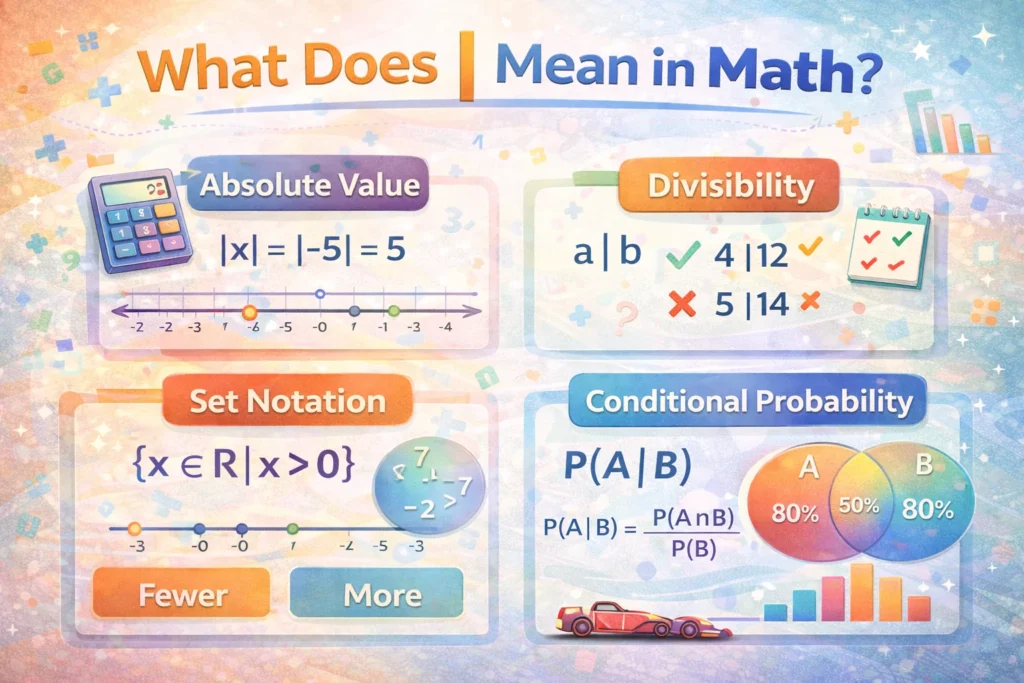
In mathematics, the vertical bar | can represent absolute value, divisibility, conditional probability, or “such that” in set notation, depending on the context in which it is used.
The vertical bar symbol | is one of those deceptively simple symbols in mathematics that can have multiple meanings depending on the context. From representing absolute value to indicating divisibility, set notation, or conditional probability, it is a versatile tool used across many branches of math. Understanding what | means in math is crucial for students, educators, and anyone working with numbers, formulas, or logical expressions.
Mathematics is full of symbols that appear straightforward but carry nuanced meanings. The vertical bar | is one of these symbols. At first glance, it might seem as simple as a punctuation mark, but its applications stretch from basic arithmetic to advanced probability and set theory.
Let’s explore this symbol in detail, uncover its history, applications, and examples, and understand why it is indispensable in mathematics today.
The Origin of the Vertical Bar in Math
The vertical bar has a rich history and has evolved across centuries to serve different purposes in mathematics:
- Absolute Value: The use of |x| for absolute value emerged in the 19th century to denote the magnitude of a number regardless of its sign. This concept became standard in algebra and calculus.
- Divisibility: In number theory, mathematicians adopted a | b to mean “a divides b,” providing a compact notation for exact division without remainders.
- Set Theory and Logic: The vertical bar became common in set notation as “such that,” helping mathematicians define sets more precisely. For instance, {x ∈ ℝ | x > 0} represents all positive real numbers.
- Probability and Statistics: Conditional probability, denoted as P(A | B), uses the bar to signify “given that,” helping statisticians express relationships between events concisely.
Its popularity stems from its simplicity, flexibility, and universal recognition in mathematical literature. Today, the vertical bar is taught in schools and appears in advanced textbooks, coding, and research papers alike.
Common Usages of | in Math
The meaning of | changes depending on the branch of mathematics and the surrounding symbols. Let’s explore each use in detail.
1. Absolute Value: Distance from Zero
Absolute value measures the distance of a number from zero on the number line, ignoring whether it is positive or negative.
Examples:
|5| = 5
|-7| = 7
|0| = 0
Table: Absolute Value Examples
| Number | Absolute Value |
|---|---|
| 8 | 8 |
| -12 | 12 |
| 0 | 0 |
| -3.5 | 3.5 |
Absolute value is widely used in mathematics, physics, engineering, and finance. For example, if a stock price changes from $100 to $90, the absolute value of the change is |100 – 90| = 10, showing the magnitude of the change without worrying about the direction.
Tip: Absolute value is not limited to numbers. It can be applied to expressions too:
|-3 + 2| = |-1| = 1
This makes it useful in solving inequalities, distances in geometry, and optimization problems.
2. Divisibility in Number Theory
In number theory, a | b means “a divides b” exactly, without leaving a remainder. This is fundamental for understanding factors, multiples, prime numbers, and modular arithmetic.
Examples:
3 | 12 ✅ (12 ÷ 3 = 4, no remainder)
5 | 12 ❌ (12 ÷ 5 = 2.4, remainder exists)
Table: Divisibility Examples
| a | b | a | b | Explanation |
|---|---|---|---|---|
| 2 | 8 | 2 | 8 | 8 ÷ 2 = 4, divisible |
| 4 | 20 | 4 | 20 | 20 ÷ 4 = 5, divisible |
| 7 | 22 | 7 | 22 | 22 ÷ 7 = 3.14, not divisible |
Divisibility is not just academic; it appears in encryption, coding theory, and algorithm design. For example, many cryptographic systems rely on divisibility rules of large prime numbers.
3. Set Notation – “Such That”
In set theory, the vertical bar acts as “such that” in defining sets with specific conditions.
Example:
{x ∈ ℝ | x > 0}
This reads as “the set of all real numbers x such that x is greater than 0.”
Real-World Example:
If a teacher wants to list students who scored above 80 in a test:
{student ∈ class | score > 80}
Table: Set Notation Examples
| Set Description | Notation |
|---|---|
| Positive integers | {x ∈ ℤ |
| Even numbers less than 20 | {x ∈ ℕ |
| Students with grade A | {student ∈ class |
This notation allows mathematicians to express complex ideas concisely.
4. Conditional Probability
In probability theory, | denotes “given that” when calculating the probability of an event under certain conditions.
Example:
P(A | B) = Probability of A occurring given that B has occurred
Table: Conditional Probability Example
| Number | Absolute Value | Explanation |
|---|---|---|
| 8 | 8 | Distance from 0 is 8 |
| -12 | 12 | Distance from 0 is 12 |
| 0 | 0 | Distance from 0 is 0 |
| -3.5 | 3.5 | Distance from 0 is 3.5 |
| 15 | 15 | Distance from 0 is 15 |
| -20 | 20 | Distance from 0 is 20 |
This table shows numbers and their absolute values with explanations for clarity.
Conditional probability is widely used in real life: weather forecasting, insurance, finance, and machine learning. For instance, an AI model predicting disease risk uses conditional probabilities extensively.
5. Logical and Programming Usage
Outside traditional math, | appears in programming and logic:
- Logical OR: In many languages like C, JavaScript, or Python (with
||), it represents a logical OR operation. - Pipe symbol in command-line interfaces: Sends the output of one command as input to another.
While not strictly math, recognizing these uses helps students and professionals avoid confusion.
Extended Examples in Everyday Life
- Absolute Value: You owe $50 and pay $70. The absolute difference is |50 – 70| = 20.
- Divisibility: Splitting 24 candies among 8 kids: 8 | 24 ✅
- Set Notation: Students with height > 150 cm: {student ∈ class | height > 150}
- Conditional Probability: Chance of traffic jam given it’s rush hour: P(Traffic | RushHour)
Even casual math problems use | without you realizing it!
Comparison with Related Symbols
It is important to distinguish | from similar-looking symbols to avoid mistakes:
| Symbol | Meaning | Difference / Notes |
|---|---|---|
| | | Absolute value | Can also represent divisibility or conditional probability depending on context |
| : | Ratio or “such that” | Less commonly used than | in set notation; separates elements and conditions |
| / | Division | Represents a mathematical operation, not a condition or relationship |
| ∈ | Element of | Denotes membership in a set, not magnitude or conditional probability |
Correctly interpreting these symbols ensures mathematical accuracy.
Polite or Professional Alternatives
In formal writing, replacing | with words can make explanations more accessible:
- Instead of | for “such that,” write: “where” or “for which”
- Instead of | for divisibility, phrase it: “a divides b”
- Instead of | for conditional probability, write: “probability of A given B”
Using words can improve readability, especially for educational or technical audiences unfamiliar with notation.
Practical Tips for Using |
- Check the context: Numbers, sets, or probability?
- Look at surrounding symbols: Absolute value surrounds numbers; divisibility is between integers.
- Mind programming context: Not all | symbols are mathematical.
- Double-check set notation: Misplacing | can completely change meaning.
- Use examples: Writing out numbers or events helps understand the symbol.
- Combine with other symbols cautiously: | often appears with %, ∈, or P() in formulas.
FAQs
1. What does | mean in absolute value?
It represents the distance of a number from zero, ignoring its sign.
2. How do you read a | b in number theory?
It is read as “a divides b,” meaning b is divisible by a without a remainder.
3. What does x ∈ S | x > 0 mean?
It’s the set of all elements x in S such that x is greater than 0.
4. How is | used in probability?
It indicates conditional probability, e.g., P(A | B) means the probability of A given B.
5. Can | mean anything in programming?
Yes, it can represent a logical OR or act as a pipe in command-line interfaces.
6. Is | the same as ||?
No. | has mathematical meanings; || is often logical OR in programming.
7. Why is | used instead of words?
It is concise, universally recognized, and widely used in textbooks and research papers.
8. Can | be replaced in formal writing?
Yes, using “such that,” “divides,” or “given that,” depending on context, improves readability.
Conclusion
The vertical bar | is a small symbol with a surprisingly large impact. Its meaning depends on context—absolute value, divisibility, set definitions, or conditional probability. Understanding | ensures accurate problem-solving in mathematics, statistics, programming, and data science.
- Context is critical: Check surrounding symbols and expressions.
- Absolute value, divisibility, set notation, and conditional probability are the most common uses.
- Alternative wording can improve readability in professional or educational materials.
- Practicing with examples ensures mastery of | in various applications.
By mastering this symbol, you unlock a small but essential piece of the vast world of mathematical notation.
Read More Related Articles:
- Atonement Meaning in the Bible: Why It Matters (2026)
- Meaning of “Ya” in Spanish: How It’s Used in Daily Conversations In 2026
- Meaning of “Linda” in Spanish: More Than Just “Pretty” In 2026

Neon Samuel is a digital content creator at TextSprout.com, dedicated to decoding modern words, slang, and expressions. His writing helps readers quickly grasp meanings and understand how terms are used in real conversations across text and social platforms.