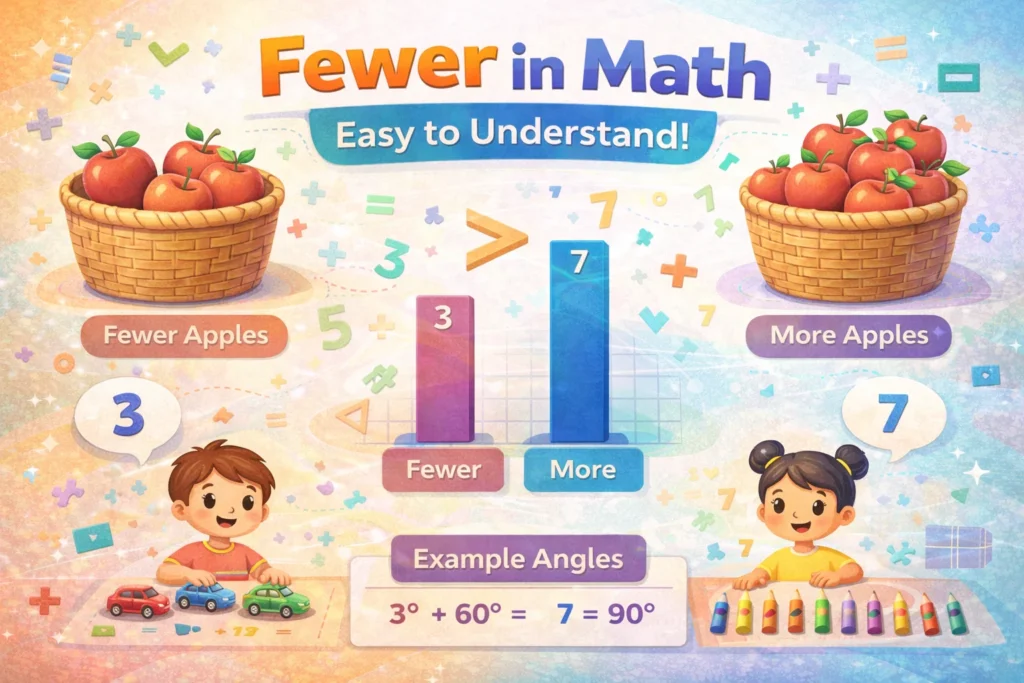
Fewer (in math) refers to a smaller number of countable items or units when compared to another set.
For example, if a basket has 3 apples and another has 7, the first basket has fewer apples.
When you first encounter the word fewer in math, it might feel simple—but understanding its proper use can make a big difference in how you interpret numbers and quantities. In everyday language, “fewer” and “less” are often used interchangeably, but in math, clarity is crucial.
In geometry, some of the most powerful ideas are built on simple relationships. One of those ideas is complementary angles. The concept is straightforward, yet it plays a huge role in solving angle problems, understanding shapes, and building strong foundations in mathematics.
Complementary angles are two angles whose measures add up to 90 degrees. That is the key rule. If one angle measures 35 degrees, its complementary angle must measure 55 degrees because together they form a right angle. This relationship appears constantly in triangles, coordinate geometry, construction, and even real world design.
In 2026, understanding why 90 degrees matters is more than a classroom requirement. Right angles define structure in architecture, screen layouts in technology, and precision in engineering. Knowing how complementary angles work helps students solve equations faster, recognize patterns quickly, and approach geometric problems with confidence.
Let’s explore what “fewer” means, where it comes from, and how it applies in real-world and classroom settings.
Origin of “Fewer”
The word “fewer” comes from Middle English, derived from the Old English word fēawa, meaning “few.”
- Historically, “fewer” has been linked to countable nouns—things you can enumerate individually.
- Its counterpart, “less,” is used for uncountable nouns like water, sand, or air.
- Over time, “fewer” became widely adopted in educational contexts, especially in teaching arithmetic and comparisons in primary school math.
The emphasis on “fewer” in math ensures that learners can distinguish between numbers of items versus amounts or mass.
Popularity and Real-World Usage
In math classrooms and textbooks, “fewer” is everywhere. Teachers often use it to:
- Encourage precise counting
- Highlight comparisons between groups
- Reinforce correct grammatical usage with numbers
Outside the classroom, you might see it in:
- Grocery shopping: “There are fewer bananas in this bag than in that one.” 🍌
- Sports stats: “Our team committed fewer fouls than the opponent.” ⚽
- Everyday conversation: “I have fewer tasks today than yesterday.”
It’s not just about grammar—it’s about making numerical comparisons clear and intuitive.
How “Fewer” Works in Math
Understanding “fewer” is simple once you remember that it applies to countable items.
Key Points
- Fewer = smaller number of items
- Always compare discrete, countable quantities
- Often used in subtraction problems or comparative questions
Examples
| Scenario | Comparison | Correct Usage | Explanation |
|---|---|---|---|
| Apples in baskets | Basket A: 3, Basket B: 7 | Basket A has fewer apples | Counting individual items |
| Books on shelf | Shelf 1: 10, Shelf 2: 4 | Shelf 2 has fewer books | Clear comparison of countable items |
| Chairs in a room | Room 1: 5, Room 2: 12 | Room 1 has fewer chairs | Fewer always refers to actual countable things |
Notice that “fewer” works perfectly when you can count the objects individually.
Examples with Context
Understanding the tone in examples can make learning “fewer” more relatable.
Friendly Tone
- “You have fewer candies than I do, but that’s okay—you can share mine!” 🍬
- “Our class has fewer students today, which means more space for everyone.”
Neutral/Informative Tone
- “There are fewer pencils in Box A than Box B.”
- “This survey shows fewer people prefer option C than option D.”
Negative/Dismissive Tone
- “Why are there fewer cookies than yesterday?!” 🍪
- “This team made fewer goals than last season. Disappointing.”
Tone helps convey the emotion behind the comparison, but the mathematical principle remains the same: a smaller number of countable items.
Fewer vs. Less – A Quick Comparison
Many people confuse fewer and less, but the distinction is straightforward in math.
| Term | Use | Examples |
|---|---|---|
| Fewer | Countable items | Fewer pencils, fewer cars, fewer students |
| Less | Uncountable quantities | Less water, less sugar, less time |
Tips for remembering:
- If you can count it individually, use fewer
- If you measure it in bulk or mass, use less
This distinction is especially important in word problems and statistics where accuracy matters.
Alternate Meanings of “Fewer”
While in math “fewer” is primarily used to indicate a smaller number of items, it can also be:
- Literary: “fewer troubles” or “fewer regrets”
- Professional/Business: “fewer errors in the report”
- Casual conversation: “fewer people attended than expected”
These usages still rely on the countable nature of the items being described.
Polite or Professional Alternatives
Sometimes in professional writing, you might want to use alternatives to “fewer”:
- Smaller number of – “This survey had a smaller number of participants.”
- Reduced count – “The reduced count of attendees made scheduling easier.”
- Less numerous – “The errors were less numerous this quarter.”
These phrases maintain clarity while sounding formal and polished.
Common Math Examples with “Fewer”
Here’s a table to reinforce how “fewer” applies to common math situations:
| Math Situation | Example Sentence | Explanation |
|---|---|---|
| Addition | “Box A has 3 balls, Box B has 5 balls. Box A has fewer balls.” | Comparing quantities after adding items |
| Subtraction | “5 – 3 = 2. There are 2 fewer apples in Box A.” | Shows difference in countable numbers |
| Statistics | “Fewer than 20 students failed the exam.” | Used in descriptive data |
| Fractions | “1/4 of the students have fewer than 2 books.” | Counting discrete items in subsets |
| Word Problems | “If Tom has 6 pencils and Jane has 9, Tom has fewer pencils.” | Real-world counting problem |
Tips for Teaching or Learning “Fewer” in Math
- Always count items physically when possible. Use blocks, toys, or pencils for hands-on learning.
- Use visual comparisons, like charts or graphs, to show which group has fewer items.
- Reinforce the fewer vs. less distinction to avoid common grammar errors.
- Introduce real-world examples from school, home, or sports for engagement.
FAQs
1. What does “fewer” mean in math?
“Fewer” refers to a smaller number of countable items or units compared to another set.
2. Can you use “fewer” with uncountable items?
No. For uncountable items like water, sand, or money, you should use “less.”
3. What is the difference between fewer and less?
“Fewer” is for countable items, “less” is for uncountable quantities. For example, fewer apples vs. less juice.
4. Is “fewer than 10” correct in math?
Yes. It indicates any number smaller than 10. For example, 9, 8, or 5 items.
5. Can “fewer” be used in statistics?
Absolutely. It describes smaller counts in surveys, experiments, and datasets.
6. How do teachers explain “fewer” to kids?
Teachers often use physical objects, like blocks, to compare quantities, highlighting which set has fewer items.
7. Can “fewer” be used in negative contexts?
Yes. For example, “There were fewer cookies than expected,” conveys a smaller amount than desired.
8. Are there synonyms for “fewer” in math?
Yes, alternatives include “smaller number of,” “reduced count,” and “less numerous.”
Conclusion
Understanding fewer in math is essential for clear communication, accurate counting, and avoiding confusion with “less.” Remember:
- Fewer is for countable items
- Always compare discrete quantities
- Use tables, examples, and real-world context to solidify understanding
- Distinguish carefully between fewer and less
Practical Tip: Next time you see a word problem, ask yourself: Can I count these items individually? If yes, “fewer” is your friend.
By mastering “fewer,” you not only improve math skills but also enhance clarity in writing and communication.
Read More Related Articles:
- GF Meaning in Soccer: A Key Stat Every Fan Should Know In 2026
- “Tata” Means in Spanish: Grammar and Daily Speech In 2026
- “Dónde” Meaning in Spanish: How to Ask “Where” Correctly In 2026

Ivy Madison is a content creator at TextSprout.com, specializing in word definitions, internet slang, acronyms, and text abbreviations. She delivers clear and engaging explanations, helping readers quickly understand modern digital language and trending terms.