
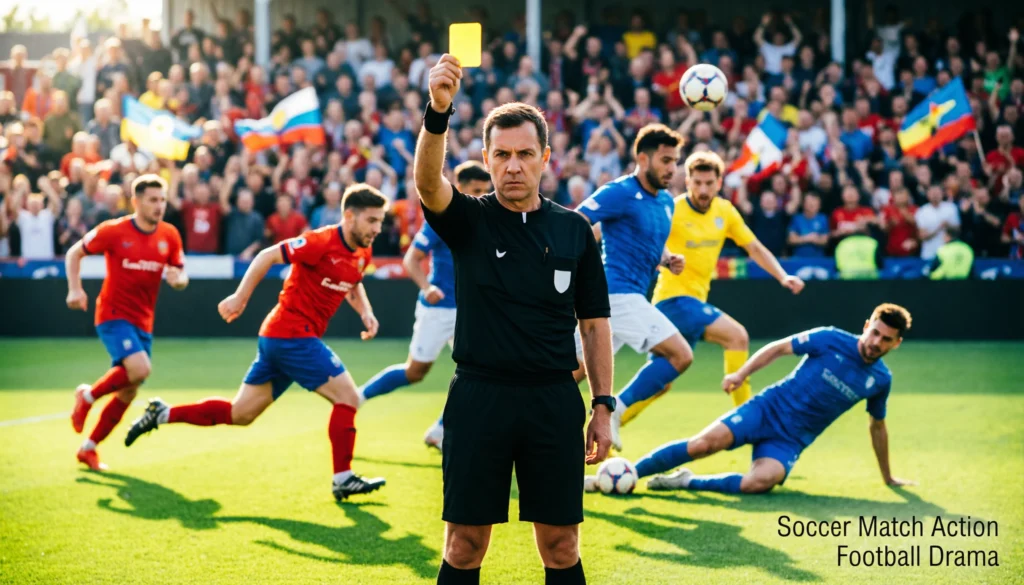
A yellow card in soccer is an official caution shown by the referee to warn a player for unsporting behavior or rule violations.
It signals that the player has committed an offense serious enough to be recorded, and receiving two yellow cards in the same match results in a red card and ejection.
Soccer is emotional, fast paced, and sometimes chaotic.
In the middle of all that energy, the referee’s yellow card acts as a clear visual warning.
Fans see it flashed.
Players instantly change behavior.
Commentators react because it can alter the entire match.
If you have ever wondered what a yellow card really means, why it matters, or how it affects players and teams, you are in the right place.
This guide explains the meaning of a yellow card in soccer in plain language.
It also covers rules, history, real match examples, comparisons, and common misunderstandings.
What Does Yellow Card Mean in Soccer?
A yellow card in soccer means the referee is officially cautioning a player for breaking the rules or behaving unsportingly.
The card serves three purposes.
- It warns the player to stop the behavior.
- It records the offense in the match report.
- It signals consequences if the behavior continues.
A player who receives two yellow cards in one match is automatically sent off with a red card.
A yellow card does not remove a player immediately.
It places them one mistake away from dismissal.
Why Yellow Cards Exist in Soccer
Soccer needs balance.
The game must stay competitive without becoming violent or unfair.
Yellow cards help referees manage matches by controlling behavior before it escalates.
They act as a middle step between a verbal warning and a red card.
This system keeps the game flowing while still enforcing discipline.
Origin of the Yellow Card System
The yellow card system was introduced after confusion during international matches.
The Problem Before Cards
Before cards existed, referees relied on verbal warnings.
Language barriers caused misunderstandings.
Players sometimes did not realize they were being cautioned or sent off.
The Solution
The card system was inspired by traffic lights.
Yellow meant caution.
Red meant stop.
This visual language worked across cultures instantly.
When It Was Introduced
Yellow and red cards were officially introduced at the 1970 FIFA World Cup.
The system quickly proved effective and became a permanent part of soccer.
What Actions Can Result in a Yellow Card?
Referees issue yellow cards for a wide range of offenses.
These actions are defined by the Laws of the Game.
Common Reasons for a Yellow Card
Unsporting behavior
Persistent fouling
Dissent by word or action
Delaying the restart of play
Failing to respect the required distance on free kicks or corners
Entering or leaving the field without permission
Simulation or diving
Some fouls look small in isolation.
Repeated behavior often triggers a caution.
Yellow Card Offenses Explained in Simple Terms
Below is a clear table showing common yellow card offenses and what they mean.
Table 1: Common Yellow Card Offenses
| OffenseWhat It Means in Real Play | |
|---|---|
| Unsporting behavior | Reckless tackles, tactical fouls, or diving |
| Dissent | Arguing with the referee or showing disrespect |
| Time wasting | Delaying throw ins, free kicks, or goal kicks |
| Persistent infringement | Repeated fouls over time |
| Failing to respect distance | Standing too close to free kicks |
| Unauthorized entry or exit | Walking on or off the field without permission |
This table helps new fans understand why cards appear even when fouls seem minor.
What Happens After a Player Gets a Yellow Card?
A yellow card changes how a player must behave for the rest of the match.
Referees watch them more closely.
Opponents may target them in one on one situations.
Coaches often adjust tactics.
If the player commits another cautionable offense, they are sent off.
Two Yellow Cards Equal a Red Card
This rule is one of the most important in soccer.
How It Works
First yellow card equals a warning.
Second yellow card in the same match equals a red card.
The player must leave the field immediately.
The team continues with one fewer player.
Why This Matters
Playing with ten players changes everything.
Teams defend deeper.
Scoring becomes harder.
Fatigue increases faster.
A single yellow card can quietly influence match strategy.
Yellow Cards in League and Tournament Play
Yellow cards do not only matter within one match.
Many competitions track yellow cards across games.
Accumulation Rules
In leagues and tournaments, players may face suspension after collecting a certain number of yellow cards.
This varies by competition.
Table 2: Typical Yellow Card Accumulation Rules
| Competition Type | Common Rule |
|---|---|
| Domestic leagues | Suspension after 5 yellow cards |
| International tournaments | Suspension after 2 yellow cards |
| Knockout stages | Cards may reset after quarterfinals |
| Group stages | Accumulation often carries over |
Always check competition rules.
They are not universal.
Examples of Yellow Card Situations in Real Matches
Context helps make sense of the rule.
Example 1: Tactical Foul
A midfielder pulls an opponent’s shirt to stop a counterattack.
The foul is not violent.
The intent is obvious.
The referee shows a yellow card.
Tone is neutral but firm.
Example 2: Dissent Toward the Referee
A defender aggressively argues a foul call.
They wave arms and shout.
The referee issues a yellow card.
Tone here is negative and corrective.
Example 3: Time Wasting Late in the Game
A goalkeeper delays a goal kick while winning.
They wait too long intentionally.
Yellow card shown.
Tone is dismissive but controlled.
Yellow Card Tone and Meaning in Context
A yellow card can carry different emotional weight depending on the situation.
Table 3: Yellow Card Tone Interpretation
| Situation | Tone Perceived |
|---|---|
| Early match caution | Preventive |
| Tactical foul | Strategic |
| Dissent | Negative |
| Time wasting | Frustrated |
| Repeated fouls | Disciplinary |
Fans often read tone into the referee’s body language.
The card itself remains neutral.
Comparison: Yellow Card vs Red Card
Many new fans confuse these two.
Here is a clear comparison.
Yellow Card
Warning
Player stays on field
Recorded offense
Second yellow leads to red
Red Card
Immediate dismissal
Player leaves field
Team plays short
No replacement allowed
A red card can be given directly without a yellow if the offense is serious.
Comparison With Other Soccer Terms
Yellow cards are often discussed alongside other concepts.
Yellow Card vs Foul
A foul is a rule violation.
A yellow card is a punishment for specific fouls or behavior.
Not every foul earns a yellow card.
Yellow Card vs Warning
A verbal warning is informal.
A yellow card is official and recorded.
Yellow Card vs Suspension
A yellow card may lead to suspension later.
Suspension is not immediate during the match.
Alternate Meanings of Yellow Card
Outside soccer, yellow card has limited alternate meanings.
In some sports, it may represent a warning system with different rules.
In everyday language, people sometimes say “that’s a yellow card moment” to mean a warning.
These uses are informal and metaphorical.
In soccer, the meaning remains strict and official.
Polite and Professional Alternatives to Saying “He Got a Yellow Card”
In writing or commentary, alternatives can sound smoother.
He was cautioned by the referee
The referee issued a booking
The player received an official warning
The player was shown a caution
These phrases are common in professional reporting.
Yellow Cards and Strategy in Soccer
Experienced players use yellow card awareness strategically.
Defenders may avoid risky tackles after being booked.
Coaches substitute players on a yellow card to avoid red cards.
Opponents try to provoke mistakes.
Referees also adapt.
They may hesitate before giving a second yellow unless the offense is clear.
Yellow Cards in Youth and Amateur Soccer
Rules are similar but enforcement may differ.
Referees often focus on education.
Verbal explanations accompany cards.
The goal is learning, not punishment.
Parents and players should remember that respect is part of the game.
FAQs:
What does a yellow card mean in soccer?
A yellow card means the referee is officially warning a player for misconduct or rule violations.
Does a yellow card mean the player must leave the field?
No. The player stays on the field unless they receive a second yellow or a red card.
How many yellow cards equal a red card?
Two yellow cards in the same match automatically result in a red card.
What happens after two yellow cards in one match?
The player is sent off, must leave the field, and cannot be replaced.
Can a goalkeeper receive a yellow card?
Yes. Goalkeepers can be cautioned for time wasting, dissent, or fouls.
Do yellow cards carry over between matches?
In many competitions, yellow cards accumulate and may lead to suspension.
Is every foul a yellow card offense?
No. Many fouls result only in free kicks without a caution.
Can a referee give a red card without a yellow first?
Yes. Serious fouls or misconduct can lead directly to a red card.
Conclusion:
Yellow cards are warnings, not punishments. They exist to control behavior and protect fair play. Two yellow cards in one match equal a red card. Accumulated yellow cards can lead to suspensions. Players must adjust behavior after being booked.
For fans, watching how referees use yellow cards adds depth to understanding the game. For players, discipline often matters as much as skill.
Read More Related Articles:
- “Dónde” Meaning in Spanish: How to Ask “Where” Correctly In 2026
- “Period” Mean in Slang? Ultimate Mic-Drop Statement (2026)
- “Le” Means in Spanish: Why This Small Word Matters So Much In 2026

Ivy Madison is a content creator at TextSprout.com, specializing in word definitions, internet slang, acronyms, and text abbreviations. She delivers clear and engaging explanations, helping readers quickly understand modern digital language and trending terms.