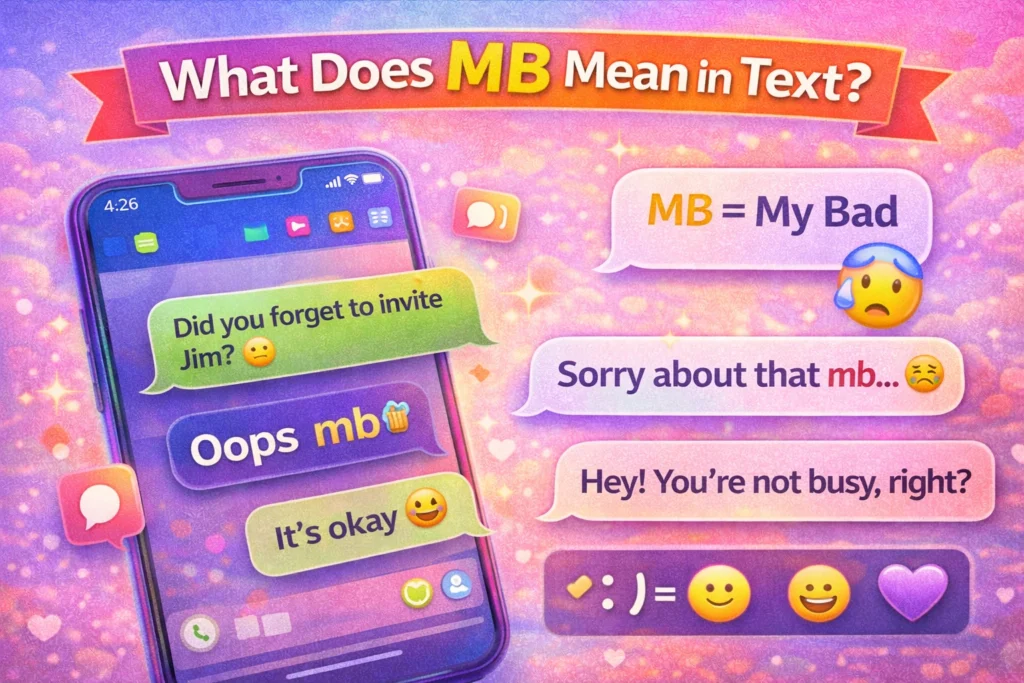
In texting, MB most commonly means “My Bad.” It is a casual abbreviation used to apologize for a small mistake, misunderstanding, or delay in conversation.
If you have ever received a quick “mb” in a chat, you might have wondered whether the person was being dismissive or simply apologizing. The truth depends on tone, context, and relationship. Let’s break it down in detail so you can understand exactly what MB means in text messages, social media, and online conversations.
Understanding MB in Text Messages
Texting language evolves fast. Shortcuts like LOL, BRB, IMO, and TBH have become everyday communication tools. MB fits right into that world.
When someone types “mb”, they are usually saying:
- Sorry
- My mistake
- I messed up
- That’s on me
It is informal and commonly used between friends, classmates, coworkers in casual chats, or gaming communities.
For example:
You: “You sent the wrong file.”
Friend: “Oh mb! Sending the right one now.”
In this case, MB clearly means “my bad,” and the tone is friendly and apologetic 😊
The Origin of MB
The phrase “my bad” originated in American slang and became widely popular in the 1980s and 1990s. It was often used in sports to admit a mistake during a game.
Example in sports context:
Player misses a shot
Teammate looks frustrated
Player says: “My bad!”
As texting became more common in the early 2000s, people shortened phrases to save time. “My bad” became simply MB.
The abbreviation spread through:
- SMS texting
- Online chat rooms
- Early social media platforms
- Gaming communities
- Group chats
Today, MB is widely understood in digital conversations, especially among younger audiences.
How MB Is Used in Different Contexts
MB can carry slightly different tones depending on the situation.
1. Friendly Tone 😊
Used between friends casually.
Example:
“Mb I forgot to reply last night.”
Tone: Light, relaxed, not overly serious.
2. Neutral Tone 😐
Used in semi-formal situations but still casual.
Example:
“MB for the delay. Here is the document.”
Tone: Apologetic but brief.
3. Slightly Dismissive Tone 🙃
Sometimes MB can feel too short or casual, especially in serious situations.
Example:
You: “You missed the meeting again.”
Them: “mb.”
Tone: May feel careless or not sincere enough.
Context matters. The same two letters can sound friendly or rude depending on delivery.
Example Usage Table
| Situation | Text Message Example | Meaning | Tone |
|---|---|---|---|
| Forgot to reply | “mb I fell asleep” | My bad | Friendly |
| Sent wrong link | “MB sending correct one” | My mistake | Neutral |
| Late to game | “mb guys traffic was impulsive” | Sorry | Casual |
| Missed important event | “mb.” | Apology but may seem dismissive | Depends on context |
This shows how tone depends heavily on the relationship and seriousness of the mistake.
Why MB Became So Popular
Several reasons explain its popularity:
- Quick and easy to type
- Works well in fast conversations
- Fits gaming and chat culture
- Casual and non-dramatic
- Less formal than “I apologize”
In today’s fast-paced digital world, people prefer short, efficient communication. It delivers an apology in just two letters.
MB vs Similar Text Abbreviations
MB is often confused with other short forms. Let’s compare them clearly.
| Abbreviation | Meaning | How It Differs From MB |
|---|---|---|
| MB | My Bad | Casual apology |
| SRY | Sorry | More direct apology |
| MYB | My Bad | Slight variation of MB |
| OOPS | Oops | Expresses surprise mistake |
| IDC | I Don’t Care | Not an apology at all |
| TBH | To Be Honest | Used for opinions, not apologies |
MB is more relaxed than “sorry” and less emotional than a full apology message.
MB in Gaming Culture
In online multiplayer games, MB is extremely common.
Example during gameplay:
Player misses a defensive move
Teammate says something
Player replies: “mb”
Here, MB quickly acknowledges fault without interrupting the flow of the game.
Gaming culture helped normalize short apologies like:
- MB
- My b
- My bad bro
- Mb fam
It keeps communication fast and efficient.
Does MB Always Mean My Bad?
Not always. While “my bad” is the most common meaning, MB can stand for other things depending on context.
Alternate Meanings of MB
| Context | Possible Meaning |
|---|---|
| Technology | Megabyte |
| Business | Management Board |
| Geography | Manitoba (Canadian province) |
| Medical | Bachelor of Medicine |
However, in texting conversations, MB almost always means “my bad.”
Context is everything.
When NOT to Use MB
Although MB is convenient, it is not suitable in all situations.
Avoid using MB:
- In professional emails
- In formal business communication
- In serious apologies
- When addressing clients or supervisors
- In academic writing
For example, writing “MB for the error in the contract” to a client may appear unprofessional.
Professional Alternatives to MB
If you need a more polished apology, consider these alternatives:
- I apologize for the mistake.
- My sincere apologies.
- That was my oversight.
- I take responsibility for the error.
- Sorry about that.
These options sound more respectful and appropriate in formal settings.
MB and Emotional Tone in Texting
Texting lacks facial expressions and voice tone. That makes short responses like MB tricky.
Compare these:
“mb lol”
“mb sorry about that”
“mb.”
Each feels different even though they all mean “my bad.”
Adding emojis can soften the tone:
- “mb 😅” feels light and friendly.
- “mb ❤️” feels warm and affectionate.
- “mb.” alone might feel cold.
Small additions completely change interpretation.
Cultural Differences in Using MB
MB is more common in:
- American English texting
- Online gaming communities
- Youth and Gen Z communication
Older generations may prefer full words like “sorry.”
International users may not recognize MB immediately, especially if English is not their first language.
MB in Social Media
On platforms like Instagram, TikTok, and Snapchat, MB appears in:
- Comment sections
- Direct messages
- Group chats
- Story replies
Example:
Follower: “You posted that twice.”
Creator: “mb deleting one now!”
Short, quick, and efficient.
Psychological Aspect of Using MB
Why do people prefer MB over saying sorry?
- It reduces emotional weight
- It keeps conversations casual
- It avoids over-apologizing
- It maintains relaxed tone
In close friendships, long formal apologies feel unnecessary. MB keeps things light.
Detailed Comparison Table: MB vs Sorry
| Factor | MB | Sorry |
|---|---|---|
| Formality | Very casual | Neutral |
| Length | Very short | Short |
| Emotional weight | Light | Moderate |
| Suitable for work | No | Sometimes |
| Suitable for friends | Yes | Yes |
| Suitable for serious issue | No | Yes |
This makes MB ideal for minor mistakes but not major ones.
FAQs
What does MB mean in texting?
MB usually means “my bad.” It is a casual way to admit a small mistake.
Is MB rude?
Not usually. It depends on context. In serious situations, it may seem too casual.
Can MB mean something else?
Yes, in technical contexts it can mean megabyte, but in text messages it almost always means my bad.
Is MB appropriate in professional communication?
No. It is better to use a full apology in professional settings.
What is the difference between MB and sorry?
MB is more casual and lighter. Sorry is more direct and appropriate for serious matters.
Do adults use MB?
Yes, but it is more common among younger generations and online communities.
Can MB be used in relationships?
Yes, especially for small misunderstandings or playful mistakes.
Why do gamers use MB often?
Because it is fast, efficient, and keeps the game moving without long explanations.
Conclusion
So what does MB mean in text?
In most cases, it simply means “my bad.” It is short, casual, and widely used in digital communication. It works perfectly for minor mistakes, forgotten replies, or small misunderstandings.
However, tone and context matter. In friendly chats, MB feels natural and relaxed. In serious or professional situations, it may feel too brief or careless.
The key is knowing your audience. If the situation is light, MB works great. If it requires sincerity, choose a fuller apology.
Now the next time you see “mb” pop up in a message, you will know exactly what it means and how to interpret it.
Read More Related Articles:
- What Does VSA Mean in a Car: Traction, Control and Safer Driving In 2026
- Meaning of a Yellow Card in Soccer: Laws and Consequences In 2026
- What Does DTE Mean in a Car: Can You Really Trust It?

Ivy Madison is a content creator at TextSprout.com, specializing in word definitions, internet slang, acronyms, and text abbreviations. She delivers clear and engaging explanations, helping readers quickly understand modern digital language and trending terms.