
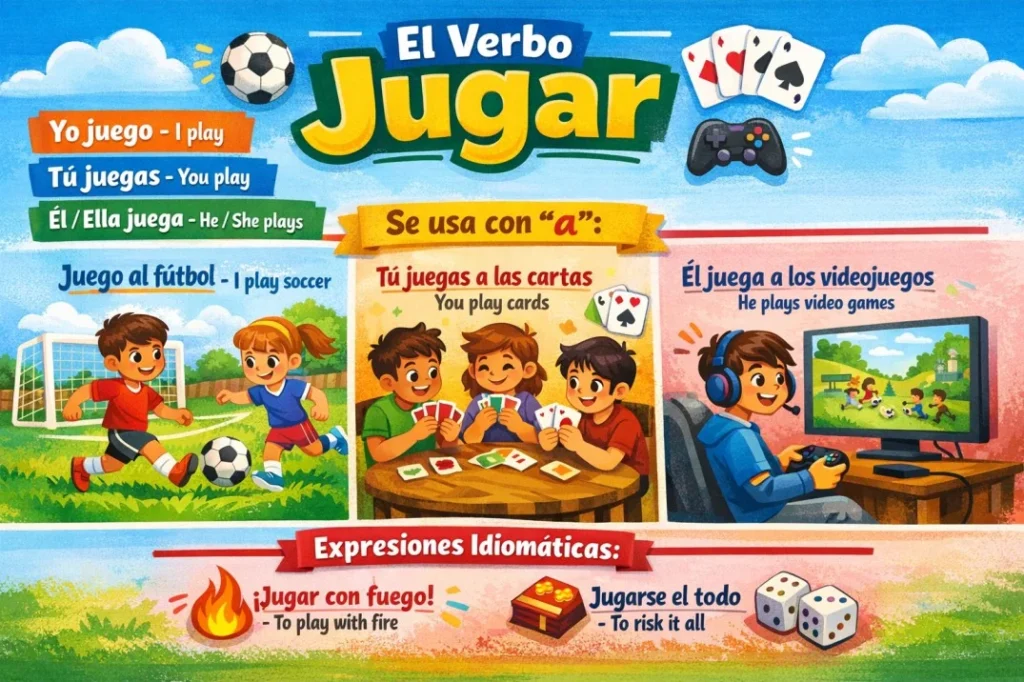
Jugar in Spanish means “to play” in English.
It is a verb commonly used to describe playing games, sports, or engaging in recreational activities. The word can also have figurative meanings depending on context, such as “to mess with” or “to take a risk.”
If you are learning Spanish, one of the first verbs you will encounter is jugar. It is everywhere in conversations about sports, games, childhood activities, and even hobbies. The word is simple, yet versatile, and understanding its full range of meanings will help you communicate more naturally in Spanish.
The literal English meaning of jugar is “to play.” However, like many verbs, its use extends beyond the literal sense. You might hear it in expressions, idioms, and cultural references. For example, a child might say, “Quiero jugar con mis amigos,” meaning “I want to play with my friends,” while a football commentator might exclaim, “Los jugadores juegan muy bien hoy,” meaning “The players are playing very well today.”
Understanding jugar is essential for anyone learning Spanish because it is widely used in everyday conversations, sports contexts, and even casual interactions. In this article, we will explore the literal and figurative meanings of jugar, how to conjugate it, its usage in sentences, comparisons with similar verbs, and cultural context, along with examples and a helpful FAQ section.
Literal Meaning of Jugar
The most basic meaning of jugar is to play, typically in relation to:
- Games
- Sports
- Toys
- Recreational activities
Here are some examples:
- “Los niños juegan en el parque.” – “The children play in the park.”
- “Me gusta jugar al fútbol los fines de semana.” – “I like to play soccer on weekends.”
- “Vamos a jugar un juego de mesa.” – “Let’s play a board game.”
Notice that in Spanish, when talking about playing sports or games, it is common to use the preposition “a” before the name of the game or sport.
Prepositions with Jugar
A key feature of jugar is that it often requires the preposition “a” when referring to a game or sport:
| Spanish | English |
|---|---|
| jugar al fútbol | to play soccer |
| jugar al tenis | to play tennis |
| jugar a las cartas | to play cards |
| jugar al baloncesto | to play basketball |
Rule of thumb: If you are referring to a sport or game, always use “jugar a” followed by the name of the activity.
Conjugation of Jugar
Jugar is an irregular verb, so its conjugation does not always follow regular patterns. The most common forms include:
Present Tense
| Subject | Conjugation | English |
|---|---|---|
| yo | juego | I play |
| tú | juegas | you play (informal) |
| él/ella/usted | juega | he/she/you play (formal) |
| nosotros/nosotras | jugamos | we play |
| vosotros/vosotras | jugáis | you all play (informal, Spain) |
| ellos/ellas/ustedes | juegan | they/you all play |
Notice the stem change from “u” to “ue” in most forms except for nosotros and vosotros.
Preterite Tense
| Subject | Conjugation | English |
|---|---|---|
| yo | jugué | I played |
| tú | jugaste | you played |
| él/ella/usted | jugó | he/she/you played |
| nosotros/nosotras | jugamos | we played |
| vosotros/vosotras | jugasteis | you all played |
| ellos/ellas/ustedes | jugaron | they/you all played |
The preterite tense is used for past actions that are completed, like “Ayer jugué al tenis” – “Yesterday I played tennis.”
Figurative Meanings of Jugar
Besides its literal meaning, jugar can also be used in a figurative sense in Spanish. Some examples include:
- To take a risk or chance
- “Está jugando con su futuro.” – “He is playing with his future.”
- Meaning: He is taking a risk regarding his future.
- To mess with someone or something
- “No juegues con mis emociones.” – “Don’t play with my emotions.”
- Meaning: Don’t toy or interfere with someone’s feelings.
- In expressions or idioms
- “Jugar sucio” – “to play dirty”
- “Jugar limpio” – “to play fair”
- “Jugar a perder” – “to play to lose”
These figurative uses make jugar a versatile verb in both casual and formal speech.
Examples in Everyday Conversations
1: Children Playing
- “Los niños juegan en el patio de la escuela todos los días.”
- Translation: “The children play in the schoolyard every day.”
2: Sports Context
- “Mi equipo juega muy bien este año.”
- Translation: “My team is playing very well this year.”
3: Figurative Use
- “No juegues con eso, es peligroso.”
- Translation: “Don’t mess with that, it’s dangerous.”
4: Idiomatic Expression
- “El político juega sucio para ganar votos.”
- Translation: “The politician plays dirty to gain votes.”
Jugar vs Tocar
Some Spanish learners confuse jugar with tocar. Here’s the difference:
- Jugar – to play a game or sport
- Tocar – to play a musical instrument
| Spanish | English |
|---|---|
| Juan juega al baloncesto | Juan plays basketball |
| María toca el piano | María plays the piano |
Remember, you never use “jugar” for instruments. That is a different verb entirely.
Jugar vs Practicar
Another verb often confused with jugar is practicar (to practice):
- Jugar – used for playing games, sports, or recreational activities
- Practicar – used for practicing skills, sports, or instruments
| Spanish | English |
|---|---|
| Juego al fútbol todos los domingos | I play soccer every Sunday |
| Practico fútbol todos los días | I practice soccer every day |
In other words, jugar is for enjoyment or competition, while practicar emphasizes improvement or training.
Cultural Context
In Spanish-speaking countries, jugar is a cultural staple. Children, teens, and adults alike use jugar to refer to:
- Playing football (soccer), the most popular sport in Latin America
- Board games and card games during family gatherings
- Traditional games like “lotería” in Mexico or “rayuela” in various countries
- Digital or video games in modern contexts
Even adults often say jugar casually when referring to sports leagues, tournaments, or friendly matches. The verb captures a sense of fun, interaction, and leisure that is highly valued in Spanish-speaking cultures.
Examples of Jugar in Regional Contexts
| Country | Example | Meaning |
|---|---|---|
| Mexico | “Los niños juegan a la pelota en la calle.” | Children play ball in the street |
| Spain | “Vamos a jugar a las cartas esta tarde.” | Let’s play cards this afternoon |
| Argentina | “Ellos juegan al fútbol los sábados.” | They play soccer on Saturdays |
| Colombia | “Mi hermana juega videojuegos todos los días.” | My sister plays video games every day |
These examples show how jugar is widely used across different countries, with minor variations in activities.
Tips for Learning Jugar
- Focus on the preposition “a” when talking about games and sports.
- Practice stem-changing forms (juego, juegas, juega) to improve fluency.
- Learn idiomatic expressions like “jugar limpio” or “jugar sucio.”
- Use in both literal and figurative contexts to sound natural.
- Combine with frequency expressions – “todos los días,” “los fines de semana” – to talk about habits.
Common Mistakes with Jugar
- Forgetting the preposition “a” before the game:
Incorrect: “Juego fútbol.”
Correct: “Juego al fútbol.” - Using jugar for instruments instead of tocar:
Incorrect: “Juego la guitarra.”
Correct: “Toco la guitarra.” - Confusing jugar with practicar:
“Juego al tenis” (I play tennis) is different from “Practico tenis” (I practice tennis).
By being aware of these nuances, Spanish learners can use jugar more accurately and confidently.
FAQs
What does jugar mean in Spanish?
Jugar means “to play” and is used for games, sports, or recreational activities.
Do I always need “a” with jugar?
You use “a” when referring to a game or sport. For general play without a specific activity, “a” is not required.
Can jugar be used figuratively?
Yes, it can mean “to mess with,” “to take a risk,” or appear in idiomatic expressions.
Is jugar regular or irregular?
Jugar is irregular. Its stem changes from “u” to “ue” in most present tense forms.
How do I say “I like to play soccer” in Spanish?
Me gusta jugar al fútbol.
Can adults use jugar too?
Yes, jugar is not only for children; it is used in sports, competitions, and casual games among adults.
Is jugar the same as tocar?
No. Jugar is for games or sports; tocar is used for playing instruments.
What is the difference between jugar and practicar?
Jugar is for enjoyment or competition, while practicar emphasizes training or improvement.
Conclusion
Jugar is a fundamental Spanish verb that means to play but carries a wide range of uses and cultural significance. From children playing in the park to adults enjoying sports, board games, or video games, jugar is a verb that captures fun, recreation, and interaction.
Its conjugation can be tricky because it is irregular, and it requires the preposition “a” when talking about sports or games. Beyond the literal meaning, jugar also appears in idiomatic and figurative expressions, making it versatile in daily conversations.
Understanding jugar is essential for anyone learning Spanish. It not only expands your vocabulary but also allows you to participate in conversations about sports, games, leisure, and cultural activities naturally.
By practicing the verb in both literal and figurative contexts, learners can speak more fluently and confidently while connecting with Spanish-speaking cultures in meaningful ways.
Read More Related Articles:
- POG Mean in Gaming: From Epic Wins to Gaming Chat Reactions (2026)
- Someone Texted You “TS”? Here’s What It Means and How to Respond (2026)
- “Eres” Meaning in Spanish: More Than Just “You Are” In 2026

Ivy Madison is a content creator at TextSprout.com, specializing in word definitions, internet slang, acronyms, and text abbreviations. She delivers clear and engaging explanations, helping readers quickly understand modern digital language and trending terms.