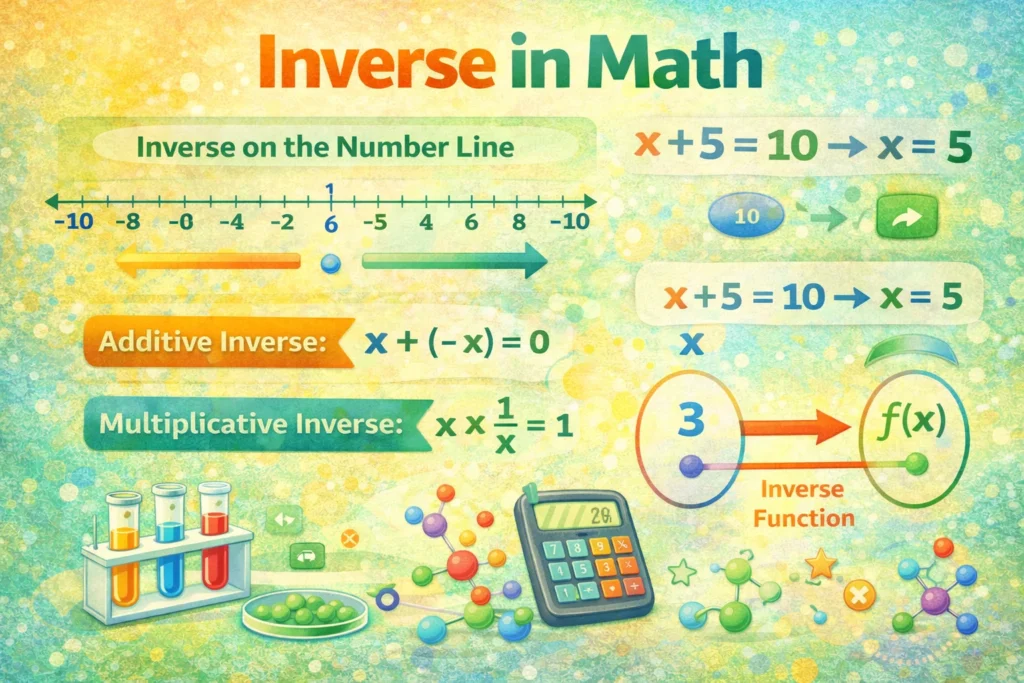
In mathematics, the term inverse refers to a value, function, or operation that reverses the effect of another. For example, the inverse of addition is subtraction, the inverse of multiplication is division, and the inverse of a function
f(x)is a functionf⁻¹(x)that returns the original input.
Have you ever wondered what inverse means in math and why it pops up everywhere—from basic arithmetic to advanced functions? Whether you’re solving simple equations, exploring operations, or working with functions, understanding inverses is essential for clarity and confidence in math.
In 2026, as math education and digital learning evolve, the concept of inverses has become more accessible and widely applied. From additive inverses like -5 being the inverse of 5, to multiplicative inverses like 1/3 being the reciprocal of 3, inverses help us undo operations, solve equations, and analyze functions efficiently.
This article will break down everything you need to know about inverses in math, including clear definitions, real-life examples, comparisons with related terms, and practical applications. By the end, you’ll not only understand what an inverse is but also how to use it confidently in any mathematical scenario.
Understanding the concept of inverses is essential for solving equations, simplifying expressions, and analyzing mathematical relationships. Whether you are a student learning algebra or a professional working with advanced mathematics, grasping inverses opens doors to clearer problem-solving.
The Origin and Popularity of the Term “Inverse” in Math
The word inverse comes from the Latin word inversus, meaning “turned upside down” or “reversed.” Its use in mathematics began to gain traction during the 17th century, alongside the formal development of algebra and calculus.
The concept became popular because it helps in undoing operations, which is a fundamental idea in problem-solving. For example:
- If 7 + x = 15, using the inverse operation subtraction helps us find x.
- In functions, finding an inverse allows us to reverse the input-output relationship, which is crucial in fields like cryptography, engineering, and computer science.
Today, “inverse” is a standard term in math education worldwide, appearing in arithmetic, algebra, trigonometry, and calculus.
Usage of Inverse in Mathematics
Inverse operations and values appear across almost all branches of math. Let’s explore the main types:
1. Inverse Numbers
An inverse number reverses the effect of an operation. There are two main types:
Additive Inverse:
The additive inverse of a number is the number that, when added to the original, results in 0.
| Number | Additive Inverse |
|---|---|
| 5 | -5 |
| -12 | 12 |
| 0.75 | -0.75 |
Multiplicative Inverse (Reciprocal):
The multiplicative inverse of a number is the number that, when multiplied with the original, results in 1.
| Number | Multiplicative Inverse |
|---|---|
| 2 | 1/2 |
| -5 | -1/5 |
| 0.25 | 4 |
Tip: Zero does not have a multiplicative inverse because no number multiplied by zero gives 1.
2. Inverse Functions
Inverse functions undo the effect of another function. If f(x) maps an input x to an output y, then its inverse f⁻¹(y) maps y back to x.
Example:
- Function: f(x) = 3x + 2
- Inverse: f⁻¹(x) = (x – 2)/3
This is particularly useful in algebra, calculus, and real-world applications like coding, finance, or physics.
3. Inverse Operations in Equations
Inverse operations allow you to solve equations by reversing actions applied to the variable.
- Example 1 (Addition/Subtraction):
- x + 7 = 12 → x = 12 – 7 → x = 5
- Example 2 (Multiplication/Division):
- 5x = 20 → x = 20 ÷ 5 → x = 4
- Example 3 (Exponents/Roots):
- x² = 49 → x = √49 → x = 7 or x = -7
These examples show how inverse operations restore the original value of the variable.
Real-World Applications of Inverses
Inverse concepts are not just abstract ideas found in math textbooks. They quietly shape many decisions, calculations, and technologies we rely on every day. At its core, an inverse helps “undo” an action or reverse a relationship. That simple idea makes it incredibly powerful in real world problem solving.
Here are some key areas where inverses play an essential role
1. Finance and Banking
In finance, inverse relationships appear frequently.
When converting currency, you often use inverse rates. If 1 dollar equals 280 rupees, the inverse helps determine how many dollars equal 1 rupee. Without understanding inverses, currency exchange calculations would be far more complicated.
Interest calculations also involve inverse reasoning. If you know the final amount and the interest rate, you may need to reverse the formula to find the original principal. Financial analysts constantly work with inverse operations to trace values backward and make accurate predictions.
2. Engineering and Physics
Engineers regularly apply inverse operations when solving for unknown variables.
For example, if force equals mass multiplied by acceleration, and you know force and mass, you can use inverse operations to solve for acceleration. This reversal process is fundamental in mechanics, electrical systems, and structural design.
Signal processing also relies on inverse transformations. Engineers use inverse functions to reconstruct original signals after they have been modified, compressed, or transmitted.
3. Computer Science and Cybersecurity
Encryption and decryption are classic examples of inverse functions in action.
When data is encrypted, it is transformed into a coded format. To read the information again, an inverse operation is applied to decode it. Without inverse algorithms, secure communication, online banking, and password protection would not be possible.
Sorting algorithms and database queries also use inverse logic to retrieve original values from processed data.
4. Medicine and Healthcare
Inverse proportionality appears in medical calculations.
For instance, if medication dosage depends on body weight, changing one variable affects the other. In some treatments, dosage adjustments follow inverse relationships to maintain balance and safety.
Healthcare professionals also reverse formulas to determine safe concentration levels or infusion rates. Precision matters, and inverse reasoning helps ensure accuracy.
5. Everyday Problem Solving
Even in daily life, you use inverses without realizing it.
If you add 10 to a number and later need to return to the original value, you subtract 10. If you double a recipe and want to go back to the original measurements, you divide by 2. These are simple inverse operations at work.
Inverses allow us to move forward and backward through calculations confidently. They provide flexibility, accuracy, and control in both simple and complex systems.
Inverses help us undo, retrace, and solve problems efficiently in almost every numerical and functional context.
Examples of Inverse with Context
| Context | Operation | Inverse Operation | Example |
|---|---|---|---|
| Friendly | Addition | Subtraction | “I gave you 10 cookies. How many did you have before? Subtract to find out!” |
| Neutral | Multiplication | Division | “If a recipe calls for 4 times the sugar I have, divide to scale down.” |
| Formal | Function | Inverse function | f(x) = 2x + 5 → f⁻¹(x) = (x – 5)/2 |
Comparison with Related Terms
| Term | Meaning | How It Differs from Inverse |
|---|---|---|
| Reciprocal | Multiplicative inverse only | Always about multiplication |
| Opposite | Usually refers to additive inverse | Only relevant for addition |
| Negative | A number less than zero | May or may not be inverse |
| Complement | Usually in sets or angles | Not the same as inverse in operations |
Understanding these distinctions ensures you use the right term in the right context, avoiding confusion in exams or professional work.
Alternate Meanings of “Inverse”
While the term inverse is most commonly associated with mathematics—referring to numbers, operations, or functions that “undo” each other—it also appears in several other fields with slightly different but related meanings. Understanding these alternate uses can deepen your appreciation of the concept and show how versatile it is in everyday language and scientific contexts.
Linguistics
In linguistics, an inverse sentence refers to a structure where the typical subject-verb-object order is flipped. For example, instead of the usual “The dog chased the cat,” an inverse construction might emphasize a different part of the sentence, such as “The cat was chased by the dog.” This reversal highlights a particular element or creates a stylistic effect. In this sense, inverse is about reversing the usual relationship between sentence elements—similar in concept to how mathematical inverses reverse operations.
Statistics
In statistics, an inverse relationship describes a situation where two variables move in opposite directions. For instance, as the number of hours spent studying increases, the number of errors on a test may decrease. This negative correlation is often described as an inverse relationship. Recognizing such patterns is critical in research, data analysis, and decision-making, helping to predict outcomes and understand dependencies between variables.
Physics
In physics, the inverse square law is a foundational principle that explains how certain forces or effects diminish with distance. For example, gravitational force, light intensity, and electric fields all decrease proportionally to the square of the distance from their source. In this context, “inverse” indicates a reversal or reduction relative to distance, showing how the concept extends far beyond numbers into the physical world.
Broader Takeaway
In all these uses—linguistics, statistics, physics—the core idea of “inverse” involves reversal, opposition, or undoing. Recognizing these patterns across disciplines can help learners connect mathematical understanding with real-world applications, making the concept both practical and intuitive.
Professional or polite alternatives in math can include “reciprocal,” “opposite,” or “reverse function” depending on the context.
Tips for Remembering Inverse Concepts
- Think undoing or reversing.
- Additive inverse always sums to 0.
- Multiplicative inverse always multiplies to 1.
- Inverse functions swap input and output.
- Practice with small numbers first before tackling variables or complex equations.
Examples Table for Quick Reference
| Type | Original | Inverse |
|---|---|---|
| Additive | 8 | -8 |
| Multiplicative | 5 | 1/5 |
| Function | f(x) = x + 4 | f⁻¹(x) = x – 4 |
| Equation | 2x = 10 | x = 5 |
FAQs
What does inverse mean in math for kids?
It means a number or operation that can “undo” another, like subtraction undoing addition.
What is the inverse of a number?
The additive inverse sums to zero, and the multiplicative inverse (reciprocal) multiplies to one.
How do you find the inverse of a function?
Swap x and y in the equation, then solve for y.
What is an example of an inverse operation?
For addition, the inverse is subtraction. For multiplication, the inverse is division.
Is the inverse always negative?
Not necessarily. Additive inverses can be negative or positive, and multiplicative inverses can be fractions or negative numbers.
What is the difference between reciprocal and inverse?
Reciprocal specifically means multiplicative inverse, while inverse is broader and includes additive and functional inverses.
Can zero have an inverse?
Zero has an additive inverse (0), but it does not have a multiplicative inverse because no number multiplied by 0 gives 1.
Why is understanding inverse important?
It helps solve equations, undo operations, and analyze functions across many areas of math and real life.
Conclusion
The concept of inverse in mathematics is a cornerstone of problem-solving. It allows us to:
- Reverse operations and undo calculations.
- Solve equations efficiently.
- Understand functions and their behavior.
- Apply mathematics to real-life scenarios, from finance to engineering.
Remember, inverse is all about reversing, undoing, or finding the opposite. Keeping this mental model in mind will make math less intimidating and more intuitive.
Whether it’s addition, multiplication, functions, or equations, mastering inverses simplifies your work and sharpens your problem-solving skills.
Read More Related Articles:
- Transitioning Mean in Hospice: A Gentle Guide for Families In 2026
- “Más” Means in Spanish: Why This One Word Changes Everything In 2026
- PF Meaning in Basketball: More Than Just a Position In 2026

Ivy Madison is a content creator at TextSprout.com, specializing in word definitions, internet slang, acronyms, and text abbreviations. She delivers clear and engaging explanations, helping readers quickly understand modern digital language and trending terms.