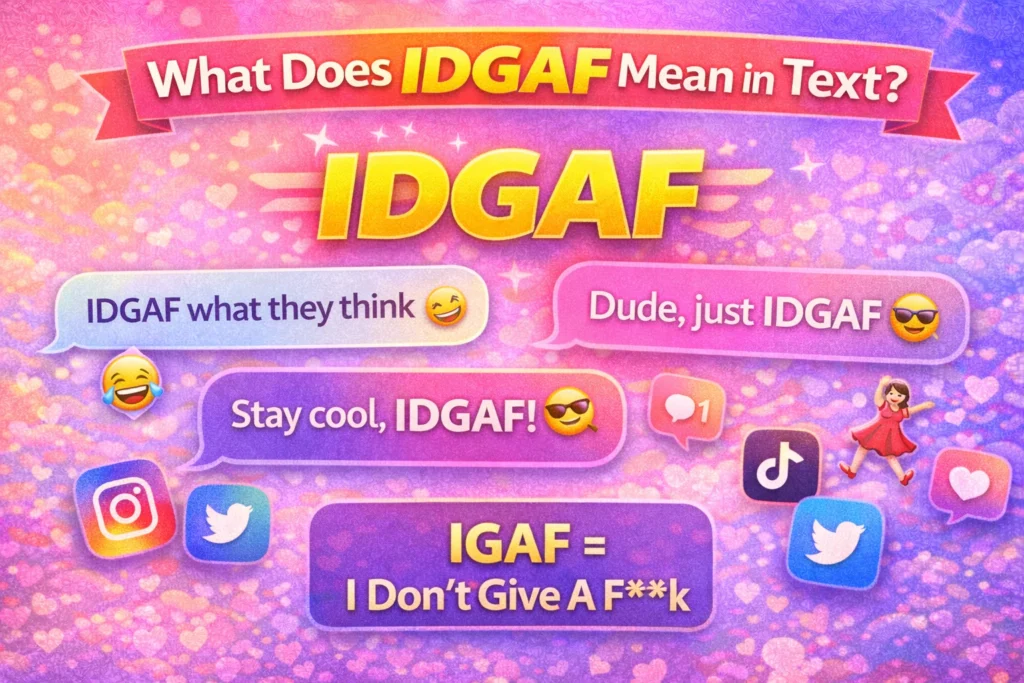
In texting and online conversations, “IDGAF” is an acronym that stands for “I Don’t Give A F*.”** It is used to express strong indifference, disregard, or lack of concern toward a person, situation, or opinion.
For example, if someone says, “Are you worried about the rumor?” and you reply “IDGAF,” it signals that you genuinely do not care about the matter.
If you spend time on social media, group chats, or online forums, you’ve probably come across the abbreviation “IDGAF.” It’s one of those bold internet acronyms that immediately grabs attention. Unlike lighthearted shortcuts such as “brb” or “lol,” this one carries a much stronger tone and emotional weight. That’s why understanding its meaning and context is important before using it yourself.
IDGAF stands for “I Don’t Give A F*.”** It’s a slang expression used to show complete indifference, frustration, or emotional detachment about something. People often use it when they want to emphasize that they truly do not care about a situation, opinion, or outcome. Because it contains profanity, it’s considered informal and can sound aggressive or blunt depending on the tone of the conversation.
The phrase became popular through internet culture, memes, music lyrics, and social media platforms where expressive, unfiltered language spreads quickly. In casual conversations among friends, it might be used jokingly or dramatically.
However, in professional or sensitive settings, using IDGAF can come across as rude or disrespectful. Context always matters. Understanding when and how this abbreviation is used helps you navigate modern digital communication more confidently and responsibly.
Origin and Popularity of “IDGAF”
“IDGAF” originated in online forums, chats, and text messaging in the early 2000s. It became more widely recognized with the rise of social media platforms like Twitter, Facebook, and Instagram, where users often prefer short, expressive abbreviations to convey emotions quickly.
The acronym gained mainstream popularity in music and pop culture as well. Many artists, particularly in hip-hop, rap, and pop genres, use the term in song lyrics to express defiance or a carefree attitude. Its bluntness makes it a favorite among younger generations who want to communicate their feelings without lengthy explanations.
Key Reasons for Its Popularity:
- Brevity: Communicates strong emotion in just four letters.
- Directness: Leaves no room for ambiguity in tone.
- Relatability: Reflects a common feeling of indifference in modern social interactions.
- Cultural Influence: Appears in memes, songs, and viral posts.
Usage of “IDGAF” in Texting and Social Media
“IDGAF” can be used in various contexts depending on tone, relationship, and social setting:
- Casual Conversations:
- Friend asks if you care about a minor drama.
- Response: “IDGAF, let them argue 😅.”
- Social Media Posts:
- “IDGAF about what people think of my style 💁♀️.”
- Expressing Anger or Frustration:
- “IDGAF if you’re mad at me!”
- Humorous or Playful Tone:
- Paired with emojis to lighten the bluntness: “IDGAF 😂😂.”
Important Note: This acronym contains profanity. It is generally inappropriate for professional settings, formal messages, or conversations with people you do not know well.
Examples of “IDGAF” in Context
Friendly Example:
- Friend: “Are you going to the meeting?”
- You: “IDGAF, I have better things to do 😎.”
Neutral Example:
- Online discussion: “Do you care about the latest trend?”
- Reply: “IDGAF, it’s not my thing.”
Dismissive/Negative Example:
- Argument in group chat: “You should be more careful!”
- Response: “IDGAF, it’s my choice.”
Table: Common “IDGAF” Scenarios
| Scenario | Tone | Example Text | Meaning |
|---|---|---|---|
| Ignoring drama | Casual | “IDGAF about the gossip.” | Shows indifference |
| Rejecting advice | Neutral | “IDGAF, I’ll do it my way.” | Declares personal choice |
| Social media post | Playful | “IDGAF if you like it or not 😂” | Expresses carefree attitude |
| Conflict | Dismissive | “IDGAF what you think.” | Signals disregard or annoyance |
Comparison with Related Acronyms and Terms
Several acronyms or phrases are similar to “IDGAF” but vary in intensity or context:
| Term | Difference from IDGAF | Example |
|---|---|---|
| IDC | Shorter, less aggressive | “IDC about the movie” → I don’t care |
| IDK | Means “I don’t know,” not indifference | “IDK what to do” |
| IMO | Opinion-based, neutral | “IMO, that’s a bad idea” |
| ILY | Positive expression, opposite tone | “ILY” → I love you |
| Meh | Informal, mild indifference | “Meh, whatever” |
Tip: Use “IDC” or “meh” for casual indifference, and reserve “IDGAF” for strong disregard or expressive statements.
Alternate Meanings and Contexts
While most commonly used in texting, “IDGAF” can appear in other contexts:
- Music and Pop Culture:
- Lyrics and song titles often use it to convey rebellion or empowerment.
- Merchandise and Memes:
- T-shirts, posters, and memes frequently feature the acronym.
- Professional Warning:
- Avoid using it in workplace chat, emails, or formal communication.
- Other Online Communities:
- Gaming forums, Reddit, and TikTok often use IDGAF to emphasize humor, apathy, or defiance.
Tips for Using “IDGAF” Appropriately
- Know Your Audience: Close friends or social media followers are appropriate; coworkers or elders are not.
- Use Emojis Carefully: Emojis can soften or amplify the tone.
- Avoid Overuse: Frequent use may come across as rude or careless.
- Alternative Expressions: Use “I don’t care,” “Not bothered,” or “Whatever” in polite or professional settings.
- Tone Matters: Written text lacks vocal cues; pairing IDGAF with context or emojis helps convey the intended tone.
Table: Alternative Expressions for IDGAF
| Alternative | Tone | Context | Example |
|---|---|---|---|
| I don’t care | Neutral | Casual and polite | “I don’t care about the results.” |
| Not bothered | Neutral | Polite or formal | “I’m not bothered by the issue.” |
| Whatever | Informal | Casual conversations | “Whatever, do what you want.” |
| IDC | Mild | Casual texting | “IDC about the drama.” |
| Meh | Slight indifference | Humor | “Meh, I’ll skip it.” |
Extended Examples in Text
Casual Conversation:
- Friend: “Do you want to join the meeting?”
- You: “IDGAF, I’ve got other plans 😎.”
Social Media Statement:
- Post: “IDGAF what people think of my outfit today! 💃”
Conflict Response:
- Group chat: “Why didn’t you follow the rules?”
- Reply: “IDGAF, it’s none of your business.”
Humorous Use:
- Comment on a meme: “IDGAF 😂😂😂, this made my day.”
FAQs
1. What does IDGAF mean in text?
It stands for “I Don’t Give A F***” and expresses strong indifference or disregard.
2. Is it rude to use IDGAF?
Yes, it can be perceived as blunt or disrespectful. Use carefully with friends or informal chats.
3. Can IDGAF be used professionally?
No, it is highly inappropriate for work, school, or formal communication.
4. What is the difference between IDGAF and IDC?
IDC is milder, simply meaning “I don’t care,” while IDGAF is stronger and often more emotional.
5. Are there positive alternatives for IDGAF?
Yes, expressions like “I’m okay with it,” “No worries,” or “Whatever works” are polite alternatives.
6. Where is IDGAF commonly used?
Texting, Instagram, TikTok, Twitter, memes, and casual online conversations.
7. Does IDGAF have cultural relevance?
Yes, it’s widely used in pop culture, songs, and social media to convey rebellion or self-confidence.
8. How do you use IDGAF correctly in a sentence?
Include context or emojis to ensure your tone is clear, e.g., “IDGAF about the argument 😅.”
Conclusion
IDGAF is a bold, expressive acronym that conveys strong indifference or disregard. Its popularity in texting, social media, and pop culture stems from its brevity, clarity, and emotional punch.
Key Takeaways:
- Stands for I Don’t Give A F*.**
- Expresses strong indifference or disregard.
- Suitable for informal conversations, texting, and social media.
- Avoid using in professional or formal contexts.
- Alternatives like “IDC” or “meh” can convey similar ideas more politely.
By understanding IDGAF, users can navigate social interactions, online conversations, and pop culture references with confidence while maintaining appropriate tone for different audiences.
Read More Related Articles:
- What Does GG Mean in Text? Discover the Hidden Meaning (2026)
- KK Mean in Texting: Why It Can Sound Passive-Aggressive (2026)
- Code Grey Mean in a Hospital: Hospital Emergency Code Meaning In 2026

Luna Hartley is a content creator at TextSprout.com, where she specializes in explaining word meanings, modern phrases, and everyday language used in texts and online conversations. Her writing focuses on clarity and context, helping readers understand how words are actually used in real communication.