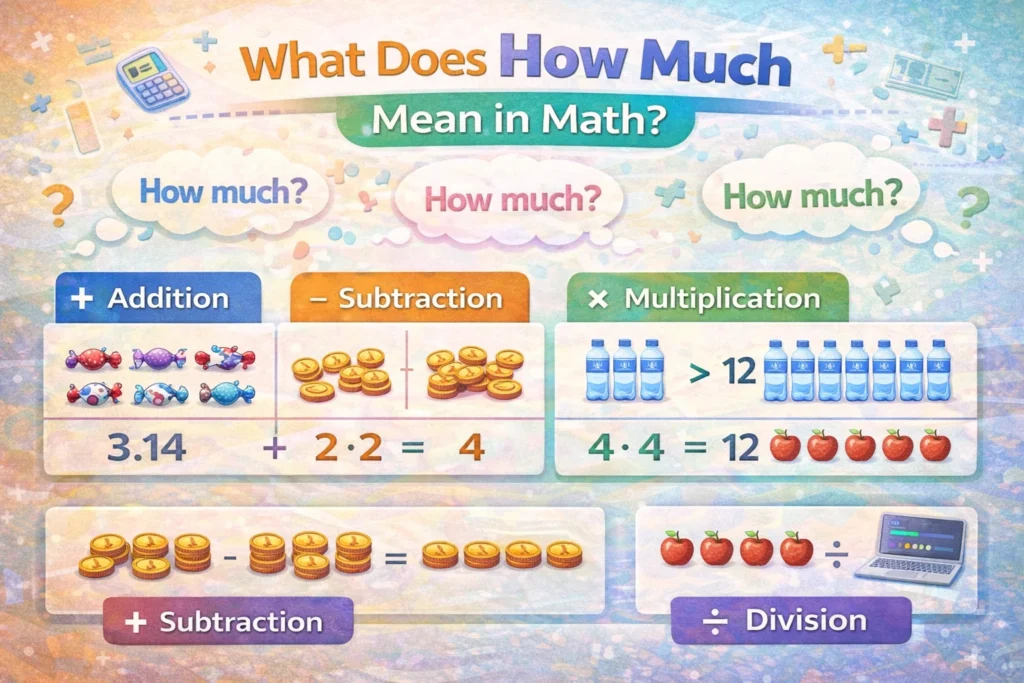
In mathematics, “how much” refers to the quantity, amount, or value of a number, object, or expression. It is a question that seeks a measurable or numerical answer, such as total, difference, or sum.
For example, when someone asks, “How much money do you have?” in math terms, it translates to calculating the exact numerical value or total amount.
Though simple in appearance, this question forms the backbone of countless math problems and real-world calculations. From figuring out how much money to save each week to determining the total number of apples in a basket, understanding how much is essential for both learners and everyday life.
Origin and Popularity of the Phrase “How Much”
The phrase “how much” originates from English usage in the early 15th century, initially applied to describe quantity, value, or degree. Over the years, it has expanded beyond casual conversation into mathematics, education, commerce, and even technical fields like accounting or finance.
In mathematics education, “how much” is extremely popular because it:
- Encourages students to think quantitatively
- Develops problem-solving skills
- Bridges abstract numbers with real-life scenarios
Teachers often use “how much” questions in story problems, which make abstract numbers more concrete. This approach helps learners visualize situations, such as calculating the amount of water in a tank or the total money spent at a store.
Historical Context in Education
Early arithmetic textbooks from the 19th century frequently used phrases like “how much” to ask students to find sums, differences, or other quantities. This approach made math accessible and practical. Over time, “how much” became the go-to question format in both elementary and middle school curricula, particularly in problems designed to mimic real-life situations.
Usage of “How Much” in Mathematics
In math, “how much” is a versatile question that can appear in multiple contexts:
- Addition – Calculating the total or sum:
Example: How much is 45 + 32? → 77 - Subtraction – Determining the difference between quantities:
Example: You had 70 pencils and gave 25 away. How much do you have left? → 45 - Multiplication – Finding repeated quantities:
Example: A packet contains 12 candies. How much candy in 7 packets? → 84 - Division – Dividing amounts into equal parts:
Example: 48 candies shared among 8 children. How much does each child get? → 6 - Comparison – Measuring differences between two or more amounts:
Example: Alex has $150, and Jamie has $90. How much more money does Alex have? → $60 - Measurement – Determining lengths, weights, volumes, or other continuous quantities:
Example: A tank holds 250 liters of water. After using 75 liters, how much remains? → 175 liters
Extended Real-Life Applications
Budgeting and Finance:
- How much money will you save if you spend $15 less per day?
- How much interest will you earn on a savings account in a year?
Cooking and Recipes:
- How much flour is needed to make three cakes if one cake requires 250 grams?
- How much water should you boil if each cup needs 200 ml?
Shopping and Discounts:
- A dress costs $80, and the discount is $15. How much do you pay? → 65 dollars
Travel and Fuel:
- Your car uses 8 liters per 100 km. How much fuel is required for 250 km? → 20 liters
Education and Homework:
- How much time will it take to read 120 pages if you read 20 pages per day? → 6 days
These examples show how “how much” questions are everywhere, making it a fundamental part of daily math reasoning.
Detailed Examples of “How Much” in Math
To make the concept practical, let’s examine scenarios in various tones:
Friendly Example:
You have 5 chocolate bars 🍫. Your friend gives you 3 more.
Question: How much chocolate do you have now?
Answer: 5 + 3 = 8 chocolate bars
Neutral Example:
A bookstore sold 120 books on Monday and 80 books on Tuesday.
Question: How much in total were sold in these two days?
Answer: 120 + 80 = 200 books
Dismissive/Negative Example:
You received $50, but the bill was $75 😕.
Question: How much are you short?
Answer: 75 – 50 = $25
Table: Common Math Scenarios Using “How Much”
| Scenario | Operation | Question | Answer |
|---|---|---|---|
| Apples in baskets | Addition | Basket 1: 12, Basket 2: 8 → How much in total? | 20 apples |
| Money spent vs. saved | Subtraction | Spent $40 from $100 → How much left? | $60 |
| Candy distribution | Division | 36 candies shared among 6 kids → How much each? | 6 candies |
| Multiplying packs | Multiplication | 7 packs of pencils, 5 pencils each → How much total? | 35 pencils |
How “How Much” Compares with Related Terms
Several similar terms in mathematics may be confused with “how much”. Understanding the differences improves accuracy:
| Term | Difference from “How Much” | Example |
|---|---|---|
| How many | Refers specifically to countable items | How many apples? → 5 apples |
| What is | General query for value, number, or expression | What is 5 + 7? → 12 |
| Amount | Typically used in finance, measurement, or totals | Amount of sugar → 250 grams |
| Quantity | Broader, often scientific | Quantity of water → 3 liters |
| Total | Formal way to ask sum | Total of 45 + 32 → 77 |
Tip: Use “how many” for discrete objects and “how much” for uncountable quantities or general sums.
Alternate Meanings and Contexts
Beyond strict mathematics, “how much” can carry other nuances:
- Informal Estimation:
- “How much is this dress?” asks for price rather than computation.
- Emotional or Qualitative Measure:
- “Do you know how much I love math?” expresses feeling rather than numbers.
- Professional or Formal Alternatives:
- Total, sum, value, or quantity can replace “how much” in official documents, reports, or academic writing.
- Scientific Measurement:
- Often replaced by precise units (grams, liters, meters) in scientific experiments.
Teaching or Using “How Much” Effectively
Tips for Teachers and Learners:
- Visual Aids: Use counters, coins, and objects to illustrate quantities.
- Story Problems: Link questions to real-life scenarios.
- Unit Clarity: Always specify what you’re measuring (dollars, liters, items).
- Practice Across Operations: Addition, subtraction, multiplication, and division.
- Interactive Tools: Digital math games or apps can reinforce “how much” concepts.
- Step-by-Step Problem Solving: Encourage students to write out each step.
Table: “How Much” Across Different Math Operations
| Operation | Example Question | Step-by-Step Solution | Answer |
|---|---|---|---|
| Addition | How much is 23 + 17? | 23 + 17 = 40 | 40 |
| Subtraction | How much is 50 – 18? | 50 – 18 = 32 | 32 |
| Multiplication | 12 candies × 4 packets → How much candy? | 12 × 4 = 48 | 48 |
| Division | 60 ÷ 5 → How much per group? | 60 ÷ 5 = 12 | 12 |
| Comparison | John $150, Mary $90 → How much more? | 150 – 90 = 60 | 60 |
Examples with Real-World Context
Budgeting:
- You earn $1,200 monthly and spend $750.
Question: How much do you save?
Answer: 1,200 – 750 = 450
Shopping Discounts:
- Item costs $200 with a $30 discount.
Question: How much do you pay?
Answer: 200 – 30 = 170
Cooking Measurements:
- Recipe calls for 400 ml water, you only have 250 ml.
Question: How much more water is needed?
Answer: 400 – 250 = 150 ml
Travel:
- Car travels 120 km using 10 liters fuel.
Question: How much fuel per km?
Answer: 10 ÷ 120 ≈ 0.083 liters/km
FAQs
1. What does “how much” mean in math?
It asks for the total, difference, or value of numbers or quantities.
2. How is it different from “how many”?
“How many” is used for countable items, while “how much” refers to uncountable amounts or sums.
3. Can “how much” be used in algebra?
Yes, it can ask for the value of variables, expressions, or equations.
4. Is it informal or formal language?
It is informal and widely used in classrooms, but “total,” “sum,” or “amount” can sound more formal.
5. Does it only apply to numbers?
Primarily yes, but it can be metaphorically used to describe value or quantity in general contexts.
6. Are there common mistakes with “how much”?
Yes, confusing it with “how many” or forgetting units (like dollars or liters) is common.
7. How do teachers introduce it to children?
Through story problems, visual counters, and interactive examples.
8. Can calculators answer “how much” questions?
Yes, calculators compute totals, differences, or other quantities asked in “how much” problems.
Conclusion
In mathematics, “how much” is more than a simple question. It’s a versatile concept that links numerical reasoning with real-world problem-solving. Whether calculating total savings, sharing candies, or measuring ingredients, understanding how much helps learners navigate practical and academic situations.
- Indicates quantity, value, or total.
- Can involve addition, subtraction, multiplication, division, or comparisons.
- Often appears in story problems for relatable math applications.
- Different from “how many,” “amount,” or “total,” but context matters.
- Practicing with visual aids and real-life examples enhances understanding.
By mastering “how much,” students, professionals, and everyday learners can approach daily calculations and math problems with confidence and clarity.
Read More Related Articles:
- What Is Inference? Unlocks Deeper Understanding In 2026
- NFS Slang Meaning: How to Use It Correctly Online (2026)
- SG in Text: The Meaning Changes More Than You Think (2026)

Neon Samuel is a digital content creator at TextSprout.com, dedicated to decoding modern words, slang, and expressions. His writing helps readers quickly grasp meanings and understand how terms are used in real conversations across text and social platforms.