
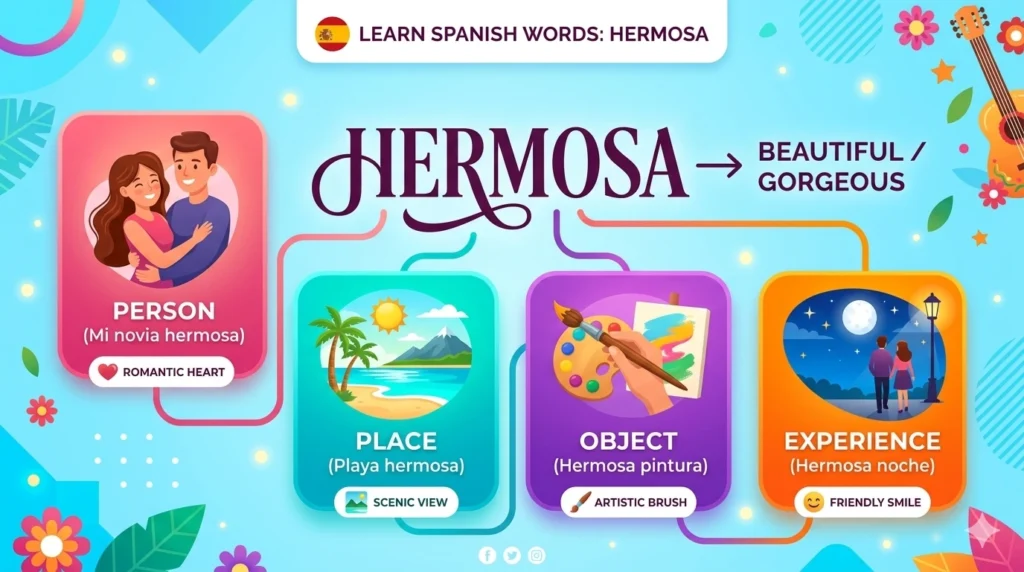
In English, hermosa translates to “beautiful” or “gorgeous.”
It is commonly used to describe people, places, or things with physical, emotional, or aesthetic beauty.
If you’ve ever watched a Spanish-language movie, listened to a Latin song, or spoken to someone from a Spanish-speaking country, you may have come across the word hermosa. But what does hermosa mean in English? This word is more than just a direct translation—it carries cultural nuance, tone, and context that make it a beautiful addition to your vocabulary.
Whether you’re learning Spanish, trying to understand song lyrics, or chatting with Spanish-speaking friends, knowing the meaning of hermosa and how to use it properly will make your communication richer and more culturally aware.
Origin of the Word Hermosa
The word hermosa comes from the Spanish adjective hermoso, which means “beautiful.” It originates from the Latin word formosus, meaning “well-formed” or “handsome.”
- Gender Note: In Spanish, adjectives have gender. Hermoso is used for masculine nouns, and hermosa is the feminine form.
- Popularity: Hermosa is widely used in Spanish-speaking countries, from Mexico to Spain, in daily conversation, literature, music, and media.
- Cultural Usage: Unlike the English word “beautiful,” hermosa can carry deeper emotional resonance, often expressing admiration or affection.
In short, it’s not just a descriptive word—it’s a compliment, a cultural expression, and sometimes even a term of endearment.
Usage of Hermosa in English
Hermosa is versatile. Its meaning depends on context, tone, and the subject it describes. Here are the primary ways hermosa is used:
1. To Describe a Person
Most commonly, hermosa describes someone who is physically attractive or beautiful.
Examples:
- Ella es hermosa. → She is beautiful.
- Mi hermana es muy hermosa. → My sister is very beautiful.
Table: Person Description Examples
| Spanish Phrase | English Translation | Context |
|---|---|---|
| Tú eres hermosa | You are beautiful | Compliment to a female |
| La mujer hermosa | The beautiful woman | Descriptive, neutral |
| Mi novia hermosa | My beautiful girlfriend | Romantic, affectionate |
| Hermosa sonrisa | Beautiful smile | Specific feature |
Using hermosa for people can express admiration or romantic interest, depending on tone.
2. To Describe Places or Things
Hermosa can also describe locations, objects, or experiences that are aesthetically pleasing or emotionally moving.
Examples:
- La playa es hermosa. → The beach is beautiful.
- Qué pintura hermosa. → What a beautiful painting.
- Esta canción es hermosa. → This song is gorgeous.
Table: Places and Objects Examples
| Spanish Phrase | English Translation | Context |
|---|---|---|
| Vista hermosa | Beautiful view | Nature, travel |
| Ciudad hermosa | Gorgeous city | Urban description |
| Hermosa obra de arte | Beautiful work of art | Art, museum, gallery |
| Hermosa experiencia | Wonderful experience | Emotional or memorable moment |
This shows that hermosa is not limited to people—it can convey admiration for beauty in many forms.
3. Tone and Emotional Usage
The tone in which hermosa is said can affect its meaning:
- Friendly/Neutral: Describing a pleasant scene or object.
- Example: “Qué lugar tan hermoso.” → “What a beautiful place.”
- Romantic/Affectionate: Complimenting someone emotionally or physically.
- Example: “Eres tan hermosa.” → “You are so beautiful.”
- Poetic/Admiring: In literature, music, or poetry, hermosa elevates the beauty of the subject.
Adding intonation or emphasis can subtly change the nuance of hermosa, making it playful, serious, or romantic.
4. Informal and Slang Usage
Sometimes, hermosa is used casually, even humorously, among friends:
- “Hermosa, ¿qué haces aquí?” → “Hey beautiful, what are you doing here?” 😄
- Can be playful or sarcastic depending on context, tone, and relationship.
Cultural awareness matters: what is flattering in one country may feel overfamiliar in another.
Comparison with Related Spanish Terms
Spanish has several words that express beauty, but each has subtle differences:
| Spanish Word | English Translation | Nuance/Difference |
|---|---|---|
| Hermosa | Beautiful, gorgeous | Classic, feminine, formal or affectionate |
| Bonita | Pretty | Lighter, casual, can describe smaller things |
| Bella | Beautiful | Literary, poetic, often more formal |
| Linda | Lovely, cute | Informal, affectionate, friendly |
| Guapa | Attractive | Common in Spain, more about physical looks |
Tip: Use hermosa when you want to convey admiration with elegance and warmth, while bonita or linda can feel lighter or more casual.
Alternate Meanings and Nuances
While hermosa primarily means beautiful, context can give it different shades of meaning:
- Emotionally Beautiful: A heartwarming scene or touching moment.
- Example: “Fue una noche hermosa.” → “It was a beautiful night.”
- Figurative Use: Complimenting skills, character, or personality.
- Example: “Tienes una forma de pensar hermosa.” → “You have a beautiful way of thinking.”
- Cultural Reference: Used in songs, poems, or literature to evoke elegance, grace, or aesthetic pleasure.
Tip: Understanding cultural context helps you avoid over-literal translations. In English, “beautiful” may cover many of these nuances, but Spanish often carries more emotional weight.
Real-World Examples of Hermosa in Media
1. Music
Many Latin songs use hermosa to describe someone or something that inspires admiration or love.
- “Eres hermosa” by Rocío Dúrcal → “You are beautiful”
- Commonly appears in lyrics as a romantic compliment, expressing both physical beauty and emotional depth.
2. Literature
In Spanish literature, hermosa elevates descriptions:
- “La ciudad hermosa bajo la luz del amanecer” → “The beautiful city under the morning light.”
3. Travel and Tourism
Travel guides often use hermosa to describe locations:
- Playa Hermosa → “Beautiful Beach”
- Hermosa Vista → “Gorgeous View”
The word adds emotional resonance to ordinary descriptions, making experiences feel richer and more immersive.
Polite or Professional Alternatives in English
If translating hermosa in writing, sometimes using alternatives can convey the right tone:
- Beautiful → Classic and neutral.
- Gorgeous → More romantic or visually striking.
- Lovely → Friendly or affectionate.
- Elegant → Professional or formal contexts.
- Stunning → Emphasizes strong visual impact.
For example:
| Spanish Phrase | English Translation | Notes |
|---|---|---|
| Ella es hermosa | She is beautiful | Neutral, safe in professional contexts |
| Vista hermosa | Gorgeous view | Descriptive, often used in travel |
| Hermosa sonrisa | Lovely smile | Warm, affectionate, friendly tone |
| Hermosa experiencia | Stunning experience | Used in writing, reviews, or storytelling |
Tips for Using Hermosa Correctly
- Match the gender: Hermosa for feminine nouns, hermoso for masculine nouns.
- Know the context: People, places, objects, or emotional experiences.
- Adjust tone: Romantic, friendly, poetic, or casual.
- Cultural sensitivity: Be aware of familiarity; compliments may be perceived differently in different regions.
- Use it in writing carefully: Literary works, travel blogs, and personal letters often employ hermosa for impact.
Examples in Different Contexts
Table: Hermosa in Context
| Context | Spanish Phrase | English Translation | Tone/Use |
|---|---|---|---|
| Romantic | Mi novia hermosa | My beautiful girlfriend | Romantic |
| Casual compliment | Qué hermosa camisa | What a beautiful shirt | Friendly/Neutral |
| Travel/Scenery | Playa hermosa | Beautiful beach | Descriptive |
| Art | Qué pintura hermosa | What a gorgeous painting | Artistic/Admiring |
| Emotional experience | Fue una noche hermosa | It was a beautiful night | Poetic/Emotional |
| Personality/Character | Tienes una forma de pensar hermosa | You have a beautiful way of thinking | Figurative/Admiring |
FAQs
1. What does hermosa mean in English?
It means “beautiful” or “gorgeous,” often used to describe people, places, or things.
2. Is hermosa used for men or women?
Hermosa is feminine; for masculine nouns, use hermoso.
3. Can hermosa describe things other than people?
Yes, it can describe places, objects, experiences, art, or even personality traits.
4. Is hermosa formal or informal?
It can be both. It’s elegant and works in formal writing, but can also be used casually as a compliment.
5. How is hermosa different from bonita?
Bonita is lighter and more casual, often used for smaller things or as a friendly compliment. Hermosa feels more impactful and expressive.
6. Can hermosa be used romantically?
Yes, when addressing someone you admire or love, it conveys both beauty and affection.
7. Are there other ways to translate hermosa in English?
Yes: beautiful, gorgeous, lovely, elegant, stunning. Context determines the best choice.
8. Does hermosa have slang meanings?
Occasionally, in informal speech, it can be playful, humorous, or teasing depending on tone and relationship.
Conclusion
Hermosa is more than just a word—it’s a cultural expression of beauty, admiration, and affection. From describing a loved one to praising a sunset or a work of art, hermosa carries emotional weight that makes it versatile and powerful.
Key Takeaways:
- Hermosa = beautiful/gorgeous in English, feminine form.
- Use hermosa for people, places, things, experiences, or character traits.
- Adjust tone for romantic, casual, poetic, or friendly contexts.
- Alternative English words include beautiful, lovely, gorgeous, elegant, and stunning.
- Cultural and gender awareness is important when using the word in conversation.
By understanding hermosa, you not only expand your Spanish vocabulary but also gain insight into the subtle ways Spanish conveys admiration and emotional nuance.
Read More Related Articles:
- Open Interest Mean in Options: How It Impacts Options Trading In 2026
- What Does Evergreen Mean in Business: Long-Term Growth Explained In 2026
- GPT Meaning in Chat GPT: What the Letters Actually Stand In 2026

Ivy Madison is a content creator at TextSprout.com, specializing in word definitions, internet slang, acronyms, and text abbreviations. She delivers clear and engaging explanations, helping readers quickly understand modern digital language and trending terms.