
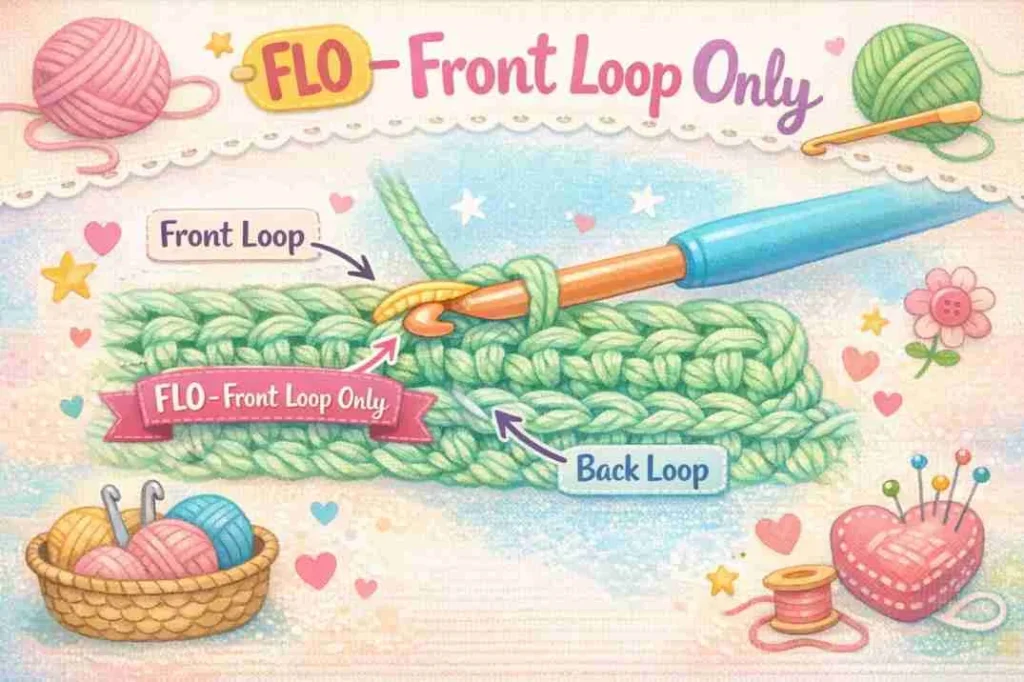
FLO in crochet stands for “Front Loop Only.”
It means you should insert your hook into only the front loop of the stitch, instead of going through both loops as you normally would.
In simple terms, FLO changes where you place your hook, which creates a different texture and appearance in your crochet work.
Crochet patterns are filled with abbreviations that can feel confusing at first, especially if you are just starting out. One of the most common terms you will come across is FLO, and if you do not understand it, your project might not turn out the way the pattern designer intended.
You might see instructions like “sc in FLO across” or “work in FLO only for this row”. These small phrases can make a big difference in how your finished piece looks and feels.
The good news is that FLO is actually a simple concept once you understand how crochet stitches are structured. Learning how to use it properly can open up new textures, patterns, and creative possibilities in your crochet projects.
Understanding Crochet Stitch Structure
To fully understand FLO, you first need to know what a crochet stitch looks like. When you crochet, each stitch forms a small loop at the top that looks like a tiny “V”.
This “V” is made up of two parts:
- The front loop, which is the loop closest to you
- The back loop, which is the loop farther away from you
Normally, when you insert your hook, you go under both loops. This creates a solid and uniform fabric.
When a pattern tells you to work in FLO, you only insert your hook into the front loop, leaving the back loop untouched.
Visual Breakdown of FLO
| Stitch Part | Description | Position |
|---|---|---|
| Front Loop | The loop facing you | Closest to your hook |
| Back Loop | The loop behind | Farthest from your hook |
| Both Loops | Standard insertion point | Creates a thicker fabric |
By using only the front loop, you change the structure of the stitch, which affects how the fabric looks and behaves.
Why Patterns Use FLO
Crochet designers use FLO for a variety of creative and practical reasons. It is not just a random instruction. It is a technique that adds detail and function to your project.
1. Creating Texture
Working in FLO creates a ribbed or layered texture. The unused back loop forms a visible line across your fabric, giving it a decorative look.
2. Adding Flexibility
FLO stitches are often more flexible than standard stitches. This makes them useful for items like:
- Hats
- Socks
- Sweaters
- Cuffs and edges
3. Making Defined Lines
FLO can create clean, horizontal lines that make your project look more structured and professional.
4. Preparing for Later Rows
Sometimes patterns leave the back loop free so it can be used later. This is common in more advanced crochet designs where additional layers or stitches are added afterward.
How to Crochet in FLO Step by Step
Learning FLO is easy once you understand the basics. Here is a simple step-by-step guide.
- Look at the top of your stitch and identify the two loops
- Find the front loop, which is closest to you
- Insert your hook under only that front loop
- Yarn over and pull through as usual
- Complete the stitch as instructed
That’s it. The only difference from normal crocheting is where you insert your hook.
Example of FLO in a Pattern
Here is how FLO might appear in a crochet pattern.
| Pattern Instruction | Meaning |
|---|---|
| sc in FLO across | Single crochet in the front loop only for each stitch |
| dc in FLO | Double crochet using only the front loop |
| work in FLO for 5 rows | Use front loop only technique for five rows |
These small instructions can significantly change the final look of your project.
FLO vs BLO in Crochet
Another common term you will see is BLO, which stands for back loop only. It is important not to confuse the two.
| Term | Meaning | Effect |
|---|---|---|
| FLO | Front Loop Only | Creates ridges and visible lines |
| BLO | Back Loop Only | Creates a ribbed, stretchy texture |
| Both Loops | Standard method | Produces a dense, uniform fabric |
Both FLO and BLO are used to create texture, but they produce slightly different visual effects.
When to Use FLO in Crochet Projects
FLO is used in many different types of crochet items. It is especially useful when you want to add detail or change the structure of your fabric.
Common Uses
- Decorative edges on blankets
- Lightweight and flexible garments
- Textured scarves and shawls
- Amigurumi shaping techniques
- Layered crochet designs
For example, using FLO in a blanket can create subtle ridges that add visual interest without making the fabric too thick.
Real World Example
Imagine you are crocheting a simple scarf.
If you use standard stitches, the scarf will look flat and smooth.
If you switch to FLO for a few rows, you will notice raised lines forming across the fabric. These lines add depth and texture, making the scarf look more detailed and stylish without adding complexity.
Advantages of Using FLO
FLO is popular because it offers several benefits.
Enhanced Texture
It creates beautiful ridges and patterns that make projects stand out.
Lightweight Fabric
Since you are only working through one loop, the fabric is slightly lighter and less dense.
Design Flexibility
It allows you to create layered or multi-dimensional designs.
Easy to Learn
Even beginners can quickly understand and use FLO.
Disadvantages of Using FLO
While FLO is useful, it also has a few limitations.
Less Durable
Working in one loop instead of two can make the fabric slightly weaker.
Gaps in Fabric
FLO stitches can create small gaps, which may not be suitable for projects that need to be tightly woven.
Not Always Suitable
Some projects, like sturdy bags or heavy blankets, may require stronger stitches using both loops.
Tips for Beginners Using FLO
If you are new to crochet, here are some helpful tips.
- Always identify the front loop carefully before inserting your hook
- Practice on a small swatch before starting a full project
- Keep your tension consistent to avoid uneven stitches
- Follow pattern instructions closely
- Do not rush, especially when learning new techniques
With a little practice, working in FLO will feel just as natural as regular crocheting.
Common Mistakes to Avoid
Beginners sometimes struggle with FLO, but most mistakes are easy to fix.
Confusing Front Loop with Back Loop
Take your time to identify the correct loop before inserting your hook.
Pulling Too Tight
Tight stitches can make it harder to see the loops and work into them.
Skipping Loops
Make sure you do not accidentally skip stitches when working in FLO.
Advanced Uses of FLO
Once you are comfortable with the basics, you can explore more advanced techniques.
Layered Crochet
Leaving the back loop free allows you to add another layer of stitches later.
Decorative Stitch Patterns
FLO is often used in textured patterns like waves, ridges, and geometric designs.
Amigurumi Details
In toy making, FLO can help create shaping, folds, or decorative edges.
FAQs
What does FLO mean in crochet?
FLO means front loop only. It tells you to insert your hook into just the front loop of a stitch instead of both loops.
Is FLO easy for beginners?
Yes, it is one of the easiest techniques to learn and is often used in beginner patterns.
What is the difference between FLO and BLO?
FLO uses the front loop, while BLO uses the back loop. Each creates a different texture.
Does FLO make crochet looser?
Yes, slightly. It creates a more flexible and less dense fabric compared to working in both loops.
Can I use FLO in any pattern?
Only if the pattern allows it. Changing to FLO can alter the final look and structure.
Why does my FLO look uneven?
This is usually due to inconsistent tension or difficulty identifying the correct loop.
Is FLO used in amigurumi?
Yes, it is often used for shaping and adding design details.
Do I always follow FLO instructions exactly?
Yes, especially in patterns where texture and structure matter.
Conclusion
FLO, or front loop only, is a simple yet powerful crochet technique that can transform your projects. By inserting your hook into just one loop instead of both, you create unique textures, flexible fabrics, and decorative details that elevate your work.
Whether you are making a scarf, blanket, garment, or toy, understanding FLO gives you more control over your design and helps you follow patterns accurately. It is beginner-friendly, easy to learn, and incredibly versatile once you start experimenting with it.
With practice, FLO will become a natural part of your crochet skills, allowing you to create more detailed and visually appealing projects with confidence.
Read More Related Articles:
- What Does BLE Mean in Medical Terms: Clinical Context In 2026
- RDW-CV Mean in a Blood Test: Explanation and Clinical Insights In 2026
- What Does the I Mean in LGBTQIA: A Complete Guide In 2026

Ivy Madison is a content creator at TextSprout.com, specializing in word definitions, internet slang, acronyms, and text abbreviations. She delivers clear and engaging explanations, helping readers quickly understand modern digital language and trending terms.