
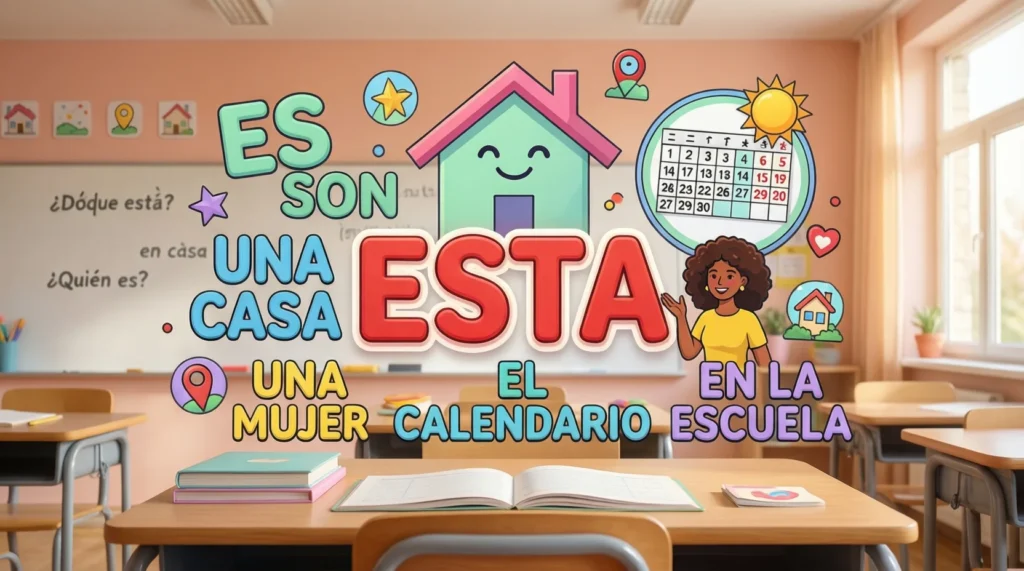
“Esta” is a Spanish word meaning “this” (feminine singular) or “is” when used as a form of the verb estar. Its meaning depends entirely on context, grammar, and sentence structure.
Spanish learners often pause when they see the word “esta” because it seems simple yet behaves in multiple ways. One moment it points to something nearby, and the next moment it acts as a verb describing a temporary state. Understanding esta is a major step toward sounding natural and confident in Spanish conversations.
This guide explains what “esta” means in Spanish, how it is used in real life, where it comes from, and how to avoid common mistakes. You will also see clear examples, tone explanations, comparison tables, FAQs, and professional alternatives so you can use esta correctly in everyday Spanish.
What Does “Esta” Mean in Spanish?
The word “esta” has two main grammatical roles in Spanish:
- A demonstrative adjective or pronoun meaning this (feminine singular)
- A conjugated verb form of estar meaning is or are depending on context
Because Spanish relies heavily on gender, agreement, and verb tense, esta changes meaning based on how it appears in a sentence.
Quick Overview of “Esta” Meanings
| Form | Type | Meaning | Example |
|---|---|---|---|
| esta casa | Demonstrative adjective | this | Esta casa es bonita. |
| esta bien | Verb (estar) | is | Ella esta bien. |
| esta noche | Time expression | this | Esta noche salimos. |
Origin and Linguistic Background of “Esta”
The word “esta” traces back to Latin, the foundation of modern Spanish.
Its roots come from:
- Latin “iste” meaning this (demonstrative origin)
- Latin “stare” meaning to stand or remain (verb estar)
Over centuries, Spanish evolved into a language where word endings reflect gender and tense, which explains why esta changes meaning depending on structure.
Popularity and Real-World Usage
“Esta” is one of the most frequently used words in Spanish, appearing in:
- Daily conversation
- News articles
- Social media captions
- Text messages
- Professional communication
Native speakers use esta effortlessly, while learners often confuse it with está, este, or es. Once you understand the patterns, recognition becomes automatic.
Meaning 1: “Esta” as “This” (Feminine Singular)
When used as a demonstrative adjective, esta means “this” and describes a feminine noun that is close to the speaker.
Key Rules
- Used only with feminine singular nouns
- Refers to something nearby or current
- Must agree with the noun
Examples
- Esta silla es cómoda.
This chair is comfortable. - Me gusta esta canción. 🎵
I like this song. - Esta idea es interesante.
This idea is interesting.
Tone and Context
This usage is neutral and natural, suitable for casual speech, academic writing, and professional settings.
Common Feminine Nouns Used with “Esta”
| Noun | Translation | Example |
|---|---|---|
| casa | house | Esta casa es nueva. |
| mesa | table | Esta mesa es grande. |
| noche | night | Esta noche llueve. |
| persona | person | Esta persona ayuda mucho. |
Meaning 2: “Esta” as a Form of the Verb “Estar”
“Esta” can also be a verb, specifically the third-person singular present tense of estar.
When “Esta” Means “Is”
- Used for temporary states
- Used for locations
- Used for conditions or feelings
Examples with Context
- Ella esta cansada. 😴
She is tired. (temporary state) - El cafe esta caliente. ☕
The coffee is hot. - Madrid esta en España.
Madrid is in Spain.
Tone Explanation
This form is neutral and descriptive, not emotional or dramatic unless emphasized with punctuation or emojis in informal settings.
Comparison: “Esta” vs Similar Spanish Words
Many learners mix up esta with related terms. This table clears up the confusion.
| Word | Meaning | Usage |
|---|---|---|
| esta | this (feminine) / is | Esta casa esta limpia. |
| este | this (masculine) | Este libro es bueno. |
| esa | that (feminine) | Esa calle es larga. |
| es | is (ser) | Ella es doctora. |
| está | is (with accent) | Incorrect spelling of esta |
Accent Confusion: “Esta” vs “Está”
Although they sound identical, accent marks matter in Spanish.
| Word | Type | Meaning |
|---|---|---|
| esta | adjective or verb | this / is |
| está | verb only | is (emphasized form) |
Important Note:
In modern Spanish writing, está with an accent is standard when used as a verb, while esta without an accent often appears as a demonstrative.
Alternate or Contextual Meanings
In some informal settings, esta may appear as part of:
- Idiomatic expressions
- Regional speech patterns
- Casual shortened phrases
These meanings still relate back to either demonstration or state, not slang or abbreviations.
Polite and Professional Alternatives
Depending on tone or formality, you might replace esta with:
| Alternative | Use Case |
|---|---|
| esta presente | professional status |
| se encuentra | formal location |
| dicha | formal writing |
| la actual | official tone |
Example:
Esta empresa crece rápido.
La empresa actual crece rápido.
Labeled Example Table: Sentence Breakdown
| Sentence | Role of “Esta” | Meaning |
|---|---|---|
| Esta camisa es azul. | Adjective | This |
| La comida esta lista. | Verb | Is |
| Esta semana trabajo mucho. | Time marker | This |
Tone Variations with “Esta”
Although the word itself is neutral, tone changes through context.
Friendly
- Esta pizza esta increíble! 🍕
Neutral
- Esta opción funciona bien.
Dismissive
- Esta idea no sirve.
Tone is shaped by adjectives, punctuation, and delivery, not by the word alone.
FAQs
What does “esta” mean in Spanish grammar?
It means either “this” (feminine singular) or “is” as a form of the verb estar.
Is “esta” masculine or feminine?
As a demonstrative, it is feminine. As a verb, gender does not apply.
What is the difference between “esta” and “es”?
“Esta” comes from estar for temporary states, while “es” comes from ser for permanent traits.
Can “esta” refer to people?
Yes, when referring to a feminine noun like persona or mujer.
Is “esta” formal or informal?
It is neutral and works in both formal and informal Spanish.
Why does Spanish use “esta” instead of “es”?
Spanish separates permanent identity from temporary condition using ser and estar.
Does “esta” always need a noun?
As an adjective, yes. As a verb, no.
Is “esta” commonly used in Latin American Spanish?
Yes, it is universal across Spanish-speaking regions.
Conclusion:
The Spanish word “esta” may look simple, yet it plays a powerful role in daily communication. Understanding its dual function helps avoid confusion and improves fluency.
Remember these practical tips:
- Use esta with feminine nouns when meaning “this”
- Use esta as a verb for temporary states and locations
- Watch for context, accents, and agreement
- Practice by reading and speaking real sentences
Once mastered, esta becomes second nature and unlocks smoother Spanish conversations.
Read More Related Articles:
- What Does K Means in Texts: Not Just Lazy Typing (2026)
- What Does DS Mean in Volleyball? From Beginner to Pro (2026)
- What Does GG Mean in Text? Discover the Hidden Meaning (2026)

Neon Samuel is a digital content creator at TextSprout.com, dedicated to decoding modern words, slang, and expressions. His writing helps readers quickly grasp meanings and understand how terms are used in real conversations across text and social platforms.