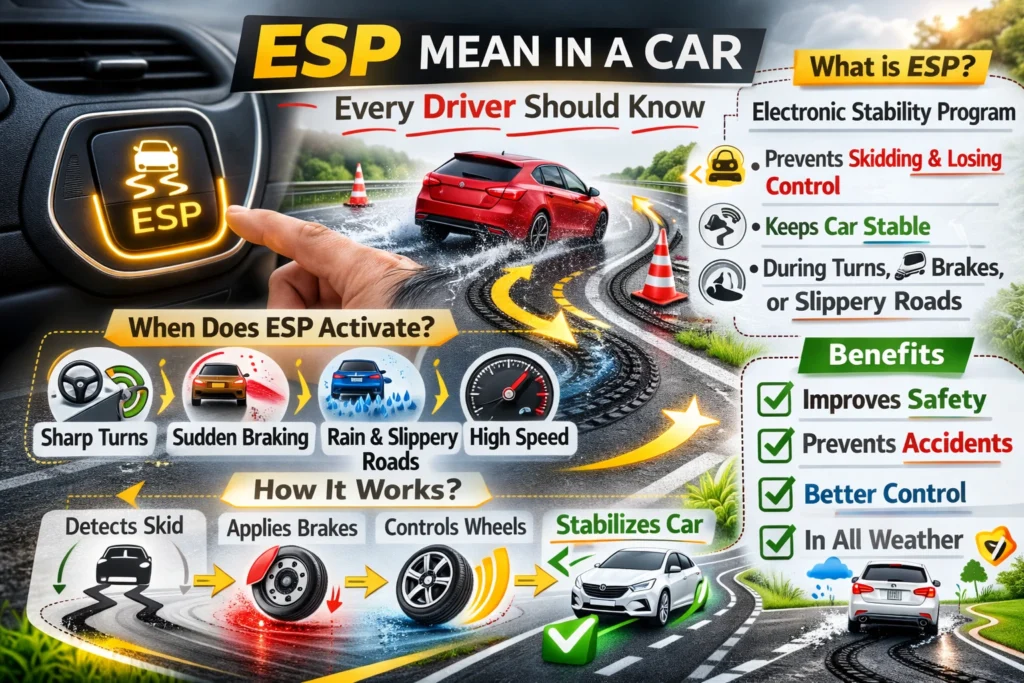
In cars, ESP stands for Electronic Stability Program (sometimes called Electronic Stability Control, ESC).
It is a safety feature that helps prevent skidding and loss of control by automatically applying brakes to individual wheels and adjusting engine power when it detects instability.
ESP is designed to improve vehicle safety during sharp turns, slippery conditions, or sudden maneuvers, making driving safer for both new and experienced drivers.
Understanding ESP in Cars
Modern vehicles come with a range of electronic safety aids, and ESP is one of the most important. Unlike airbags or seatbelts, which protect occupants during accidents, ESP helps prevent accidents from happening in the first place.
When ESP activates:
- The system detects wheel slip, loss of traction, or oversteer/understeer.
- Brakes are applied selectively to one or more wheels.
- Engine power is reduced if needed to regain stability.
- The driver often notices a blinking ESP light on the dashboard.
ESP works quietly in the background to ensure that drivers maintain control, especially in wet, icy, or uneven road conditions.
The Origin of ESP
ESP technology was first developed in the 1990s, primarily by Mercedes-Benz in collaboration with Bosch. It became widely adopted after research showed that electronic stability systems could dramatically reduce accident rates caused by skidding or loss of control.
Key milestones:
- 1995–2000: First implementation in high-end luxury cars like the Mercedes S-Class.
- 2000s: Gradual adoption in mid-range vehicles, including BMW, Audi, and Volkswagen models.
- 2010 onwards: ESP became mandatory in many countries, including EU nations and the United States, for all new vehicles.
The widespread adoption reflects the technology’s proven safety benefits. In fact, studies show that ESP can reduce single-vehicle crashes by 30–50%, especially in slippery conditions.
How ESP Works
ESP uses a combination of sensors, computers, and brakes to help maintain vehicle stability.
Key Components:
| Component | Function | Driver Impact |
|---|---|---|
| Yaw Sensor | Detects rotation of the car’s body | Monitors oversteer/understeer |
| Steering Angle Sensor | Measures intended direction | Compares with actual car movement |
| Wheel Speed Sensors | Tracks wheel rotation speed | Detects slip or loss of traction |
| Braking System | Applies brakes to individual wheels | Corrects skidding or spinning |
| Engine Control | Reduces power when necessary | Prevents acceleration from worsening instability |
When a car begins to slide or spin, ESP automatically corrects its trajectory, often without the driver even noticing. This subtle intervention can mean the difference between a controlled maneuver and an accident.
Real-World Examples of ESP Activation
ESP is most noticeable in challenging driving conditions:
- Friendly Example 😊
Sarah is driving her 2026 Mercedes-Benz in light rain. She accidentally takes a corner too fast. ESP kicks in, braking individual wheels and stabilizing her car. She safely regains control without spinning out. - Neutral Example 😐
Alex is driving on a snowy road. The car lightly slides while turning. The ESP light flashes, and the system adjusts braking and engine power. He notices the light but only feels a slight correction. - Dismissive or Negative Example 🙁
Mike dislikes ESP because it sometimes intervenes when he wants more control during spirited driving on a race track. He finds the corrections slightly intrusive, though they are designed for safety.
When to Use or Disable ESP
ESP is generally always recommended to be active, but there are exceptions:
- Ideal for:
- Rainy, snowy, or icy conditions
- Off-road or uneven terrain (moderate speed)
- Emergency maneuvers to avoid accidents
- Situations where ESP may be turned off:
- High-performance driving on a track
- Getting a car unstuck in deep snow or mud (some wheel spin may help)
- Off-road conditions requiring wheel slip for traction
Some vehicles have a dedicated ESP Off button, which is usually indicated on the dashboard when deactivated. Always consult the owner’s manual before turning it off.
Comparison With Related Terms
ESP is often confused with other car safety systems. Here’s a detailed comparison:
| Feature | Definition | Difference from ESP |
|---|---|---|
| ABS (Anti-lock Braking System) | Prevents wheel lock during braking | ESP uses ABS as part of its system, but also adjusts engine power and individual wheel braking |
| TCS (Traction Control System) | Prevents wheel spin during acceleration | TCS works mainly at lower speeds; ESP handles overall stability, including turning |
| VSC (Vehicle Stability Control) | Toyota’s brand name for ESP | Functionally similar to ESP; just a branding difference |
| ESC (Electronic Stability Control) | Generic term for ESP | Essentially the same as ESP, depending on manufacturer terminology |
| Brake Assist | Provides extra brake force in emergencies | Focuses only on braking; ESP actively manages power and individual brakes |
Understanding these differences helps drivers know which system is helping them in which situation, especially in adverse weather or emergency maneuvers.
Technical Explanation: How ESP Prevents Skidding
ESP constantly monitors the car’s behavior using hundreds of calculations per second.
Steps:
- Sensor detection: ESP monitors wheel speed, steering angle, yaw rate, and lateral acceleration.
- Comparing intended vs. actual path: It calculates if the car is deviating from the intended trajectory.
- Applying corrective measures: If the car is oversteering or understeering, brakes are applied to selected wheels.
- Engine adjustment: Throttle may be reduced to prevent acceleration from worsening instability.
This process occurs in milliseconds and is usually imperceptible to drivers, making ESP an invisible safety guardian on the road.
Examples of ESP in Popular Vehicles
| Vehicle | ESP Name | Notes | Benefit |
|---|---|---|---|
| Mercedes-Benz C-Class 2026 | ESP | Full system with ABS and traction integration | Helps prevent skids on wet roads |
| BMW 3 Series | DSC (Dynamic Stability Control) | ESP equivalent | Manages oversteer during sharp turns |
| Toyota Corolla 2026 | VSC | Toyota’s branded ESP | Activates in emergency maneuvers or slippery surfaces |
| Nissan Rogue | ESP | Works with TCS and ABS | Enhances SUV stability during sudden steering |
Most modern cars manufactured after 2012 have some form of ESP or ESC as a standard safety feature.
Alternate Meanings of ESP
While ESP in cars almost always refers to Electronic Stability Program, it has other meanings in different contexts:
- Extrasensory Perception: Psychic ability to perceive things beyond the normal senses.
- English for Specific Purposes: Educational term for specialized English courses.
- Encapsulated Security Payload: A technical term in networking.
In automotive contexts, you can safely assume ESP refers to Electronic Stability Program unless clearly specified otherwise.
Professional Alternatives to ESP
In manuals, blogs, or educational content, you can use:
- “Electronic Stability Control system”
- “Vehicle stability management system”
- “Anti-skid safety system”
These alternatives help readers understand the function without relying solely on the acronym.
Tips for Maximizing ESP Benefits
- Keep ESP activated at all times for general driving safety.
- Pair ESP with winter tires for enhanced stability in snow or ice.
- Understand the ESP dashboard light: steady light indicates system active, blinking light indicates activation.
- Avoid turning ESP off unless necessary for off-road or track use.
- Combine ESP with safe driving habits: gradual steering, controlled braking, and smooth acceleration.
FAQs:
What does ESP mean in a car?
It stands for Electronic Stability Program and helps prevent skidding and loss of control by selectively braking wheels and adjusting engine power.
Is ESP the same as ABS?
No, ABS prevents wheel lock during braking, while ESP controls overall vehicle stability using ABS plus engine and wheel-specific adjustments.
Do all cars have ESP?
Most cars manufactured after 2012 come with ESP or ESC as standard, especially in Europe and North America.
Can ESP be turned off?
Yes, some vehicles allow temporary deactivation via a dashboard button, mainly for off-road or track use.
Does ESP work in the rain or snow?
Absolutely. ESP is particularly useful on slippery surfaces to prevent skidding.
Will ESP save my car from every accident?
ESP improves safety but cannot prevent collisions in all situations. Safe driving is still essential.
What does the ESP light mean?
A steady light indicates the system is on. A blinking light signals ESP is actively correcting the car’s path.
Is ESP the same as traction control?
No. Traction control prevents wheel spin during acceleration, while ESP manages overall vehicle stability during steering and braking.
Does ESP affect fuel consumption?
Minimal impact. The system mainly intervenes for safety and rarely affects regular driving efficiency.
Conclusion:
- ESP enhances vehicle safety by preventing skids and loss of control.
- It works with sensors, brakes, and engine management to stabilize the car.
- Best used in adverse weather, slippery roads, or emergency maneuvers.
- Can usually be temporarily deactivated for off-road or track situations.
- Modern cars often integrate ESP with other systems like ABS and traction control for full safety coverage.
ESP is not just a tech feature—it’s a life-saving system that quietly keeps drivers and passengers safe.
Read More Related Articles:
- Consecutive Mean in Math: Hidden Pattern Behind Many Word Problems In 2026
- Someone Texted You “TS”? Here’s What It Means and How to Respond (2026)
- “YH” Means in Text: Most People Get This Wrong (2026)

Neon Samuel is a digital content creator at TextSprout.com, dedicated to decoding modern words, slang, and expressions. His writing helps readers quickly grasp meanings and understand how terms are used in real conversations across text and social platforms.