
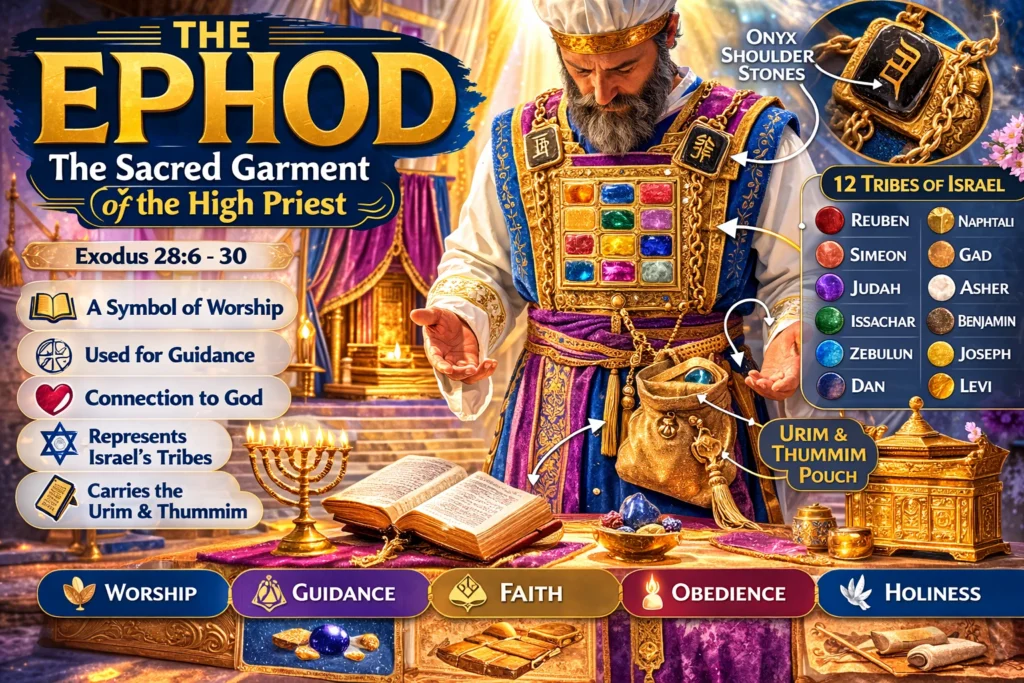
In the Bible, an ephod is a sacred vest or ceremonial garment worn by the high priest of Israel, often richly embroidered and adorned with precious materials.
It symbolized the priest’s role as a mediator between God and His people and was used with the Urim and Thummim to discern God’s will. The ephod was both a practical and symbolic item representing authority, holiness, and spiritual guidance.
When reading the Bible, you might stumble upon unusual words that spark curiosity. One of these intriguing terms is ephod. From Aaron in the wilderness to David on the battlefield, the ephod appears in stories that illustrate devotion, divine guidance, and sometimes cautionary tales about misusing sacred objects.
At first glance, the ephod may seem like just a piece of clothing. But in reality, it is much more—it embodies spiritual authority, ceremonial importance, and a unique link between humanity and the divine.
The ephod also shows up in surprising ways. For example, Gideon’s golden ephod led to idolatry despite being intended as a symbol of devotion. This duality—sacred yet potentially misused—makes the ephod a fascinating topic for Bible study and spiritual reflection.
This article will guide you through the meaning of ephod, its historical and cultural context, examples in scripture, comparisons with other biblical items, alternate interpretations, and practical spiritual lessons for today.
Origin of the Ephod
Historical Context
The ephod first appears in the Old Testament, especially in Exodus, Leviticus, and 1 Samuel. It was a key garment for the Israelite priests, with the high priest’s ephod being particularly elaborate.
- The high priest’s ephod represented authority and a direct connection to God.
- Ordinary priests also wore ephods, but these were simpler and less adorned.
Linguistic Background
- The Hebrew word ’ēphōd literally means “to bind” or “to gird.”
- This connects to its design, as the garment was fastened around the body and worn over the robe or tunic.
- Ephods could be made of fine linen, with gold, blue, purple, and scarlet threads woven into intricate patterns.
Symbolic Elements
- Shoulder Pieces with Onyx Stones – Engraved with the names of the twelve groups of Israel, symbolizing that the priest carried the people before God.
- Urim and Thummim – Objects placed in a pouch on the ephod to seek God’s guidance, often interpreted as a divine decision-making tool.
| Feature | Description | Scriptural Reference |
|---|---|---|
| Material | Fine linen, gold, blue, purple, scarlet threads | Exodus 28:6–14 |
| Shoulder Stones | Onyx stones with group names | Exodus 28:9–12 |
| Divine Tool | Urim and Thummim | Exodus 28:30 |
| Worn By | High Priest and occasionally other priests | Leviticus 8:7 |
| Symbolism | Holiness, authority, mediation | Exodus 28:29 |
Design and Function
The ephod was carefully designed to serve multiple purposes:
- Spiritual Function – Signified the priest’s role as God’s mediator.
- Ceremonial Function – Worn during sacrifices, festivals, and temple rituals.
- Decision-Making Function – Used with the Urim and Thummim to determine divine guidance.
Detailed Description
- The ephod consisted of two main pieces joined at the shoulders.
- Gold chains and fastenings ensured it stayed in place during ceremonies.
- A decorative belt or sash often accompanied it.
- The breastplate (choshen) was sometimes attached to the ephod, enhancing its sacred significance.
| Component | Function | Reference |
|---|---|---|
| Shoulder Pieces | Represented the groups of Israel | Exodus 28:9–12 |
| Urim & Thummim Pouch | Divination or seeking God’s will | Exodus 28:30 |
| Decorative Threads | Signified holiness and beauty | Exodus 28:6–14 |
| Belt or Sash | Secured the ephod to the body | Exodus 28:8 |
Usage of the Ephod
The ephod was not merely decorative—it played a central role in Israelite worship and leadership.
In Worship
- Worn during sacrifices and rituals in the Tabernacle and later in Solomon’s Temple.
- Signaled the presence of God and the priest’s role as mediator.
- Served as a visual reminder for the people of Israel of God’s holiness.
For Divine Guidance
- The ephod was used to consult God in difficult or critical decisions.
- Example: David sought God’s guidance via the ephod during military campaigns (2 Samuel 30:7–8).
- The Urim and Thummim, stored within the ephod, allowed yes/no answers or divine direction, though the exact mechanism remains a mystery.
Everyday Context
- Gideon created an ephod from gold in Judges 8:27, which became an object of worship among the people.
- This demonstrates the ephod’s power as a symbol but also its potential for misuse.
| Scenario | Purpose | Outcome |
|---|---|---|
| Aaron’s High Priest Duties | Mediation, worship | Spiritual authority established |
| David Consulting God | Decision-making | Received divine guidance |
| Gideon’s Golden Ephod | Commemoration | Led to unintended idolatry |
Biblical Examples
Aaron the High Priest
- Exodus 28:6–14 provides detailed instructions on Aaron’s ephod.
- Included intricate embroidery, shoulder stones, and a breastplate.
- Symbolized his role as the primary mediator between God and Israel.
David Using the Ephod
- In 2 Samuel 30:7–8, David uses the ephod to determine the best course after recovering captives.
- Demonstrates the ephod’s use as a decision-making tool.
Gideon’s Golden Ephod
- Judges 8:27 describes Gideon crafting an ephod from gold collected after war spoils.
- While intended as a symbol of devotion, it became an idol among the Israelites.
- Shows the duality of sacred objects: reverence vs misuse.
Tone of Each Example
| Example | Tone | Significance |
|---|---|---|
| Aaron | Positive | Sacred ritual and devotion |
| David | Neutral/Positive | Seeking guidance from God |
| Gideon | Negative | Warning against idolatry |
Comparisons With Related Items
| Term | Similarities | Differences |
|---|---|---|
| Breastplate (Choshen) | Often attached to ephod, contains Urim & Thummim | Specific to divination; ephod is the garment |
| Robe | Worn by priests | Robe is simpler, lacks sacred adornments |
| Tunic | Inner garment | Everyday use; ephod is ceremonial |
| Sash/Belt | Complements ephod | Functional vs symbolic purpose |
Understanding these comparisons highlights the ephod’s unique combination of clothing, sacred symbol, and spiritual tool.
Alternate Meanings
While ephod primarily refers to the high priest’s garment, some scholars view it metaphorically:
- Spiritual Armor – Represents a faithful stance in spiritual duties.
- Divine Access – Symbolizes connection with God, bridging heaven and earth.
In rare translations, “ephod” may be used more generally for ceremonial aprons or priestly vests, but this is uncommon.
Modern Spiritual Lessons
Studying the ephod offers insights for today:
- Responsibility in Leadership – Authority comes with spiritual and ethical duties.
- Seeking Guidance – Just as the ephod was used to seek God’s will, we are encouraged to seek wisdom and discernment in our decisions.
- Guard Against Misuse – Sacred objects can lose meaning if treated carelessly.
- Cultural Appreciation – Understanding the ephod helps in appreciating biblical history, traditions, and symbolism.
| Lesson | Application Today |
|---|---|
| Authority | Leadership must be responsible and mindful |
| Guidance | Seek wisdom in decision-making |
| Sacred Respect | Avoid misusing symbols of faith |
| Cultural Understanding | Appreciate ancient biblical traditions |
Polite or Professional Alternatives
If explaining the ephod to a general audience, educators, or in sermons, consider these terms:
- High Priest’s Vest – Simplifies the concept.
- Ceremonial Garment – Neutral and descriptive.
- Biblical Apron – Good for teaching children or new learners.
These alternatives keep explanations clear while preserving spiritual significance.
FAQs
What is an ephod in simple words?
It is a sacred vest or apron worn by the high priest of Israel, symbolizing authority and divine guidance.
Who wore the ephod in the Bible?
Primarily the high priest, such as Aaron, but occasionally other priests or figures like Gideon.
What materials were used to make an ephod?
Fine linen with gold, blue, purple, and scarlet threads, often with onyx stones on the shoulders.
Was the ephod used for decision-making?
Yes, often alongside the Urim and Thummim to seek God’s guidance.
Can an ephod become an idol?
Yes, Gideon’s golden ephod became an object of worship among Israelites.
Is the ephod still used today?
No, it was specific to the Israelite priesthood and temple worship.
How is the ephod different from a robe or tunic?
It is ceremonial, richly decorated, and used for spiritual purposes, unlike everyday garments.
What lessons can modern readers learn from the ephod?
Faith, responsibility, proper use of sacred symbols, and cultural understanding.
Conclusion
The ephod is a remarkable biblical object, bridging history, culture, and spirituality. From Aaron’s priestly duties to Gideon’s cautionary tale, the ephod represents holiness, authority, and divine guidance. It teaches us the importance of reverence, careful stewardship of spiritual symbols, and the timeless relevance of seeking guidance wisely.
Studying the ephod enriches biblical literacy, enhances spiritual reflection, and connects modern readers to the rich traditions of ancient Israel. Whether for education, devotion, or cultural appreciation, understanding the ephod offers a glimpse into the profound spiritual life of the Bible.
Read More Related Articles:
- ABC Meaning in Roblox: What It Stands For and How It’s Used In 2026
- Torque Mean in a Car: Secret to Quick Acceleration In 2026
- NOI Mean in Real Estate: Number That Drives Value In 2026

Neon Samuel is a digital content creator at TextSprout.com, dedicated to decoding modern words, slang, and expressions. His writing helps readers quickly grasp meanings and understand how terms are used in real conversations across text and social platforms.