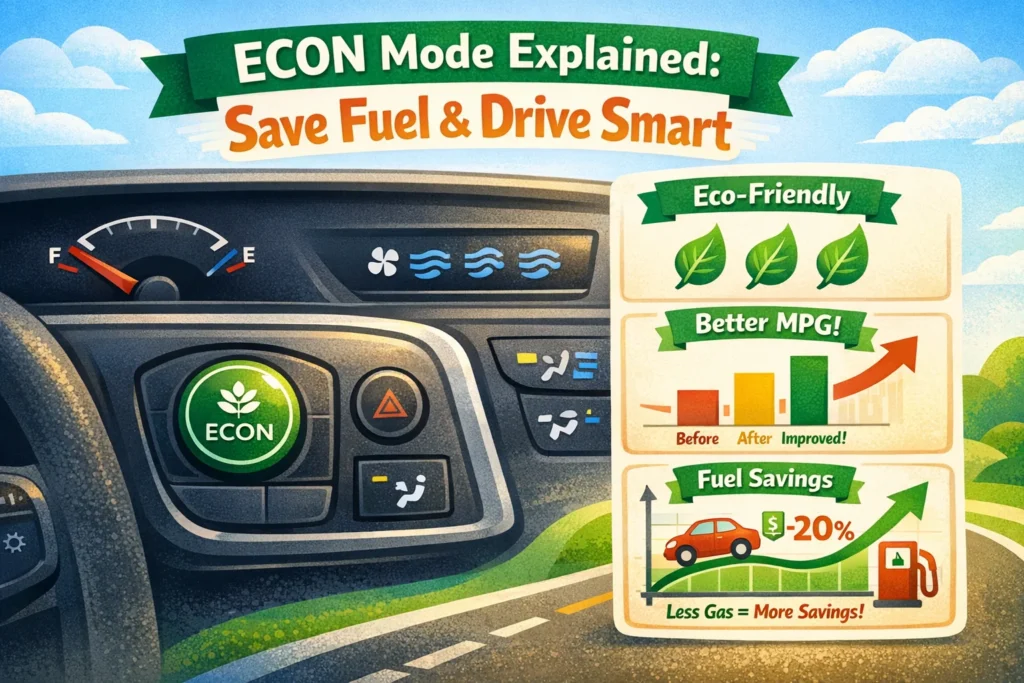
In cars, ECON (short for Economy Mode) is a driving feature designed to optimize fuel efficiency and reduce emissions. When activated, ECON adjusts engine performance, transmission response, and air conditioning settings to help drivers save fuel while maintaining smooth and safe driving.
ECON mode is now a staple in many modern vehicles, from sedans to hybrids, and even some SUVs. It is particularly popular in vehicles from brands like Honda, Toyota, Nissan, and Hyundai, aiming to make every drop of fuel go further without compromising comfort or safety.
Understanding ECON in Cars
Modern cars are no longer just about power—they are also about efficiency, technology, and environmental responsibility. ECON mode is a perfect example of this shift. When you press the ECON button in your car, it signals the vehicle’s computer system to adjust various systems for fuel conservation.
Key adjustments include:
- Engine performance: Throttle response is softened so that acceleration is smoother and less fuel-intensive.
- Transmission behavior: The car may shift gears earlier to keep RPMs lower and fuel consumption minimal.
- Air conditioning: The AC system reduces its workload slightly to save energy.
- Cruise control and driving feel: Acceleration becomes gentler, and speed adjustments are more gradual.
In simpler terms, ECON mode encourages a “smooth and steady” driving style, making every mile more fuel-efficient.
The Origin of ECON Mode
ECON mode emerged in the early 2000s when car manufacturers started integrating advanced electronic systems into vehicles. Rising fuel costs and environmental concerns made fuel-saving technologies more attractive to consumers.
Honda is often credited with popularizing the ECON mode in vehicles like the Civic and Accord. Toyota and Nissan soon followed, integrating similar modes in their hybrids and fuel-efficient models.
The popularity of ECON mode grew because:
- Consumers wanted to reduce fuel costs without compromising on comfort.
- Environmental awareness increased, and governments encouraged greener vehicles.
- Advanced computer-controlled engines allowed smart fuel-saving features to be implemented without manual adjustments.
How ECON Mode Works
ECON mode does not magically increase fuel efficiency. Instead, it makes strategic adjustments that collectively reduce fuel consumption.
Key System Adjustments:
| System | ECON Adjustment | Driver Impact |
|---|---|---|
| Engine | Limits throttle sensitivity | Slower, smoother acceleration |
| Transmission | Shifts gears earlier | Lower RPM, less fuel burned |
| Air Conditioning | Reduces compressor workload | Slightly warmer cabin |
| Cruise Control | Maintains speed gently | More efficient long-distance driving |
Think of ECON mode as your car’s “gentle nudge” to drive smarter. It balances comfort, performance, and fuel savings.
Real-World Examples of ECON Mode
ECON mode usage varies depending on driving style, location, and vehicle type. Here are some relatable examples:
- Friendly Example 😊
Emma drives a 2026 Honda Civic. On her daily commute, she switches to ECON mode. Acceleration feels lighter, but her fuel consumption drops noticeably. Over a month, she saves a few gallons of gas while enjoying a smoother ride. - Neutral Example 😐
Alex uses ECON on a long highway drive. Acceleration is slightly slower, but the car maintains steady cruising. He doesn’t feel much difference except that the cabin is a little warmer due to AC adjustments. - Negative/Dismissive Example 🙁
Liam prefers sporty driving and finds ECON mode restrictive. On highways or overtakes, the reduced throttle response feels frustrating. For him, the minor fuel savings aren’t worth the slower reaction time.
When to Use ECON Mode
ECON mode is ideal in specific scenarios:
- City Driving: Stop-and-go traffic benefits from smoother acceleration.
- Highway Cruising: ECON helps maintain steady fuel-efficient speeds.
- Hot Weather: Reduces AC usage without turning it off entirely.
- Hybrid Vehicles: Works in conjunction with EV mode for maximum efficiency.
Avoid using ECON mode in the following situations:
- Steep inclines or towing: Reduced power may make climbing hills or towing slower.
- Quick overtakes: If rapid acceleration is needed, ECON might feel restrictive.
- Sporty driving: Those seeking maximum responsiveness may prefer Sport mode.
Comparison With Related Features
Many car owners confuse ECON mode with other fuel-saving or driving modes. Here’s a detailed comparison:
| Feature | Definition | Difference from ECON |
|---|---|---|
| Eco Mode | General fuel-saving mode | ECON is a brand-specific, detailed implementation of eco-friendly driving |
| EV Mode | Electric-only mode in hybrids | ECON adjusts fuel/electric efficiency; EV mode stops the engine entirely |
| Sport Mode | Performance-focused mode | Opposite of ECON; prioritizes power and acceleration |
| Idle Stop/Start | Engine shuts off at idle | Often works alongside ECON, reducing fuel wasted during stops |
| Hybrid Auto Mode | Hybrid system automatically balances engine/electric use | ECON affects throttle and AC to complement hybrid efficiency |
By understanding these differences, drivers can make informed decisions on which mode suits their driving style.
Technical Explanation: How ECON Saves Fuel
ECON mode uses advanced engine management software. Key mechanisms include:
- Throttle Control: Limits fuel delivered during acceleration.
- Transmission Mapping: Changes shift points to reduce engine revs.
- Climate Control Optimization: Air conditioning cycles less aggressively.
- Cruise Control Tuning: Smooth throttle adjustments reduce fuel spikes.
Some hybrids add regenerative braking optimization, capturing more energy during deceleration. Over time, these small changes can translate into significant fuel and cost savings.
Examples of ECON Mode in Popular Vehicles
| Vehicle | Mode Name | Fuel Economy Impact | Notes |
|---|---|---|---|
| Honda Civic 2026 | ECON | +10–15% MPG | Adjusts throttle, AC, and transmission |
| Toyota Corolla Hybrid | ECO | +8–12% MPG | Works with hybrid EV mode for extra efficiency |
| Nissan Altima 2026 | ECON | +7–10% MPG | Slightly reduces AC and throttle sensitivity |
| Hyundai Ioniq Hybrid | ECO | +10–14% MPG | Integrates regenerative braking with economy settings |
These numbers are approximate and depend on driving habits and terrain.
Alternate Meanings of ECON
While ECON in cars almost always refers to Economy Mode, it has other meanings in different contexts:
- Economics: Often used as shorthand for “economics” in academic or professional writing.
- Electronics: Refers to “economical operation” in technical manuals.
- Travel/Transport: Sometimes seen as “economy class” in airline tickets, though unrelated to cars.
In automotive discussions, it’s safe to assume ECON is about fuel efficiency unless specified otherwise.
Professional Alternatives to ECON
When writing for manuals or blogs, using more formal terms may help:
- “Fuel-efficient driving mode”
- “Eco-friendly performance setting”
- “Economy-oriented operation mode”
These alternatives are helpful in professional contexts where readers might not recognize brand-specific terms.
Tips for Maximizing ECON Mode Benefits
- Combine ECON with gentle acceleration for smooth fuel savings.
- Keep air conditioning moderate; high AC usage reduces ECON benefits.
- Activate ECON in urban and moderate-speed highway driving.
- For hybrid cars, use ECON with EV mode when possible.
- Avoid ECON in conditions requiring high power like towing or steep hills.
- Maintain regular tire pressure to further enhance fuel efficiency.
- Combine ECON with lightweight cargo load to reduce energy consumption.
FAQs
What does the ECON button do in a car?
It activates a fuel-saving mode that adjusts engine throttle, transmission, and air conditioning for maximum efficiency.
Is it safe to drive with ECON mode on?
Yes. It’s designed by manufacturers to be completely safe while optimizing fuel use.
Does ECON mode reduce acceleration?
Yes, acceleration may feel softer, especially when pressing the gas pedal aggressively.
Which cars have ECON mode?
Most Honda, Toyota, Nissan, and Hyundai vehicles include ECON mode. Always check your owner’s manual.
Can ECON mode be used on highways?
Absolutely. It’s best for steady-speed cruising to maximize fuel efficiency.
Does ECON mode save a lot of fuel?
Savings typically range from 5% to 15% depending on driving style, traffic, and terrain.
Does ECON mode affect the air conditioning?
Yes. It reduces AC intensity to conserve energy, which may slightly warm the cabin.
Can ECON mode be combined with other features?
Yes. ECON often complements hybrid EV mode, regenerative braking, and idle stop/start systems.
Does using ECON mode wear out the car faster?
No. It is a standard feature designed for long-term use without additional wear.
Conclusion:
- ECON mode is a practical tool for saving fuel and reducing emissions.
- It optimizes engine performance, transmission, and climate control.
- Ideal for city and moderate highway driving.
- Avoid using it when maximum power or acceleration is needed.
- Combined with gentle driving habits, ECON mode can significantly reduce fuel costs over time.
ECON mode is not just a gimmick; it’s a smart feature that benefits drivers financially and environmentally, while keeping the driving experience comfortable.
Read More Related Articles:
- Coplanar Mean in Geometry: Simple Idea Behind Complex 3D Figures In 2026
- MK Meaning in Texting: Tone, and When to Use It (2026)
- PP Meaning in Text: Everything You Need to Know (2026)

Ivy Madison is a content creator at TextSprout.com, specializing in word definitions, internet slang, acronyms, and text abbreviations. She delivers clear and engaging explanations, helping readers quickly understand modern digital language and trending terms.