
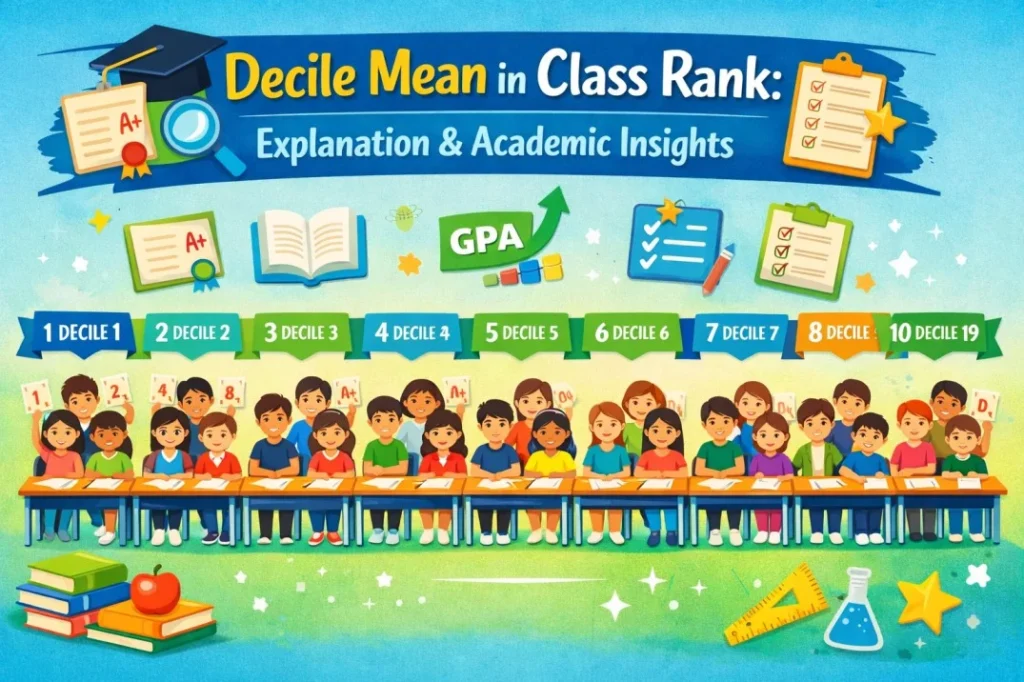
A decile in class rank is a statistical measure that divides a group of students into ten equal parts based on their academic performance.
Each decile represents 10 percent of the class. For example, students in the first decile are in the top 10 percent of the class, while students in the tenth decile are in the bottom 10 percent. Deciles are a way to categorize students’ relative performance without focusing solely on exact percentages or GPAs.
If you’ve ever been in school, whether in high school or college, you’ve probably encountered the concept of class rank. Class rank is a way of comparing students’ academic performance relative to their peers, and it can play a significant role in college admissions, scholarships, and academic recognition. One term often used in this context is decile, which can seem confusing at first glance.
Understanding what a decile means, how it is calculated, and how it affects your academic standing can make the concept much clearer. It can also help you set goals, plan your studies, and interpret your academic performance in a meaningful way.
Understanding Class Rank and Deciles
Class rank is a system that compares students’ academic achievements to one another. It is often based on cumulative grade point average (GPA), and in some cases, weighted GPA that accounts for honors, advanced placement, or other rigorous courses.
Deciles take this a step further by dividing the class into ten equal segments. This method allows educators, colleges, and scholarship committees to see not only who is at the very top of the class but also how performance is distributed across the group.
Unlike simply ranking students numerically, deciles provide a broader perspective. A student in the second decile is in the top 20 percent of the class, which communicates high achievement even if they are not exactly the number one ranked student.
How Deciles Are Calculated
Calculating deciles in class rank involves a few steps, though it may seem complicated at first. Here is a simplified explanation:
- Arrange students by GPA: Start by listing all students from the highest GPA to the lowest.
- Divide the class into ten equal groups: Count the total number of students and divide by ten. Each group represents one decile.
- Assign deciles: Students are assigned to a decile based on their position in the ordered list.
For example, in a class of 100 students:
- First decile (top 10%): Students ranked 1–10
- Second decile (top 20%): Students ranked 11–20
- Third decile (top 30%): Students ranked 21–30
- …
- Tenth decile (bottom 10%): Students ranked 91–100
This approach makes it easy to see where students fall relative to their peers without focusing exclusively on precise rank numbers.
Why Deciles Are Used in Class Rank
Deciles offer several advantages over simple numerical ranking:
1. Provides Context
Being ranked 15th in a class of 100 sounds impressive, but placing it in deciles shows that the student is in the second decile, which clearly communicates their standing as part of the top 20 percent of the class.
2. Simplifies Comparisons
Deciles make it easier to compare students across different schools or programs. While GPAs and grading scales may vary, deciles show relative performance in a standardized way.
3. Supports Fair Evaluation
Deciles help admissions officers and scholarship committees evaluate students more equitably, particularly in large schools where numerical ranks alone might not fully reflect achievement distribution.
4. Reduces Pressure
While some students may feel stressed about precise rank numbers, deciles can provide a more balanced perspective, showing whether a student is generally in the top, middle, or bottom portion of the class.
Examples of Deciles in Class Rank
Understanding deciles is easier with examples. Consider a school with 200 students.
| Decile | Percentile Range | Student Position | Interpretation |
|---|---|---|---|
| 1 | Top 10% | Rank 1–20 | Top-performing students, eligible for highest honors |
| 2 | Top 20% | Rank 21–40 | High achievers, strong candidates for scholarships |
| 3 | Top 30% | Rank 41–60 | Above average performance, consistent academic standing |
| 4 | Top 40% | Rank 61–80 | Middle of the pack, steady GPA |
| 5 | Top 50% | Rank 81–100 | Average performance, meets academic expectations |
| 6 | 50–60% | Rank 101–120 | Slightly below average, may need improvement |
| 7 | 60–70% | Rank 121–140 | Below average, may benefit from academic support |
| 8 | 70–80% | Rank 141–160 | Lower end, focus on academic growth |
| 9 | 80–90% | Rank 161–180 | Struggling academically, intervention may be necessary |
| 10 | Bottom 10% | Rank 181–200 | Lowest performance, additional support recommended |
From this table, you can see that deciles provide a clear picture of relative performance, rather than just a numerical rank, which can feel intimidating or meaningless without context.
Decile vs Percentile
It is common to confuse deciles and percentiles, but they are slightly different concepts:
- Decile divides a population into ten equal groups, each representing 10 percent of the total.
- Percentile indicates the percentage of students that fall below a certain point.
For example, being in the first decile means a student is in the top 10 percent of the class. In percentile terms, they would be in the 90th percentile, meaning they scored higher than 90 percent of their classmates. Understanding both terms can help students interpret their class rank more accurately.
Importance of Deciles in College Admissions
Colleges often consider class rank as part of the admissions process. While exact rank may vary depending on school size, deciles give admissions officers a sense of academic performance relative to peers.
Being in the first or second decile signals exceptional achievement, which can enhance your chances for competitive programs and merit-based scholarships. Students in middle deciles still have opportunities, but may need to highlight other strengths such as extracurricular activities, leadership, or personal achievements.
Deciles are particularly helpful when comparing students from different schools, where grading scales and rigor may vary. Instead of focusing solely on GPA numbers, colleges can use deciles to understand how a student performs in context.
Decile and Academic Awards
Many schools award honors, certificates, or recognition based on deciles. Students in the top decile may receive distinctions like:
- Valedictorian or salutatorian consideration
- Honor roll placement
- National merit recognition
Deciles also provide teachers and counselors a way to identify students who may benefit from mentorship, advanced courses, or enrichment programs.
How Students Can Use Deciles
Understanding deciles is not just for administrators or admissions officers. Students can use this knowledge to:
- Set realistic academic goals: Knowing your current decile helps you understand where improvement is needed.
- Monitor progress over time: Moving from the fourth to the second decile shows significant academic growth.
- Plan college applications strategically: If you are in the top decile, you might focus on competitive schools. If you are in middle deciles, highlighting strengths outside GPA may be beneficial.
- Seek support where needed: Lower deciles can indicate areas where tutoring or academic support may help improve performance.
By using deciles as a tool, students can take control of their academic journey rather than feeling overwhelmed by raw rank numbers.
Common Misconceptions About Deciles
Many students and parents have misunderstandings about deciles. Some of the most common include:
- First decile always means valedictorian: Not necessarily. The first decile includes the top 10 percent of students, so multiple students may fall into that category.
- Lower deciles mean failure: Being in a lower decile does not automatically indicate poor performance. It shows relative standing in the class and can provide a baseline for improvement.
- Deciles replace GPA: Deciles are an additional tool, not a substitute for GPA. Both numbers are important for a complete picture of academic performance.
- Deciles are fixed: Your decile can change each semester based on grades and performance, making it a dynamic reflection of your current standing.
FAQs
What does decile mean in class rank?
A decile divides the class into ten equal groups based on academic performance. Each decile represents 10 percent of the class.
Is being in the first decile good?
Yes, it means you are in the top 10 percent of your class.
Can my decile change over time?
Yes, deciles are recalculated as grades change and can move up or down each semester.
How is decile different from percentile?
Deciles divide the class into ten equal parts, while percentiles indicate the percentage of students below a certain point.
Does decile affect college admissions?
Yes, colleges use deciles to understand how students perform relative to peers, especially when comparing applicants from different schools.
Can a student in a lower decile still succeed academically?
Absolutely. Deciles show relative standing, but other factors like improvement, extracurriculars, and personal achievements matter.
Do all schools use deciles?
No, not all schools calculate deciles, but they are common in high schools and some universities for ranking purposes.
Are deciles only based on GPA?
Mostly, but some schools may factor in weighted GPA, course rigor, or additional assessments.
Conclusion
Deciles are a useful tool in understanding class rank and academic performance. By dividing the class into ten equal groups, deciles provide context, clarity, and perspective on where a student stands relative to peers. They help colleges, teachers, and students themselves make informed decisions about academic growth, college applications, and academic recognition.
Being in the top deciles can open doors to scholarships, honors, and advanced opportunities, while lower deciles can highlight areas for improvement and targeted support. By understanding and tracking deciles, students can approach their academic journey with clarity, motivation, and strategic planning.
Deciles are not just numbers. They are guides that provide insight into relative performance, help shape academic goals, and offer a roadmap for achieving success in school and beyond.
Read More Related Articles:
- ABC Meaning in Roblox: What It Stands For and How It’s Used In 2026
- Torque Mean in a Car: Secret to Quick Acceleration In 2026
- NOI Mean in Real Estate: Number That Drives Value In 2026

Neon Samuel is a digital content creator at TextSprout.com, dedicated to decoding modern words, slang, and expressions. His writing helps readers quickly grasp meanings and understand how terms are used in real conversations across text and social platforms.