
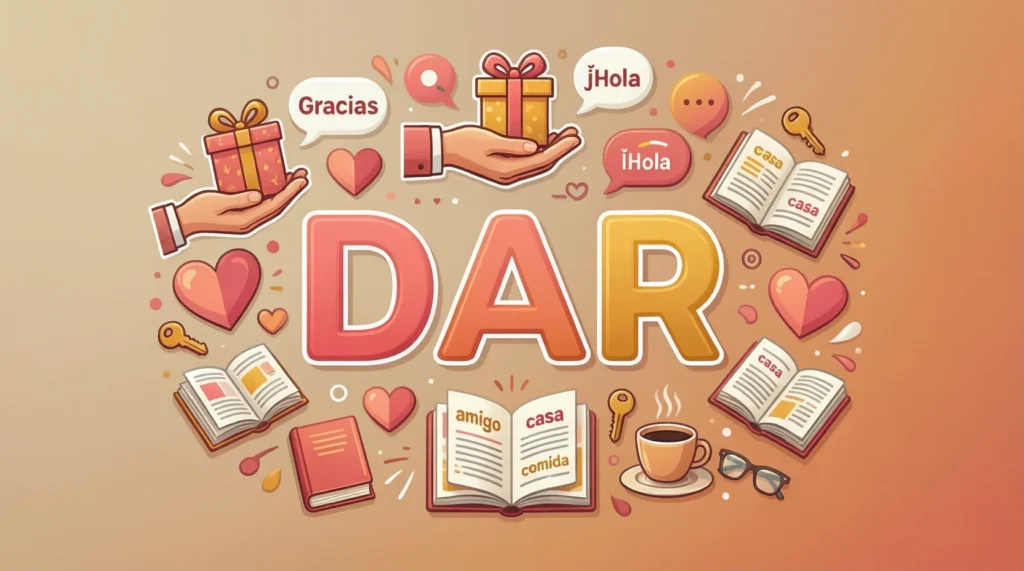
Dar is a common Spanish verb that means “to give.” It is used to express giving objects, offering help, providing information, causing an effect, or even expressing emotions and actions in everyday Spanish conversation.
Spanish learners run into the verb dar very early and for good reason. It appears everywhere. Native speakers use it in casual chats, professional settings, idioms, and emotional expressions. Understanding what dar means in Spanish unlocks a huge part of how the language actually works in real life.
This guide breaks it all down in a clear and friendly way. You will learn where the word comes from, how it is used today, common expressions, tone differences, comparisons with similar verbs, and practical tips to sound more natural when using it.
Origin and Background of the Verb Dar
The verb dar comes from Latin dare, which also meant “to give.”
Over centuries, Spanish kept the original meaning while expanding its use into dozens of expressions.
Because giving and exchanging actions are central to daily life, dar became one of the most frequently used verbs in Spanish. It is considered an irregular verb, which explains why learners often find it tricky at first.
Despite that, native speakers use it instinctively. Once you understand its patterns and common phrases, it becomes much easier to master.
Core Meaning of Dar in Spanish
At its most basic level, dar means to give something to someone.
Examples in simple form:
- Te doy un regalo.
I give you a gift. - Ella dio dinero a la fundación.
She gave money to the foundation.
However, this is only the starting point. Spanish uses dar far beyond physical giving.
How Dar Is Used in Real Life
Spanish speakers use dar to express actions, reactions, emotions, time, and even abstract ideas. The verb adapts based on context.
Common Uses of Dar
- Giving an object
- Offering help or support
- Causing a result or feeling
- Providing information
- Expressing idiomatic meanings
This flexibility makes dar one of the most powerful verbs in Spanish.
Dar Conjugation Snapshot
Before jumping into expressions, it helps to see how dar changes.
Table 1: Present Tense of Dar
| Pronoun | Conjugation |
|---|---|
| Yo | doy |
| Tú | das |
| Él Ella Usted | da |
| Nosotros | damos |
| Vosotros | dais |
| Ellos Ellas | dan |
The yo form is irregular, while others follow more predictable patterns.
Common Expressions Using Dar
Spanish relies heavily on expressions built around dar. These phrases often cannot be translated word for word.
Table 2: Everyday Dar Expressions and Meanings
| Expression | Meaning | Example |
|---|---|---|
| Dar tiempo | To give time | Dame tiempo para pensar |
| Dar ayuda | To help | Ella me dio ayuda |
| Dar miedo | To cause fear | Esa película da miedo |
| Dar igual | To not matter | Me da igual |
| Dar cuenta | To realize | Me di cuenta tarde |
Learning these expressions is more valuable than memorizing grammar rules.
Tone and Emotional Use of Dar
The tone of dar depends entirely on context. It can sound warm, neutral, or even dismissive.
Friendly or Warm Tone
- Te doy las gracias
I give you thanks - Me da mucha alegría verte 😊
It gives me great joy to see you
These uses show kindness or emotional warmth.
Neutral or Informational Tone
- El profesor dio instrucciones claras.
The teacher gave clear instructions - El banco da préstamos.
The bank gives loans
Used in news, business, or education.
Negative or Dismissive Tone
- Me da igual lo que digas.
I do not care what you say - Eso me da vergüenza.
That embarrasses me
In these cases, dar expresses emotional impact rather than generosity.
Dar vs Similar Spanish Verbs
Spanish has several verbs related to giving, but each has a different nuance.
Table 3: Dar Compared With Similar Verbs
| Verb | Meaning | When to Use |
|---|---|---|
| Dar | To give | General use |
| Entregar | To hand over | Formal or official |
| Ofrecer | To offer | Polite or optional |
| Regalar | To gift | Emphasis on generosity |
| Prestar | To lend | Temporary giving |
Example comparison:
- Te doy el libro
I give you the book - Te presto el libro
I lend you the book
The difference changes the entire meaning.
Alternate Meanings of Dar in Spanish
While dar primarily means “to give,” it also appears in expressions where the meaning shifts.
Examples:
- Dar la hora
To tell time - Dar un paseo
To take a walk - Dar un beso
To give a kiss
These phrases describe actions rather than direct giving.
Polite and Professional Alternatives to Dar
In formal settings, speakers sometimes replace dar with more refined verbs.
Professional alternatives include:
- Proporcionar
Used in business or academic contexts - Facilitar
Common in customer service or official communication - Otorgar
Used for awards, permissions, or legal matters
Example:
- La empresa proporcionó información detallada.
This sounds more professional than using dar repeatedly.
Tips for Using Dar Naturally
Spanish learners often overthink dar, but fluency comes from patterns.
Helpful tips:
- Learn expressions, not isolated meanings
- Pay attention to emotional context
- Practice with real sentences
- Notice how native speakers use it daily
The more exposure you get, the more intuitive it becomes.
FAQs
What does dar literally mean in Spanish?
Dar literally means to give. Its use expands through expressions and idioms.
Is dar a regular or irregular verb?
Dar is irregular, especially in the yo form and some past tenses.
Can dar mean something other than giving?
Yes. It can express emotions, actions, reactions, or abstract ideas.
Is dar used in formal Spanish?
Yes, but in very formal contexts alternatives like proporcionar are preferred.
What is a common phrase with dar?
Me da igual is very common and means I do not care.
Does dar change meaning with tone?
Yes. Context determines whether it sounds friendly, neutral, or dismissive.
Is dar hard for beginners?
It looks complex at first, but learning common expressions makes it easier.
How can I practice using dar?
Use it in daily sentences and focus on real expressions instead of rules.
Conclusion
Understanding what dar means in Spanish goes far beyond translating it as “to give.”
It is a foundational verb that shapes how emotions, actions, and ideas are expressed in everyday Spanish.
By learning its common expressions, tone variations, and real-world usage, you gain confidence and sound more natural.
Practice it often, listen to native speakers, and focus on meaning over memorization.
Once dar clicks, Spanish feels far more alive and expressive.
Read More Related Articles:
- OFC Meaning in Text: Everything You Need to Know in 2026
- GPI Meaning in Text: What This 3-Letter Slang Really Says (2026)
- What Does ISTG Mean? Used When People Are Fed Up (2026)

Neon Samuel is a digital content creator at TextSprout.com, dedicated to decoding modern words, slang, and expressions. His writing helps readers quickly grasp meanings and understand how terms are used in real conversations across text and social platforms.