
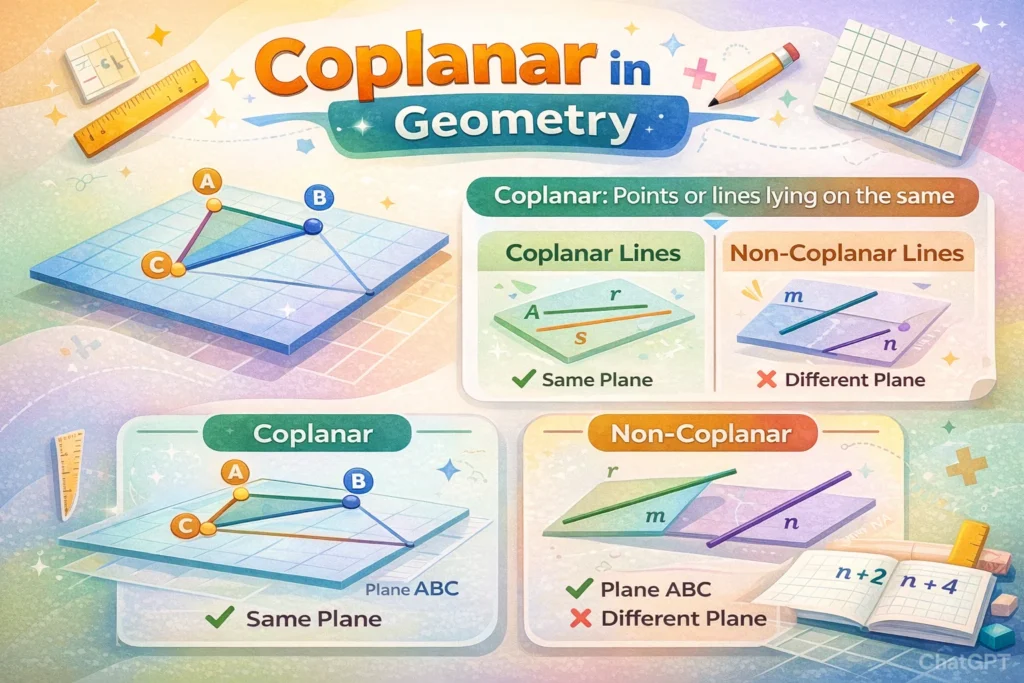
In geometry, coplanar refers to points, lines, or shapes that all lie on the same plane. A plane is a flat, two-dimensional surface that extends infinitely in all directions.
If multiple points or lines are coplanar, you could imagine placing a sheet of paper through all of them every element touches that same flat surface.
In geometry, understanding how shapes relate to one another is key to visualizing space and solving problems. One concept that often comes up, especially in three-dimensional figures, is coplanar. At its simplest, coplanar refers to points, lines, or shapes that lie on the same plane a flat, two-dimensional surface that extends infinitely in all directions. While it may sound abstract, this idea is surprisingly practical and forms the foundation for understanding more complex 3D structures.
In 2026, coplanarity remains a crucial tool in mathematics, architecture, engineering, and computer graphics. Architects use it to ensure walls, floors, and ceilings align perfectly. Engineers rely on coplanar components to design mechanical systems that work smoothly.
Even 3D modeling software uses the concept to render accurate digital representations. By understanding which elements share a plane, you can tackle complex structures step by step, making challenging problems easier to visualize and solve.
Understanding coplanarity is essential in geometry, architecture, engineering, and even computer graphics. Knowing whether objects are coplanar helps simplify complex problems and ensures accurate constructions.
Origin of the Term “Coplanar”
The term coplanar comes from the Latin words “co”, meaning “together,” and “planus”, meaning “flat” or “level.” Essentially, it conveys the idea of objects being “together on a plane.”
Coplanar first appeared in mathematical texts during the 19th century, as mathematicians formalized geometric concepts and began analyzing spatial relationships beyond simple lines and angles. Today, the term is widely used in:
- Mathematics and geometry classes
- Engineering design and CAD software
- Computer graphics and 3D modeling
- Physics when analyzing forces on a flat surface
Its popularity stems from its clarity: if points, lines, or vectors are coplanar, computations, projections, and diagrams become much simpler.
Why Understanding Coplanar Matters
Being able to determine whether points or lines are coplanar has many practical applications:
- Architecture & Engineering – Ensuring beams, columns, and walls align on the same plane prevents structural errors.
- Computer Graphics – 3D models rely on coplanar surfaces for accurate rendering.
- Mathematical Problem Solving – Simplifies calculations for distances, angles, and intersections.
- Physics – Forces or moments applied on a plane can be easier to calculate if all vectors are coplanar.
Think of it like arranging objects on a tabletop. If everything sits flat, it’s coplanar. If one object sticks up or tilts, it’s no longer coplanar, and calculations become trickier.
Examples of Coplanar Objects
To make it crystal clear, here are some examples of coplanar and non-coplanar elements:
| Type of Object | Coplanar Example | Non-Coplanar Example |
|---|---|---|
| Points | Three points forming a triangle on a flat surface | Four points forming a tetrahedron in 3D space |
| Lines | Two intersecting lines on the same plane | Two skew lines in 3D that do not meet |
| Shapes | A square and a triangle drawn on the same sheet of paper | A square on the floor and a triangle floating above it |
Friendly Example
Imagine a pizza 🍕. The toppings, edges, and crust are all on the same flat surface. They are coplanar.
Neutral Example
In a classroom, the books stacked neatly on a table lie coplanar. If one book tilts or hangs off the edge, it’s no longer coplanar.
Negative/Dismissive Example
Saying “These lines are coplanar” when they clearly float in different directions in 3D space would be inaccurate. It’s like trying to claim spaghetti strands in the air are flat—they aren’t.
Coplanar Lines vs Non-Coplanar Lines
Understanding the distinction between coplanar and non-coplanar lines is crucial in geometry:
| Feature | Coplanar Lines | Non-Coplanar Lines |
|---|---|---|
| Definition | Lines that lie on the same plane | Lines that do not lie on the same plane |
| Intersection | May intersect or be parallel | Never intersect, may be skew |
| Examples | Two parallel roads on a map | A road on a bridge and a road on the ground below |
Tip: Skew lines are a classic example of non-coplanar lines. They don’t meet, and there is no single plane containing both.
Coplanar Points and Their Significance
In 3D geometry, points can determine a plane:
- Three points are always coplanar (unless they are the same point or collinear, in which case they form a line).
- Four points may or may not be coplanar. If they lie on the same flat surface, they are coplanar; otherwise, they define a 3D shape like a tetrahedron.
Example Table: Coplanar Points in Space
| Points | Plane Formed? | Notes |
|---|---|---|
| A(0,0,0), B(1,0,0), C(0,1,0) | Yes | Three distinct points always form a plane |
| A(0,0,0), B(1,0,0), C(0,1,0), D(0,0,1) | No | Four points forming a tetrahedron are not coplanar |
| A(2,2,0), B(3,3,0), C(4,4,0), D(5,5,0) | Yes | All lie on z=0 plane |
Pro Tip: Visualizing coplanar points in 3D is easier with graph paper or a CAD program.
Real-World Applications of Coplanar Concepts
- Engineering & Construction: Floors, walls, and panels must align coplanar to ensure stability and proper load distribution.
- Computer Graphics & Animation: 3D artists ensure polygons are coplanar to avoid rendering glitches.
- Navigation & Mapping: Geographic coordinates on the same plane simplify calculations for maps.
- Physics & Mechanics: Forces acting on a coplanar surface can be resolved using 2D vector math.
Even simple tasks like laying tiles, plotting graphs, or arranging furniture rely on the principle of coplanarity.
Coplanar vs Collinear vs Concurrent
These terms often confuse students, but here’s a clear comparison:
| Term | Definition | Key Difference from Coplanar |
|---|---|---|
| Coplanar | Points or lines lying on the same plane | Focuses on the plane, not alignment |
| Collinear | Points lying on the same line | All collinear points are coplanar, but not all coplanar points are collinear |
| Concurrent | Lines meeting at a single point | Concurrent lines may or may not be coplanar |
Example: Three cities on a map are coplanar (flat map), but if they fall perfectly on a straight road, they are also collinear.
Alternate Meanings and Contexts
While geometry is the primary context, “coplanar” appears in other areas:
- Electronics: Coplanar circuits refer to components lying on the same substrate or plane.
- Astronomy: Orbits of planets or satellites can be described as approximately coplanar if they lie in nearly the same orbital plane.
- Polite/Professional Alternative: In formal writing, you might say “lying on the same plane” instead of using coplanar.
Polite & Professional Usage Tips
- Avoid overusing “coplanar” in casual conversations.
- In technical documents, combine with visuals: diagrams or tables make understanding much easier.
- When explaining to beginners, use analogies like flat sheets, tables, or tabletops.
FAQs
1. What does coplanar mean in simple terms?
Coplanar means that points, lines, or shapes all lie on the same flat surface or plane.
2. How can I tell if points are coplanar?
Three points are always coplanar. For four or more points, check if a single flat plane can pass through all points.
3. Are all collinear points coplanar?
Yes, because a line lies on a plane. Collinear points are always coplanar, but coplanar points aren’t always collinear.
4. Can lines be coplanar but not intersect?
Yes. Parallel lines on the same plane are coplanar but do not intersect.
5. What is an example of non-coplanar lines?
Skew lines in 3D space, like one line on the floor and another on a suspended bridge, are non-coplanar.
6. Why is coplanar important in geometry?
It simplifies calculations, helps in 3D modeling, and ensures accurate alignment in constructions or designs.
7. Can four points always form a plane?
No. Four points may or may not be coplanar. If one point is out of plane with the other three, they form a 3D shape.
8. Is coplanar used outside mathematics?
Yes, in electronics, astronomy, and 3D graphics, where elements need to lie on the same plane.
Conclusion:
- Coplanar means lying on the same plane.
- Three points are always coplanar, but four or more may not be.
- Coplanarity simplifies math, engineering, and graphics problems.
- Visualization tools like tables, diagrams, or CAD software help determine coplanarity.
- Understanding the difference between coplanar, collinear, and concurrent is essential for accuracy.
Practical Tip: When in doubt, draw a flat plane or use a physical model like a sheet of paper to test if points or lines are coplanar. It makes spatial reasoning much easier.
Read More Related Articles:
- Redshirt Means in College: Hidden Year That Changes Everything In 2026
- PRN Means in Jobs: Flexible Work or Unpredictable Hours In 2026
- “Dar” Means in Spanish : The Verb That Means More Than “To Give” In 2026

Ivy Madison is a content creator at TextSprout.com, specializing in word definitions, internet slang, acronyms, and text abbreviations. She delivers clear and engaging explanations, helping readers quickly understand modern digital language and trending terms.