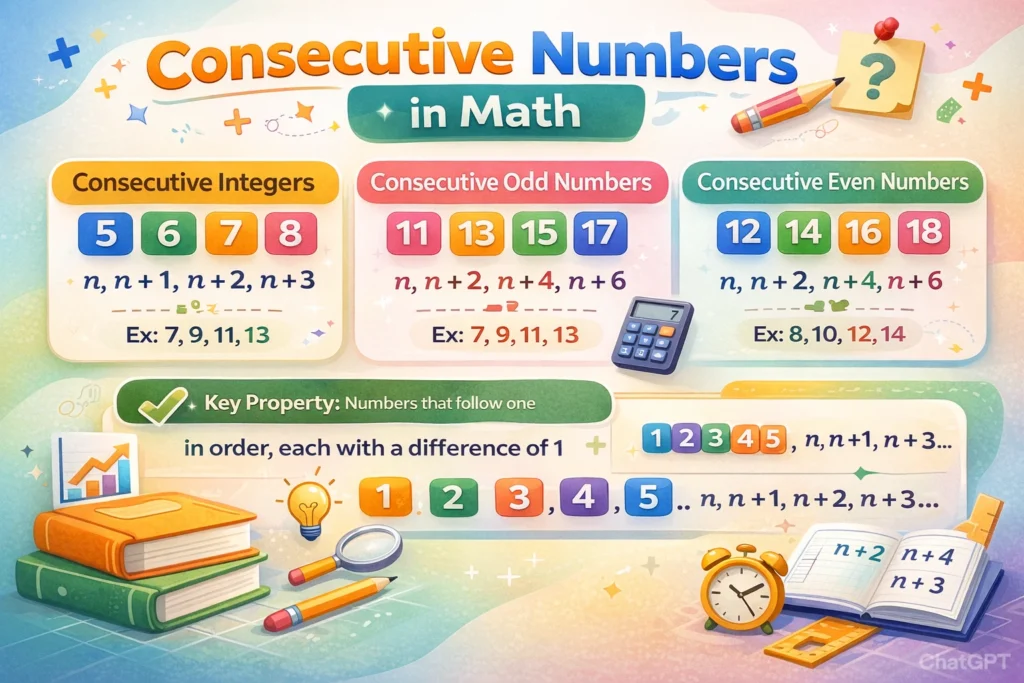
In mathematics, consecutive refers to numbers, integers, or elements that follow one another in order without any gaps.
For example, 4, 5, and 6 are consecutive numbers because each number comes immediately after the previous one.
At first glance, the word consecutive sounds technical. In reality, it describes one of the simplest and most powerful ideas in mathematics. Consecutive numbers are numbers that follow each other in order without gaps. That is it. Simple. Yet this small concept quietly unlocks dozens of algebra tricks, number puzzles, and problem solving shortcuts.
Think about the numbers 4, 5, and 6. They are consecutive because each number increases by one. The same idea applies to 21 and 22, or even negative numbers like minus 3, minus 2, and minus 1. When numbers move step by step with no interruptions, they are consecutive. This pattern may look basic, but it becomes incredibly useful when solving equations, finding sums, or identifying number relationships.
In 2026, consecutive numbers continue to play a major role in algebra, competitive exams, coding logic, and data sequencing. Many word problems rely on consecutive integers. For example, if the sum of three consecutive numbers is 45, you can represent them as x, x plus 1, and x plus 2. That small setup transforms a confusing question into a clean algebraic equation.
Consecutive patterns also appear in geometry, statistics, and programming sequences. Recognizing them quickly helps reduce complex problems into organized steps. Instead of guessing, you apply structure.
Understanding the concept of consecutive numbers is essential for solving problems in arithmetic, algebra, and even real-world scenarios like scheduling or statistics. It may sound simple, but recognizing consecutive sequences can make a huge difference in calculations and logical reasoning.
Origin of the Term “Consecutive”
The word consecutive comes from the Latin word consecutivus, which means “following closely” or “succeeding in order.” Over time, it evolved in English to refer not only to general sequences but specifically to sequences in mathematics, sports, time, and other ordered systems.
Mathematically, it gained popularity in school curricula because understanding consecutive numbers lays the foundation for advanced concepts like arithmetic progressions, series, and pattern recognition.
Usage of Consecutive in Math
In mathematics, consecutive is most commonly used with:
- Integers: Numbers like 1, 2, 3, or 10, 11, 12.
- Odd or even numbers: Consecutive odd numbers such as 3, 5, 7, or consecutive even numbers like 2, 4, 6.
- Other sequences: In some contexts, consecutive fractions, decimals, or steps in an algorithm.
Consecutive numbers are also widely used in problem-solving questions where patterns or sums are involved. For example:
- Finding the sum of consecutive numbers from 1 to 10.
- Determining three consecutive integers whose product is a given number.
- Identifying consecutive even numbers in probability problems.
Examples of Consecutive Numbers
Here are some examples to make it easier to visualize:
Table 1: Basic Consecutive Numbers
| Type | Example Sequence |
|---|---|
| Consecutive Integers | 7, 8, 9, 10 |
| Consecutive Odd Numbers | 1, 3, 5, 7 |
| Consecutive Even Numbers | 2, 4, 6, 8 |
| Consecutive Negative Numbers | -3, -2, -1, 0 |
Notice how each number immediately follows the previous one without skipping.
Contextual Examples
- Friendly Tone: “Imagine you are lining up your favorite books. If you place the first, second, and third books side by side, those positions are consecutive!” 📚
- Neutral Tone: “In mathematics, consecutive integers are useful for solving algebraic equations or finding averages.”
- Dismissive/Negative Tone: “It’s basic, but you’d be surprised how often people confuse consecutive with random numbers. Don’t make that mistake!”
Consecutive in Word Problems
Many students encounter consecutive numbers in word problems. Here’s a classic example:
Example:
Find three consecutive integers whose sum is 48.
Solution:
- Let the first integer be x.
- The next two consecutive integers are x+1 and x+2.
- The sum is x+(x+1)+(x+2)=3x+3.
- Set the sum equal to 48: 3x+3=48.
- Solve: 3x=45, x=15.
So the consecutive integers are 15, 16, 17.
Consecutive Odd and Even Numbers
Consecutive odd or even numbers follow the same pattern but differ by 2 instead of 1.
Table 2: Consecutive Odd and Even Numbers
| Sequence Type | Formula | Example |
|---|---|---|
| Consecutive Odd | x,x+2,x+4 | 5, 7, 9 |
| Consecutive Even | x,x+2,x+4 | 4, 6, 8 |
This distinction is essential when solving problems involving parity, divisibility, or pattern recognition.
Comparison with Related Terms
| Term | Meaning | Difference from Consecutive |
|---|---|---|
| Sequence | An ordered list of numbers | Not all sequences are consecutive |
| Continuous | No interruption or break | Continuous refers to space/time, not necessarily numbers |
| Arithmetic Progression | Numbers increase/decrease by a constant gap | Can have gaps larger than 1, not always consecutive |
| Successive | Following in order | Often interchangeable but broader than consecutive |
Alternate Meanings of Consecutive
While most commonly used in math, “consecutive” can also appear in:
- Sports: “The team won three consecutive matches.”
- Time: “He worked for five consecutive hours.”
- Events: “They had consecutive meetings scheduled.”
In professional or academic writing, you could use alternatives like successive, sequential, or back-to-back when appropriate.
Tips for Recognizing Consecutive Numbers
- Look for a difference of 1 (or 2 for odd/even numbers).
- Check the context: Are the numbers part of integers, odd, or even sequences?
- Use formulas in algebra to represent consecutive numbers (like x,x+1,x+2).
- Practice word problems with sums, products, or averages.
Polite or Professional Alternatives
If writing for formal documents or instructions, you can replace consecutive with:
- Successive: “Three successive integers…”
- Sequential: “Sequential numbers starting from 10…”
- Back-to-back: “The system logged back-to-back events…”
Example Table of Consecutive Numbers in Word Problems
| Problem Type | Equation Representation | Example Solution |
|---|---|---|
| Sum of 3 consecutive numbers | x+(x+1)+(x+2)=48 | 15, 16, 17 |
| Sum of 2 consecutive odd numbers | x+(x+2)=28 | 13, 15 |
| Product of 2 consecutive numbers | x(x+1)=56 | 7, 8 |
FAQs
1. What are consecutive numbers?
Consecutive numbers are numbers that follow each other in order without any gaps.
2. How do I find consecutive numbers in a problem?
Assign a variable for the first number (e.g., x) and represent others as x+1,x+2, etc.
3. Can consecutive numbers be negative?
Yes. Negative numbers like -5, -4, -3 are consecutive integers.
4. What is the difference between consecutive and successive numbers?
They are similar, but successive is broader and can refer to sequences that may skip certain values.
5. How do consecutive odd numbers work?
Consecutive odd numbers increase by 2. Example: 1, 3, 5, 7.
6. Are consecutive numbers always integers?
Typically, yes, but in some contexts, decimals or fractions could form consecutive sequences.
7. Can consecutive numbers be used in algebra?
Absolutely. Algebra often represents consecutive integers with formulas like x,x+1,x+2.
8. Why are consecutive numbers important?
They help in arithmetic, pattern recognition, problem-solving, and real-life planning.
Conclusion
Consecutive numbers are a simple yet powerful concept in mathematics. They provide the foundation for arithmetic, algebra, pattern recognition, and real-life problem-solving. By understanding the differences between consecutive, odd/even sequences, and related terms like successive or sequential, you can tackle math problems more efficiently.
Remember to look for sequences with a consistent difference (usually 1 for integers, 2 for odd/even), practice algebraic representations, and apply the concept to both numbers and real-world scenarios.
Next time you see consecutive numbers, you’ll see patterns and possibilities instead of just numbers lined up.
Read More Related Articles:
- Someone Texted You “TS”? Here’s What It Means and How to Respond (2026)
- “Eres” Meaning in Spanish: More Than Just “You Are” In 2026
- PH Means in Texting: Meaning Most People Get Wrong (2026)

Neon Samuel is a digital content creator at TextSprout.com, dedicated to decoding modern words, slang, and expressions. His writing helps readers quickly grasp meanings and understand how terms are used in real conversations across text and social platforms.