
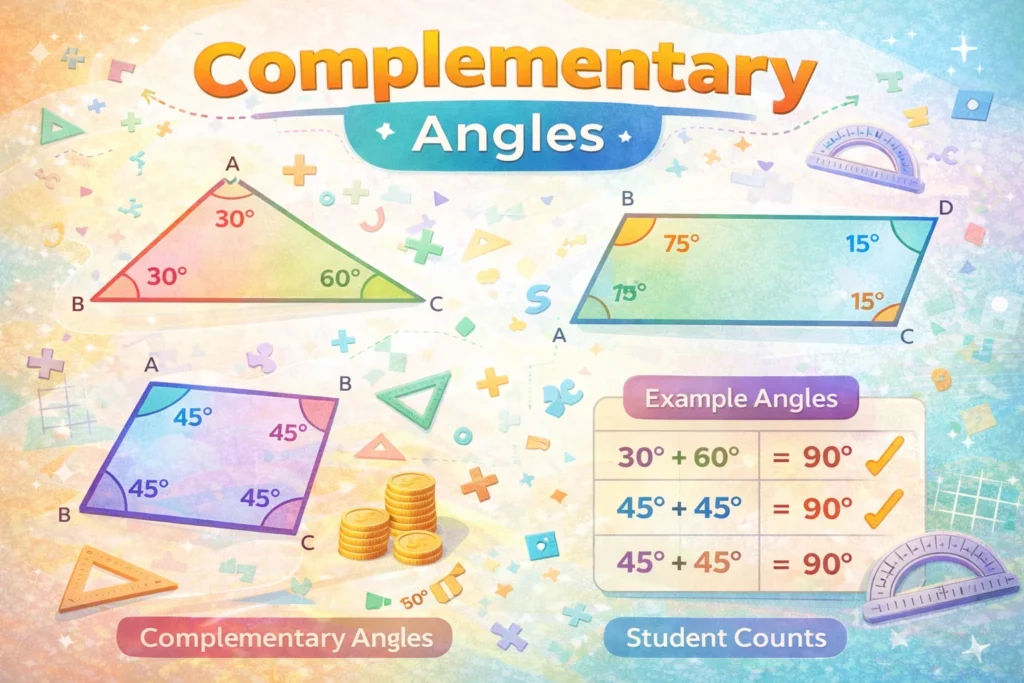
In geometry, complementary angles are two angles whose measures add up to exactly 90 degrees. Each angle complements the other, meaning that together they form a right angle.
In geometry, some of the most powerful ideas are built on simple relationships. One of those ideas is complementary angles. The concept is straightforward, yet it plays a huge role in solving angle problems, understanding shapes, and building strong foundations in mathematics.
Complementary angles are two angles whose measures add up to 90 degrees. That is the key rule. If one angle measures 35 degrees, its complementary angle must measure 55 degrees because together they form a right angle. This relationship appears constantly in triangles, coordinate geometry, construction, and even real world design.
In 2026, understanding why 90 degrees matters is more than a classroom requirement. Right angles define structure in architecture, screen layouts in technology, and precision in engineering. Knowing how complementary angles work helps students solve equations faster, recognize patterns quickly, and approach geometric problems with confidence.
Understanding the concept of complementary angles is fundamental in mathematics, especially in geometry, trigonometry, and real-world applications like construction, design, and engineering. Even if you’ve never thought much about angles beyond your high school classroom, complementary angles appear in everyday scenarios—think of corner walls, computer screens, or even a slice of pizza that isn’t quite a full right angle.
Let’s dive deep into what “complementary” really means in geometry, its origin, examples, comparisons with related concepts, and practical applications.
Origin of the Term “Complementary” in Geometry
The word complementary comes from the Latin word complementum, which means “something that completes.” In the context of geometry, one angle is said to complete another angle to reach a total of 90 degrees.
Historically, the concept was popularized in Euclidean geometry, where understanding the relationships between angles, triangles, and other shapes was crucial. Over time, it became a standard term in textbooks, exams, and real-world measurements.
Complementary angles are not just a theoretical concept—they’re used in fields like:
- Architecture and interior design
- Engineering and construction
- Computer graphics and animation
- Trigonometry and calculus
Knowing which angles complement each other ensures precision and accuracy in these applications.
Usage of Complementary Angles
Complementary angles are everywhere. Their primary property is simple but powerful:
Sum of two complementary angles = 90°
Here’s how they are commonly used:
- In right triangles: The two non-right angles of a right triangle are always complementary because the right angle itself measures 90°.
- Construction and carpentry: Ensuring corner joints meet at a right angle often involves measuring complementary angles.
- Trigonometry: Complementary angles have special relationships in sine, cosine, and tangent functions. For example, sin(θ) = cos(90° − θ).
- Everyday objects: Screens, doors, ramps, or any right-angled structure indirectly rely on complementary angles for proper alignment.
In teaching, complementary angles often serve as a stepping stone to understanding adjacent angles, supplementary angles, and angle pairs in more complex geometric problems.
Examples of Complementary Angles
Here are some clear examples to understand complementary angles in context:
| Angle A | Angle B | Are they complementary? | Notes |
|---|---|---|---|
| 30° | 60° | Yes | 30° + 60° = 90° |
| 45° | 45° | Yes | Two equal angles forming a right angle |
| 20° | 70° | Yes | Common in real-world triangle problems |
| 40° | 50° | Yes | Often appears in polygon angle calculations |
| 60° | 25° | No | Sum = 85°, not complementary |
Real-world Examples
- Friendly context: A carpenter measures a 35° angle for a custom table leg and needs a complementary angle of 55° for the adjoining support. ✅
- Neutral context: In a triangle with a right angle, the remaining angles must add up to 90° to satisfy geometric rules.
- Negative or dismissive context: Claiming that angles measuring 20° and 60° are complementary is incorrect since their sum is 80°, not 90°. ⚠️
How to Identify Complementary Angles
Identifying complementary angles is simple with these steps:
- Add the two angles.
- Check if the sum equals 90°.
- If yes, they are complementary. If no, they are not.
Tips for students and professionals:
- Remember the mnemonic: “Complementary completes the right angle.”
- Use a protractor to measure unknown angles.
- In trigonometry, look for relationships like sin(θ) = cos(90° − θ).
Comparison With Related Terms
It’s helpful to distinguish complementary angles from other angle-related terms:
| Term | Definition | Key Difference from Complementary |
|---|---|---|
| Complementary angles | Two angles adding up to 90° | Forms a right angle together |
| Supplementary angles | Two angles adding up to 180° | Forms a straight line, not a right angle |
| Adjacent angles | Two angles sharing a common vertex and side | Can be complementary or not |
| Right angle | Angle measuring exactly 90° | Complementary angles sum to this |
So, while complementary and supplementary both deal with sums of angles, complementary angles specifically focus on the right angle total, while supplementary deals with straight lines.
Alternate Meanings of “Complementary”
While in geometry, “complementary” has a precise meaning, it can also appear in other contexts:
- General English: Something that completes or goes well with another.
- Example: “The red scarf is complementary to her outfit.”
- Biology: Complementary DNA strands pair perfectly (A-T, C-G).
- Marketing: Free complementary items are extra gifts or bonuses.
When using the term in a professional or educational setting, the geometric meaning should be clear by context.
Professional alternatives in geometry:
- Right-angle pair
- Angle complement
- Completing angles
Fun Facts About Complementary Angles
- Angles in a right triangle: Always complementary if not the right angle itself.
- Trigonometric connection: Cosine and sine are complementary functions: sin(θ) = cos(90° − θ).
- Real-life observation: Every corner of a square or rectangle has angles that are technically “pairs” of complementary angles when split diagonally.
Example Problems Table
| Problem | Solution |
|---|---|
| Find the complement of 35° | 90° − 35° = 55° |
| Two angles are complementary, one is 25° | Other angle = 90° − 25° = 65° |
| Are 40° and 55° complementary? | 40° + 55° = 95°, so No |
| Angle A = 50°, Angle B = ? | Angle B = 90° − 50° = 40° |
| If angle X + angle Y = 90°, and angle X = 70° | Angle Y = 20° |
Tips for Working With Complementary Angles
- Double-check your addition: Small mistakes in sums can lead to errors.
- Use diagrams: Visuals help identify complementary angles quickly.
- Apply in real life: Observe angles in doors, corners, or screens.
- Trigonometric check: sin(θ) = cos(90° − θ) can confirm complementary angles in calculations.
- Use technology: Apps, geometry software, or protractors can verify angles precisely.
FAQs
What does complementary mean in geometry?
Complementary angles are two angles that add up to 90 degrees. They complete each other to form a right angle.
Are complementary angles always adjacent?
Not necessarily. Complementary angles can be adjacent (sharing a side) or separate in different parts of a diagram.
Can complementary angles be equal?
Yes, for example, two 45° angles are complementary and equal.
How do you find the complement of an angle?
Subtract the given angle from 90°. For instance, the complement of 60° is 30°.
Are all angles in a right triangle complementary?
Only the two non-right angles are complementary. The right angle itself is 90°.
Can angles greater than 90° be complementary?
No. Complementary angles must each be less than 90° to sum to 90°.
What is the difference between complementary and supplementary angles?
Complementary angles sum to 90°, while supplementary angles sum to 180°.
Where are complementary angles used in real life?
They are used in construction, carpentry, trigonometry, engineering, and designing objects with right angles.
Conclusion
Complementary angles are a simple yet essential concept in geometry. They teach us how angles can work together to form right angles, appear in everyday structures, and even connect to trigonometric functions.
- Complementary angles always sum to 90°.
- They may or may not be adjacent.
- Found in triangles, construction, and design.
- Useful in both theoretical math and real-world applications.
By mastering complementary angles, you build a solid foundation for understanding more advanced geometric principles and practical applications. Always remember: they are the angles that “complete” each other perfectly! 🎯
Read More Related Articles:
- What Does RT Mean in Messages? Hidden Meanings Behind RT (2026)
- What Does PK Mean in Betting? How Pick’em Lines Work in Sportsbooks In 2026
- What Does GG Mean in Text? Discover the Hidden Meaning (2026)

Neon Samuel is a digital content creator at TextSprout.com, dedicated to decoding modern words, slang, and expressions. His writing helps readers quickly grasp meanings and understand how terms are used in real conversations across text and social platforms.