
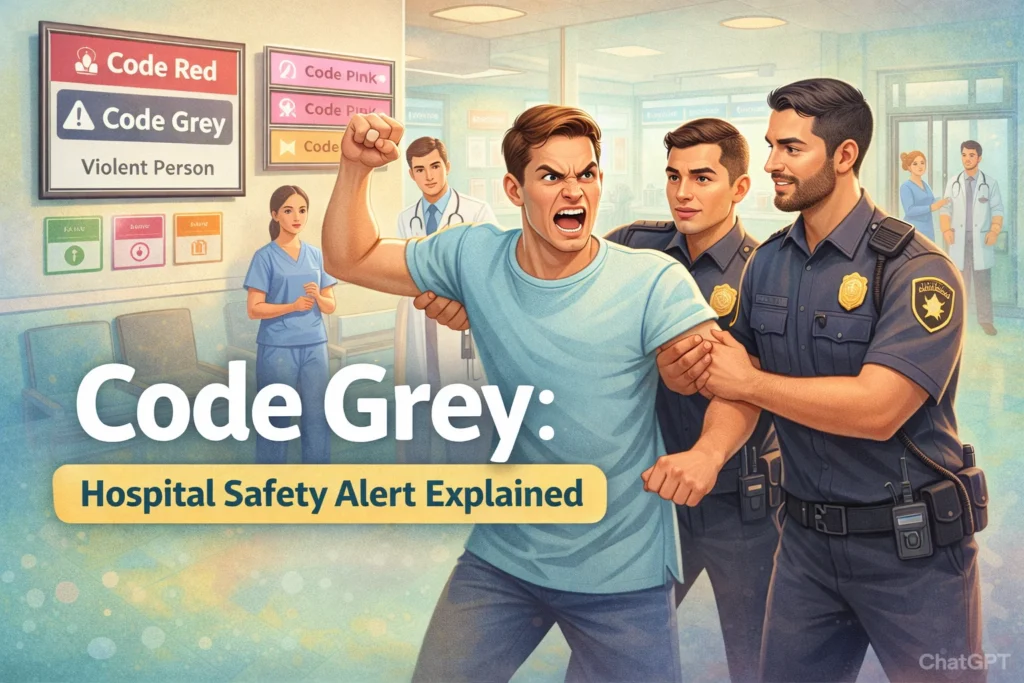
Code Grey in a hospital refers to a specific alert indicating a combative or aggressive person, often a patient, visitor, or staff member, requiring immediate security intervention. It is part of a standardized hospital emergency code system used to maintain safety and protect both patients and healthcare professionals.
Hospitals can be stressful environments, with emergencies ranging from medical crises to security threats. Among the many codes—like Code Blue for cardiac arrest or Code Red for fire—Code Grey specifically deals with aggression, violence, or threats within the hospital premises. Understanding its meaning, purpose, and proper response can help staff, visitors, and patients stay safe.
Origin of Code Grey
The term Code Grey has a fascinating history rooted in hospital safety protocols.
- Standardization of Hospital Codes:
Hospital emergency codes were created to quickly communicate emergencies without alarming patients unnecessarily. Colors and numbers were chosen for simplicity and rapid recognition. - Why Grey?
Grey often symbolizes caution, neutrality, or an alert that is serious but not immediately life-threatening. Hospitals adopted this color to indicate a security concern that requires attention but differs from medical emergencies like cardiac arrests. - Global Usage:
While many hospitals in North America, Australia, and New Zealand use Code Grey for aggressive persons, the exact color-code meanings can vary. Some hospitals may combine Code Grey with additional identifiers, such as Code Grey – Physical Assault or Code Grey – Threatening Behavior.
Real-World Usage of Code Grey
Code Grey is activated when:
- A patient becomes physically aggressive toward staff or other patients.
- A visitor or intruder exhibits threatening behavior.
- Staff members witness or anticipate a violent situation requiring intervention.
The purpose is clear: to mobilize trained security or emergency response teams efficiently. By using a standardized code, staff can maintain calm and coordinate safety measures discreetly.
Key Features of Code Grey Response
- Immediate notification of hospital security
- Use of de-escalation techniques
- Possible involvement of police if situation escalates
- Documentation and review after the incident
Example Table: Situations Triggering Code Grey
| Situation | Response Required | Tone/Consideration |
|---|---|---|
| Patient throwing objects in ER | Call security, maintain safe distance | Neutral, professional |
| Visitor yelling threats in waiting area | Activate Code Grey, alert staff | Friendly but firm |
| Staff member threatened by aggressive behavior | Immediate intervention, possibly remove aggressor | Polite and professional |
Examples of Code Grey in Context
Understanding Code Grey is easier when we see how it applies in real scenarios.
- Friendly Context:
- A confused patient becomes frustrated and raises their voice. Security arrives calmly, assists staff, and helps de-escalate the situation without incident.
- Neutral Context:
- A visitor refuses to leave a restricted area. Security responds after Code Grey is announced and escorts them out safely.
- Negative or High-Risk Context:
- A patient physically attacks a nurse. Code Grey is activated, multiple security personnel intervene, and police may be notified. ⚠️
💡 Tip: Using a code instead of loudly announcing “violence” helps prevent panic among patients and maintains order.
Comparison with Related Hospital Codes
Hospitals use a variety of color-coded alerts. Understanding the differences is critical for staff, volunteers, and visitors.
| Code | Meaning | Notes |
|---|---|---|
| Code Blue | Cardiac or respiratory arrest | Immediate medical response |
| Code Red | Fire or smoke | Evacuation may be needed |
| Code Pink | Infant or child abduction | High alert, search initiated |
| Code Grey | Aggressive or combative person | Security intervention needed |
| Code Black | Bomb threat | Evacuation or lockdown protocols |
| Code White | Pediatric medical emergency | May vary by hospital |
Key Difference: Code Grey is about aggression or violence, not a medical emergency. While Code Blue is life-threatening, Code Grey focuses on maintaining safety and preventing harm.
Alternate Meanings and Interpretations
While the primary hospital meaning of Code Grey is about aggressive behavior, the term may have other interpretations in different contexts:
- IT or Security: Sometimes “Code Grey” can refer to system alerts or cybersecurity issues, though this is not hospital-specific.
- Non-Hospital Settings: Schools or corporate facilities may adopt similar codes for aggressive behavior, inspired by hospital protocols.
Professional Alternatives for Communication
Instead of saying “Code Grey” publicly, hospitals may opt for:
- “Security assistance needed in [area]”
- “Assistance required for combative individual”
- “Behavioral alert”
These phrases maintain professionalism and reduce panic among patients or visitors.
How to Respond to Code Grey Situations
For Hospital Staff
- Remain calm and keep a safe distance.
- Avoid confrontation unless trained.
- Alert security immediately using the Code Grey system.
- Follow de-escalation protocols.
For Visitors or Patients
- Do not approach aggressive individuals.
- Follow staff instructions promptly.
- Move to a safe area if necessary.
Table: Quick Response Checklist for Code Grey
| Step | Action | Responsible Party |
|---|---|---|
| 1 | Recognize aggressive behavior | Any staff/observer |
| 2 | Alert security via Code Grey | Staff/Reception |
| 3 | Maintain safe distance | Everyone nearby |
| 4 | Assist de-escalation if trained | Trained staff/security |
| 5 | Document incident | Supervisor/HR |
FAQs
What does Code Grey mean in simple terms?
It means there is a combative or aggressive person in the hospital, and security needs to respond immediately.
Who activates a Code Grey?
Usually, hospital staff, nurses, or reception personnel who witness the aggression.
Is Code Grey a medical emergency?
No, it is a security or behavioral alert, not a medical one like Code Blue.
Can visitors trigger a Code Grey?
Yes, any person, including visitors, staff, or patients, can trigger it if they display threatening behavior.
What should I do if I hear a Code Grey?
Stay calm, follow staff instructions, and maintain a safe distance from the area.
Are Code Grey protocols the same in every hospital?
No, protocols vary by region and hospital policy, though the general meaning is consistent.
Does Code Grey always involve physical violence?
Not always. Verbal threats or highly aggressive behavior may also trigger it.
Why is it called Grey?
Grey symbolizes caution and neutrality, signaling a serious but non-medical emergency.
Conclusion
Understanding Code Grey is essential for anyone entering or working in a hospital. It ensures safety, allows staff to respond efficiently, and helps protect patients, visitors, and personnel.
- Code Grey is about aggression or combative behavior.
- It requires immediate security response.
- Different hospitals may have slight variations in protocol.
- Staying calm, following instructions, and maintaining distance are critical.
- Awareness of related codes helps prevent confusion during emergencies.
By learning the meaning and purpose of Code Grey, hospitals and communities can create safer environments for everyone.
Read More Related Articles:
- Zeal Meaning in the Bible: Passion or Problem? (2026)
- Rebuke Mean in the Bible: Learn Its Meaning and Power (2026)
- What Does NIL Stand For? The New Era of College Football In 2026

Ivy Madison is a content creator at TextSprout.com, specializing in word definitions, internet slang, acronyms, and text abbreviations. She delivers clear and engaging explanations, helping readers quickly understand modern digital language and trending terms.