
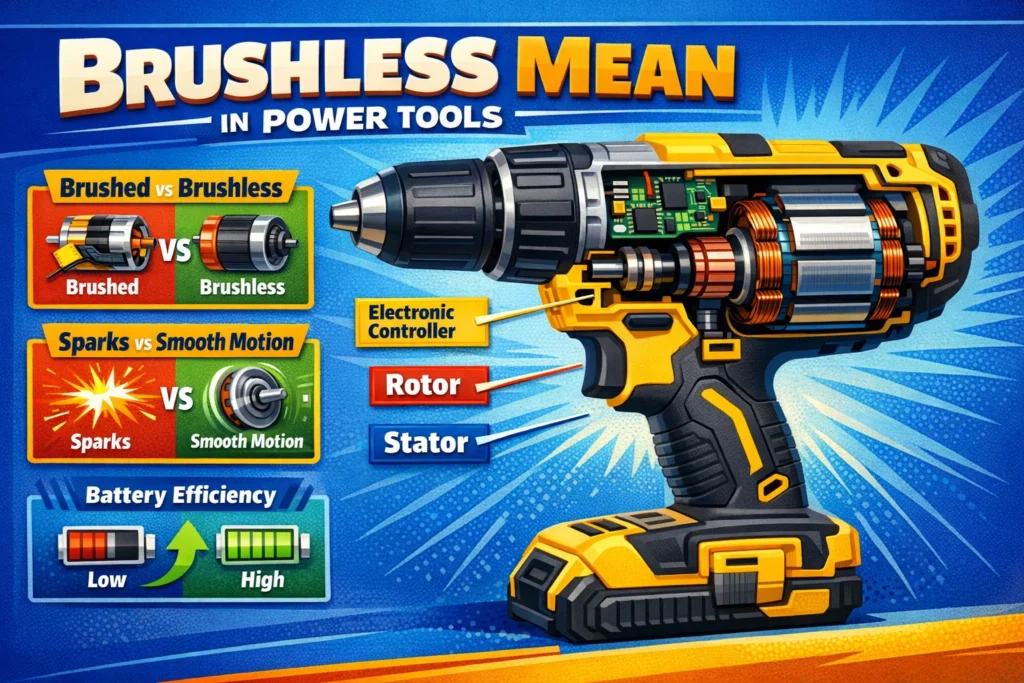
Brushless in power tools refers to a type of electric motor that operates without carbon brushes.
Instead of using physical brushes to transfer electricity to the motor, a brushless motor uses electronic controllers to manage power and rotation.
This design reduces friction, improves efficiency, increases battery life, and makes the tool more durable compared to traditional brushed motors.
If you’ve ever shopped for a drill, impact driver, or cordless saw, you’ve probably noticed the term “brushless motor” printed on many power tools. Manufacturers often highlight this feature as a major advantage, but many people are unsure what it actually means.
Does it make the tool stronger?
Does it last longer?
And is a brushless tool really worth the extra cost?
Understanding what brushless means in power tools can help you choose the right equipment for DIY projects, home repairs, or professional construction work. Once you understand how these motors work, the benefits become much clearer.
Before diving deeper, let’s start with a simple definition.
In simple terms, brushless power tools run cooler, last longer, and use energy more efficiently.
Understanding How Brushless Motors Work
To understand brushless motors, it helps to first understand how traditional motors work.
Many older power tools use brushed motors, which rely on physical components called carbon brushes to deliver electricity to the spinning part of the motor.
These brushes constantly touch a rotating component called the commutator.
While this design works well, it also creates:
- friction
- heat
- wear and tear
- energy loss
Brushless motors eliminate this problem.
Instead of mechanical brushes, they use electronic circuitry to control the motor’s movement.
Basic Brushless Motor Process
- Battery sends electricity to the electronic controller
- Controller directs power to coils inside the motor
- Magnetic forces rotate the motor shaft
- Sensors adjust power for optimal performance
Because there are no brushes rubbing against moving parts, the system is smoother and more efficient.
Key Parts of a Brushless Motor
| Component | Function |
|---|---|
| Electronic Controller | Regulates power and motor speed |
| Stator | Stationary coils that create magnetic fields |
| Rotor | Rotating component that spins the tool |
| Sensors | Monitor position and adjust power flow |
These components work together to create a precise and efficient motor system.
Why Power Tool Manufacturers Use Brushless Motors
Brushless technology has become extremely popular in modern cordless power tools. Manufacturers prefer it because it improves both performance and durability.
Here are the most important reasons companies use brushless motors.
1. Higher Efficiency
Brushless motors convert more electricity into usable power.
Less energy is wasted as heat or friction.
This means the tool delivers stronger performance while using less battery power.
2. Longer Tool Life
Traditional brushes gradually wear down over time.
Since brushless motors do not contain brushes, they require less maintenance and last longer.
3. Better Battery Life
Because brushless motors waste less energy, batteries last longer between charges.
This is especially valuable for cordless tools used on job sites.
4. Less Heat
Reduced friction means the motor generates less heat.
Lower heat helps protect internal components.
5. More Power Control
Electronic systems can adjust motor speed and torque instantly.
This allows the tool to respond better to different materials.
Brushless vs Brushed Power Tools
Understanding the differences between the two motor types can make your purchasing decision easier.
| Feature | Brushless Motor | Brushed Motor |
|---|---|---|
| Brushes | No | Yes |
| Efficiency | High | Moderate |
| Maintenance | Very low | Brushes wear out |
| Heat generation | Low | Higher |
| Battery life | Longer | Shorter |
| Cost | Higher | Lower |
Both types can work well, but brushless tools usually offer better long term performance.
Examples of Brushless Power Tools
Many modern tools now use brushless motors.
Here are common examples.
| Tool Type | Typical Use |
|---|---|
| Cordless drill | Drilling holes and driving screws |
| Impact driver | Fast screw and bolt installation |
| Circular saw | Cutting wood and construction materials |
| Angle grinder | Grinding and cutting metal |
| Reciprocating saw | Demolition and rough cutting |
| Leaf blower | Outdoor yard work |
Most major tool brands now offer brushless versions of these tools.
Real World Example of Brushless Performance
Imagine using a cordless drill to build a deck.
A brushed drill might lose power quickly and drain the battery faster.
A brushless drill behaves differently.
The electronic controller senses resistance when drilling into tough wood.
Instead of wasting energy, it automatically adjusts power to maintain speed.
This results in:
- smoother drilling
- longer battery life
- less overheating
For professionals who use tools all day, this difference can be significant.
Advantages of Brushless Power Tools
Here are the biggest benefits users notice.
Stronger Performance
Brushless motors deliver higher torque and consistent power.
Longer Battery Runtime
Less wasted energy means more work per battery charge.
Longer Tool Lifespan
Without brushes wearing down, internal parts last longer.
Quieter Operation
Brushless motors often run more smoothly and quietly.
Smart Power Control
Electronics adjust power depending on workload.
Potential Disadvantages of Brushless Tools
Although brushless technology offers many advantages, there are a few tradeoffs.
Higher Price
Brushless tools usually cost more because they include electronic controllers.
More Complex Electronics
If something fails, repairs may be more expensive.
However, failures are relatively rare compared to worn brushes in traditional motors.
Signs a Tool Uses a Brushless Motor
Manufacturers usually advertise brushless motors clearly.
Look for labels such as:
- Brushless Motor
- BL Motor
- Advanced Brushless Technology
Tool packaging and product descriptions typically highlight this feature.
How to Decide if Brushless Tools Are Worth It
Whether brushless tools are worth the investment depends on how often you use them.
| User Type | Recommendation |
|---|---|
| Occasional DIY user | Brushed tools may be enough |
| Home improvement enthusiast | Brushless tools are a great upgrade |
| Professional contractor | Brushless tools are strongly recommended |
Frequent users benefit most from efficiency, durability, and longer battery life.
Brushless Tools and Battery Technology
Brushless motors work especially well with modern lithium ion batteries.
The electronic control system can communicate with the battery to optimize performance.
This allows:
- intelligent power management
- longer battery lifespan
- consistent speed under load
Many manufacturers design entire tool systems around this technology.
Common Misconceptions About Brushless Motors
Some myths surround brushless power tools.
Let’s clear up a few.
| Myth | Reality |
|---|---|
| Brushless tools are always more powerful | They are usually more efficient, not always stronger |
| Brushless motors never fail | They still contain electronics that can break |
| Brushless tools are only for professionals | DIY users can benefit too |
Understanding these facts helps buyers make informed decisions.
FAQs
What does brushless mean in power tools?
Brushless refers to a motor design that operates without carbon brushes. Instead, electronic controllers manage the flow of electricity to rotate the motor.
Are brushless power tools better than brushed tools?
In most cases yes. Brushless tools are more efficient, last longer, produce less heat, and often provide longer battery life.
Do brushless tools have more power?
They can deliver strong and consistent power because energy is used more efficiently. However, overall power also depends on the tool design and battery.
Why are brushless tools more expensive?
They include advanced electronic control systems that increase manufacturing costs.
Do brushless motors require maintenance?
Very little maintenance is needed because there are no brushes to replace.
How long do brushless motors last?
Brushless motors often last significantly longer than brushed motors because fewer parts wear out.
Are brushless tools worth it for home use?
Yes if you frequently use power tools. Occasional users may not notice a big difference.
Can brushless motors overheat?
They can heat up under heavy loads, but they generally run cooler than brushed motors.
Conclusion
Brushless technology has transformed modern power tools by making them more efficient, durable, and intelligent.
By eliminating traditional carbon brushes and replacing them with electronic controls, brushless motors reduce friction and energy loss. The result is longer battery life, smoother performance, and tools that last longer.
While brushless power tools usually cost more upfront, they often provide better value over time, especially for people who use their tools regularly.
Whether you are a DIY enthusiast or a professional contractor, understanding what brushless means in power tools can help you choose equipment that delivers reliable performance and long term durability.
Read More Related Articles:
- MS Meaning in Coins: How It Affects Price and Rarity In 2026
- ESP Mean in a Car: Every Driver Should Know In 2026
- White Heart Mean in Text: More Than Just a Pretty Symbol In 2026

Neon Samuel is a digital content creator at TextSprout.com, dedicated to decoding modern words, slang, and expressions. His writing helps readers quickly grasp meanings and understand how terms are used in real conversations across text and social platforms.