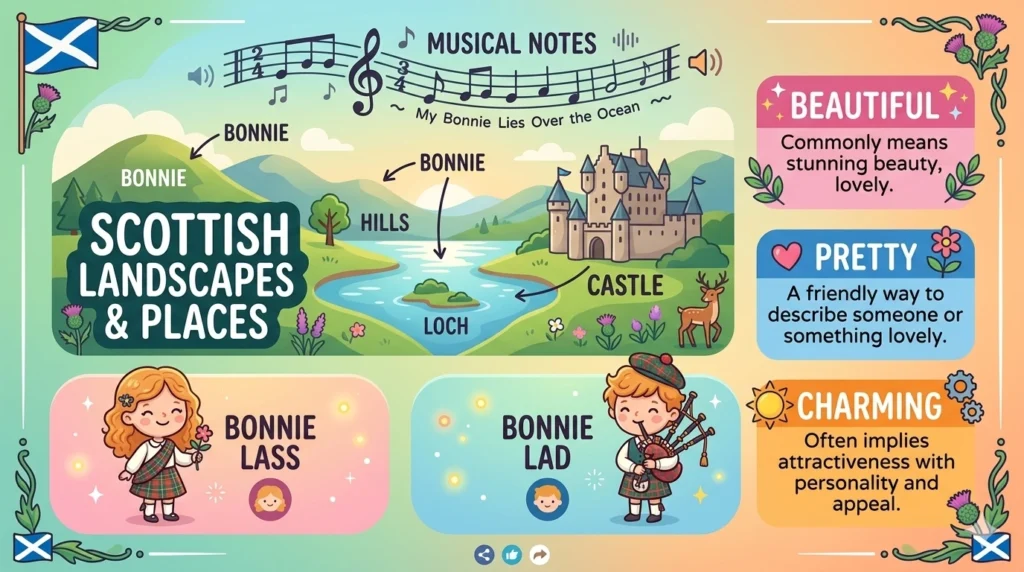
In Scottish language and culture, “Bonnie” means beautiful, pretty, or attractive. It is commonly used to describe people, places, or objects in an affectionate, complimentary way.
For example, saying “She’s a bonnie lass” in Scotland means “She’s a pretty girl.”
The word carries a warm, friendly tone, often invoking charm, youthfulness, or endearment. It is deeply embedded in Scottish dialects, literature, songs, and everyday conversation, making it one of the most recognizable Scottish expressions worldwide.
Understanding Bonnie in its cultural and linguistic context gives insight into Scottish traditions, speech patterns, and the emotional resonance of language.
Origin and Historical Context of “Bonnie”
The word Bonnie has roots in the Scots language, which evolved from early Northern Middle English and was influenced by Old English, Norse, and Gaelic over centuries. Its earliest recorded use dates back to the 15th century, primarily in Scotland, where it described beauty or goodness.
Historical Examples
- In 16th-century Scottish poetry, writers often used “bonnie” to praise the physical beauty of women or the aesthetic charm of landscapes.
- Traditional Scottish songs like “My Bonnie Lies Over the Ocean” (circa 19th century) popularized the word internationally, embedding it into global culture as a symbol of Scottish charm.
- Literature by authors such as Sir Walter Scott frequently employed “bonnie” to create vivid imagery, describing both people and scenery.
The word’s popularity grew beyond Scotland through music, films, and literature, often representing an affectionate, nostalgic, or romantic notion of Scotland.
Meaning and Usage of Bonnie in Scottish Context
In contemporary Scottish usage, Bonnie serves as both an adjective and a term of endearment:
- Describing Beauty or Attractiveness
- Example: “That’s a bonnie day!” → That’s a beautiful day
- Example: “You’ve got a bonnie smile.” → You have a pretty smile
- Affectionate or Endearing Term
- Example: “Bonnie lass” → Pretty girl
- Example: “Bonnie lad” → Handsome boy
- Describing Places and Objects
- Example: “The Highlands are bonnie.” → The Highlands are beautiful
- Example: “What a bonnie painting!” → What a lovely painting
Tone Variations:
- Friendly and positive
- Romantic or admiring
- Poetic or nostalgic
The word is rarely negative and is always associated with something appealing or charming.
Examples of Bonnie in Everyday Scottish Speech
Table 1: Examples in Conversation
| Context | Scottish Phrase | Meaning in English |
|---|---|---|
| Compliment to a woman | She’s a bonnie lass | She’s a beautiful girl |
| Compliment to a man | He’s a bonnie lad | He’s a handsome boy |
| Admiring scenery | The glen is bonnie today | The valley is beautiful today |
| Admiring objects | That painting is bonnie | That painting is lovely |
| General compliment | You look bonnie | You look attractive or charming |
Friendly Example
- “Aye, that’s a bonnie wee cottage by the loch.”
Translation: Yes, that’s a beautiful small cottage by the lake.
Neutral Example
- “It’s a bonnie day for a walk.”
Translation: It’s a lovely day for a walk.
Romantic Example
- “Bonnie lass, will you join me for tea?”
Translation: Pretty girl, will you join me for tea?
Comparison With Related Terms
Several Scottish or English words may appear similar but have slightly different connotations:
| Term | Meaning | Difference from Bonnie | Example |
|---|---|---|---|
| Lovely | Pleasant or attractive | More general, less dialect-specific | “That’s a lovely view” |
| Beautiful | Visually appealing | Formal English; not Scottish dialect | “She is beautiful” |
| Pretty | Attractive in a delicate way | Less poetic than Bonnie | “You look pretty” |
| Fair | Attractive, often light-skinned | Archaic in modern use | “A fair maiden” |
| Handsome | Attractive for men or objects | Gender-specific; formal | “A handsome boy” |
Tip: Use Bonnie in Scottish contexts for charm, warmth, and authenticity. Other terms may convey similar meaning but lack the cultural nuance.
Alternate Meanings and Uses
While Bonnie primarily refers to beauty or attractiveness, it has other nuances in specific contexts:
- Affection or Endearment:
- “My bonnie boy” can imply affection, not just looks.
- Poetic or Nostalgic Usage:
- In songs, poems, or literature, Bonnie may evoke longing or admiration for the past.
- Naming Conventions:
- Bonnie is also used as a female given name worldwide, inspired by its Scottish meaning.
- Metaphorical Uses:
- “Bonnie” can describe situations, experiences, or even animals in a positive, charming way.
Table 2: Expanded Contexts of Bonnie
| Context | Example | Interpretation |
|---|---|---|
| Human beauty | She’s a bonnie lass | Pretty girl |
| Male appearance | He’s a bonnie lad | Handsome boy |
| Nature | The loch looks bonnie | Beautiful lake |
| Objects | That tartan is bonnie | Lovely fabric/pattern |
| Affection | My bonnie dog | Dear or charming dog |
| Emotional | What a bonnie memory | Beautiful or cherished memory |
Popularity of Bonnie as a Name
Bonnie as a given name became internationally popular in the 20th century, particularly in English-speaking countries:
- United States: Frequently given to girls; often evokes charm, warmth, and Scottish heritage.
- Scotland: Used in combination with other names, retaining the original meaning of beauty.
- Global Influence: Spread through literature, film, and songs, especially “My Bonnie Lies Over the Ocean.”
Cultural Impact:
- Songs, movies, and literature using “Bonnie” have reinforced its association with sweetness, charm, and Scottish identity.
- Famous figures and fictional characters named Bonnie often embody beauty or warmth.
Teaching or Using Bonnie in Scottish English
For learners of Scottish English or those exploring Scottish culture:
- Listen to Native Speech: Exposure to Scottish songs, films, or podcasts helps understand tone.
- Use in Context: Combine with nouns like lass, lad, day, or scenery for authenticity.
- Poetic Application: Ideal for descriptive writing or creative storytelling.
- Respect Tone: Always positive; avoid using sarcastically.
- Cultural Nuance: A word like “bonnie” conveys charm and warmth beyond mere appearance.
Table 3: Common Adjective Placement With Bonnie
| Placement | Scottish Phrase | English Translation | Notes |
|---|---|---|---|
| Before noun | Bonnie lass | Pretty girl | Most common usage |
| After noun | The day is bonnie | The day is beautiful | Typical with weather or scenery |
| As exclamation | Aye, bonnie! | Yes, beautiful! | Expressing delight |
| With possessive | My bonnie dog | My charming dog | Expressing affection |
Extended Examples in Literature and Songs
- Literature
- Sir Walter Scott: “A bonnie maiden wandered through the glen” → A beautiful girl walked through the valley.
- Scottish poetry often uses bonnie to enhance imagery and emotion.
- Songs
- My Bonnie Lies Over the Ocean
- Bonnie Banks o’ Loch Lomond
These songs solidified the global recognition of “Bonnie” as Scottish beauty and charm.
- Everyday Speech
- “It’s a bonnie day for a stroll.” → Casual use in conversation.
- “You’ve a bonnie smile!” → Compliment among friends or family.
FAQs
1. What does Bonnie mean in Scottish?
Bonnie means beautiful, pretty, or charming. It is often used to describe people, places, or objects in an affectionate way.
2. Is Bonnie only used for girls?
No, it can describe both females (lass) and males (lad) as well as scenery, objects, and experiences.
3. How did Bonnie become a name?
Inspired by the Scottish meaning of beauty, Bonnie became a given name internationally, especially in English-speaking countries.
4. Is Bonnie informal or formal language?
Bonnie is informal, warm, and affectionate, often used in speech, songs, and literature.
5. Can Bonnie describe objects or nature?
Yes, it can describe anything charming or visually appealing, from landscapes to paintings to textiles.
6. Are there similar Scottish words?
Yes, words like “bonnie-like,” “fair,” and “braw” convey beauty, charm, or attractiveness in slightly different contexts.
7. Can it be used metaphorically?
Yes, for example, “bonnie memory” means a cherished or beautiful memory.
8. How is Bonnie pronounced in Scottish?
Typically pronounced /ˈbɒni/ with a soft “o” and short “i,” similar to English but with Scottish dialect flavor.
Conclusion
In Scottish language and culture, Bonnie is far more than just a word; it is a symbol of beauty, charm, and affection. Whether describing people, landscapes, objects, or emotions, the word carries warmth, positivity, and poetic resonance.
Key Takeaways:
- Means beautiful, pretty, or attractive.
- Can be applied to people, objects, scenery, and experiences.
- Used affectionately in speech, songs, and literature.
- Has historical roots in Scottish dialects dating back to the 15th century.
- Influenced global culture and became a popular female name.
- Conveys charm and warmth beyond simple appearance.
By understanding Bonnie, learners and enthusiasts can appreciate Scottish language, literature, and cultural expression more deeply.
Read More Related Articles:
- Arrow Mean in a Chemical Equation: Complete Student Guide In 2026
- What Does PK Mean in Betting? How Pick’em Lines Work in Sportsbooks In 2026
- Exclamation Point Mean in a Car: Don’t Ignore This Warning In 2026

Luna Hartley is a content creator at TextSprout.com, where she specializes in explaining word meanings, modern phrases, and everyday language used in texts and online conversations. Her writing focuses on clarity and context, helping readers understand how words are actually used in real communication.