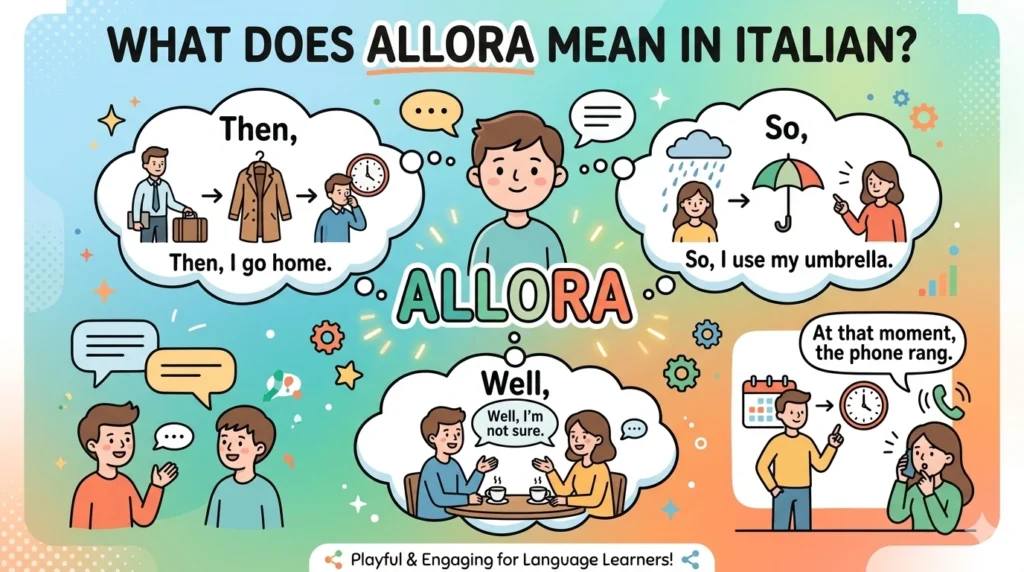
In Italian, “allora” is a versatile word that can mean “then,” “so,” “at that time,” or “therefore” depending on the context.
It is commonly used in conversations to indicate a sequence of events, introduce conclusions, or express hesitation and reflection.
For example, “Allora, cosa facciamo?” translates to “So, what shall we do?”
Despite its simple appearance, allora is one of the most frequent and nuanced words in Italian. It is not just a time marker; it can convey emotion, hesitation, logical reasoning, or continuity in conversation, making it essential for anyone learning Italian to master.
Origin and Popularity of “Allora”
“Allora” comes from Latin roots, combining ad (“to” or “towards”) and hora (“hour” or “time”). Its literal sense originally meant “at that hour” or “at that time.” Over centuries, its usage evolved to include causal, temporal, and conversational nuances, making it extremely versatile in modern Italian.
Why It’s Popular
- It’s frequently used in spoken Italian, especially in informal contexts.
- It helps connect ideas smoothly in conversation.
- It can convey tone, hesitation, or emphasis, making speech feel natural and fluid.
In everyday Italian, you might hear it dozens of times in a single conversation. It appears in movies, TV shows, casual chat, and even in literature, often bridging ideas like English words “so,” “then,” or “well.”
Usage of “Allora” in Italian
Allora has multiple uses, each with subtle differences depending on context:
1. Temporal Meaning (“Then” / “At that time”)
Used to indicate a point in time or a sequence of events.
Examples:
- Allora ero giovane. → Then I was young.
- Siamo andati a Roma nel 2019, e allora faceva molto caldo. → We went to Rome in 2019, and it was very hot then.
2. Consequential / Logical Meaning (“So” / “Therefore”)
Used to express cause, consequence, or reasoning.
Examples:
- Non hai studiato, allora non puoi superare l’esame. → You didn’t study, so you can’t pass the exam.
- Allora, se sei pronto, possiamo partire. → So, if you’re ready, we can leave.
3. Conversational Filler / Hesitation (“Well” / “So then”)
Used at the beginning of sentences to pause, reflect, or introduce a topic.
Examples:
- Allora… cosa facciamo adesso? → Well… what do we do now?
- Allora, ti va di uscire stasera? → So, do you feel like going out tonight?
4. Emphatic Use (“At that moment” / “Right then”)
Used to emphasize a particular moment or event.
Examples:
- Allora capii che avevo fatto un errore. → At that moment, I realized I had made a mistake.
- Era molto arrabbiato, e allora decisi di non intervenire. → He was very angry, and at that moment, I decided not to intervene.
Examples of “Allora” in Context
Italian is rich with nuances, and allora can shift in meaning based on tone, placement, or context.
Friendly/Neutral Example
- Amico 1: “Allora, andiamo al cinema?” → So, shall we go to the cinema?
- Amico 2: “Sì, volentieri!” → Yes, gladly!
Reflective/Emotional Example
- “Allora, pensai che fosse la scelta giusta.” → At that time, I thought it was the right choice.
Causal/Logical Example
- “Non mi hai chiamato, allora non sapevo cosa fare.” → You didn’t call me, so I didn’t know what to do.
Table 1: Different Meanings of “Allora” With Examples
| Meaning | English Equivalent | Example in Italian | Translation |
|---|---|---|---|
| Temporal | Then / At that time | Allora ero giovane. | Then I was young. |
| Consequential | So / Therefore | Non hai studiato, allora non puoi superare l’esame. | You didn’t study, so you can’t pass the exam. |
| Conversational filler | Well / So | Allora… cosa facciamo? | Well… what do we do? |
| Emphatic | At that moment | Allora capii che avevo fatto un errore. | At that moment, I realized I had made a mistake. |
Comparisons With Related Italian Words
“Allora” is versatile, but it can be confused with other common Italian words. Here’s a breakdown:
| Word | Difference | Example |
|---|---|---|
| Poi | Refers to a later time or after something | Sono andato al negozio e poi al parco. → I went to the store and then to the park. |
| Quindi | Always indicates consequence or conclusion | Non ha studiato, quindi non passerà. → He didn’t study, so he won’t pass. |
| Bene | Means “well” as a quality or confirmation, not filler | Hai fatto bene. → You did well. |
| Ecco | Draws attention or introduces something, not causal | Ecco il tuo libro. → Here is your book. |
| Allora vs. Dopodiché | “Allora” can be conversational; “dopodiché” is formal sequence | Andammo al museo, dopodiché pranzammo. → We went to the museum, after which we had lunch. |
Tip: Use allora for natural, conversational Italian. Reserve quindi or dopodiché for formal writing or structured explanations.
Polite and Professional Alternatives
While “allora” is perfect for casual speech, formal or professional contexts may prefer:
- Quindi → Therefore / So
- Pertanto → Thus / Accordingly
- Di conseguenza → As a result
- In quel momento → At that moment (temporal)
Example:
- Informal: Allora, firmiamo il contratto? → So, shall we sign the contract?
- Formal: Pertanto, procediamo alla firma del contratto. → Therefore, let us proceed to sign the contract.
Real-Life Scenarios Using “Allora”
Conversations:
- Allora, sei pronto per la riunione? → So, are you ready for the meeting?
- Allora, come è andata la tua giornata? → Well, how was your day?
Storytelling / Past Narratives:
- Allora avevo solo 20 anni e non capivo nulla. → Back then, I was only 20 and didn’t understand anything.
- Allora decisi di cambiare lavoro. → At that time, I decided to change jobs.
Logical Conclusions:
- Non vuoi venire? Allora ci andrò da solo. → You don’t want to come? Then I’ll go alone.
- Non hai risposto alle email, allora dobbiamo chiamarti. → You didn’t answer the emails, so we need to call you.
Table 2: “Allora” in Different Tones and Contexts
| Tone | Example Sentence | Meaning |
|---|---|---|
| Friendly | Allora, vuoi un gelato? | So, do you want ice cream? |
| Reflective | Allora capii l’errore. | At that moment, I realized the mistake. |
| Causal / Logical | Non hai chiesto, allora non lo sai. | You didn’t ask, so you don’t know. |
| Hesitation / Filler | Allora… cosa facciamo adesso? | Well… what do we do now? |
Common Mistakes Learners Make With “Allora”
- Confusing with “poi” – “Poi” indicates a later time, not causality or conversational filler.
- Overusing in formal writing – Use “quindi” or “pertanto” in essays or business letters.
- Misinterpreting tone – “Allora” can sound impatient or dismissive if overused in conversation.
- Literal translation to “then” – Context determines whether it’s temporal, logical, or conversational.
Extended Examples With Nuances
- Temporal:
- “Allora vivevamo in centro.” → Back then, we lived downtown.
- Logical / Causal:
- “Hai perso il treno, allora arriverai in ritardo.” → You missed the train, so you will be late.
- Conversational filler / hesitation:
- “Allora… non so se possiamo farlo.” → Well… I don’t know if we can do it.
- Emphasis / storytelling:
- “Era una giornata piovosa, e allora decisi di restare a casa.” → It was a rainy day, and at that moment, I decided to stay home.
Table 3: Nuances of “Allora” With English Equivalents
| Use | Italian Example | English Equivalent | Notes |
|---|---|---|---|
| Temporal | Allora eravamo in vacanza. | Then we were on vacation. | Refers to a point in the past |
| Logical | Non ha risposto, allora dobbiamo chiedere. | He didn’t answer, so we need to ask. | Expresses consequence |
| Conversational / Filler | Allora… cosa facciamo? | Well… what do we do? | Adds hesitation or thinking |
| Emphatic / Storytelling | Allora compresi l’errore. | At that moment, I realized the mistake. | Adds emphasis in narrative |
FAQs
1. What does “allora” mean in Italian?
It can mean “then,” “so,” “at that time,” or “therefore,” depending on context.
2. How is it different from “poi”?
“Poi” refers strictly to something happening later, while “allora” can indicate time, consequence, or conversational pause.
3. Can “allora” be used in formal writing?
It’s usually informal; formal alternatives include “quindi,” “pertanto,” or “di conseguenza.”
4. Is “allora” a filler word?
Yes, it can be used as a conversational filler similar to “well” or “so” in English.
5. How often is “allora” used in spoken Italian?
Extremely frequently; it is one of the most common words in casual conversation.
6. Can it express emotion?
Yes, it can convey hesitation, reflection, or emphasis depending on tone.
7. Are there regional differences in usage?
Minor differences exist; in southern Italy, it may be slightly more frequent in casual speech.
8. How can learners master “allora”?
Practice listening to native speakers, movies, TV shows, and conversational exercises to understand its multiple nuances.
Conclusion
Allora is one of the most versatile and essential words in Italian. It is used to:
- Indicate temporal sequences (“then” / “at that time”)
- Express consequences or reasoning (“so” / “therefore”)
- Act as a conversational filler (“well” / “so”)
- Add emphasis in storytelling (“at that moment”)
Understanding allora allows learners to sound more natural, fluid, and expressive in Italian conversation. While it is informal, mastering it alongside its alternatives like quindi, pertanto, dopodiché ensures both conversational and formal proficiency.
Key Takeaways:
- Context is everything when translating “allora.”
- It frequently bridges ideas and helps conversations flow naturally.
- Listening to native speech is crucial to mastering its subtle tonal shifts.
- Practice with real-life scenarios, storytelling, and logical sequences.
By grasping allora, learners unlock a core part of Italian fluency, improving both comprehension and spoken confidence.
Read More Related Articles:
- What Does Patent Mean in Medical Terms? Clinical Significance In 2026
- What Does Pick 6 Mean in Football? From Interception to Touchdown In 2026
- What Does SRS Mean in a Car: Why This Safety Feature Matters In 2026

Ivy Madison is a content creator at TextSprout.com, specializing in word definitions, internet slang, acronyms, and text abbreviations. She delivers clear and engaging explanations, helping readers quickly understand modern digital language and trending terms.