
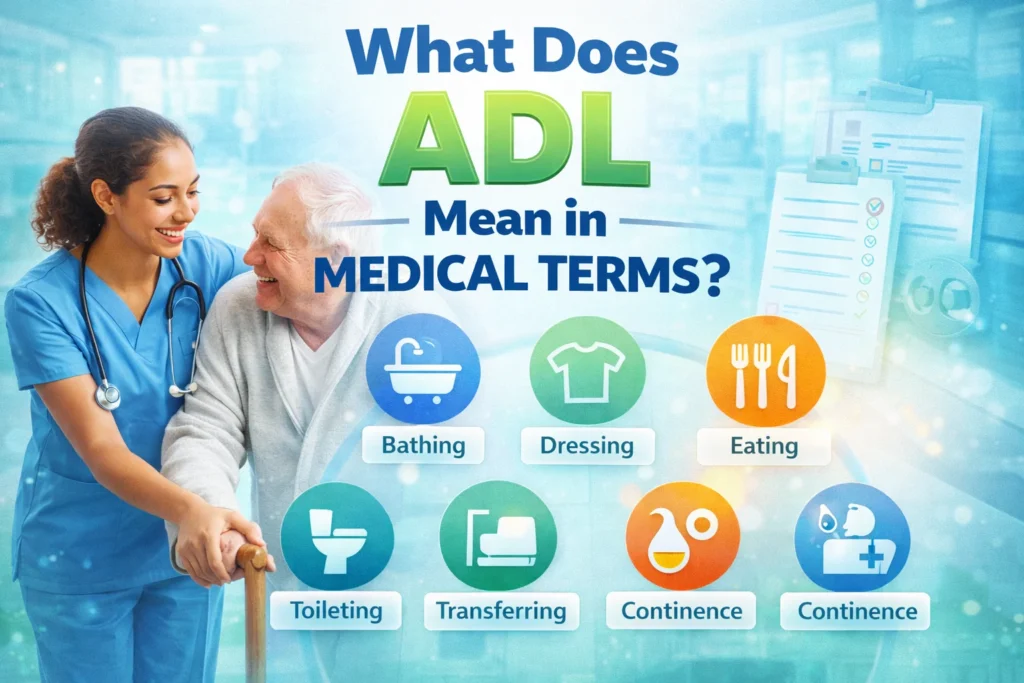
ADL in medical terms stands for “Activities of Daily Living.” It refers to the basic self-care tasks a person must be able to perform independently to live safely and functionally.
These tasks typically include bathing, dressing, eating, toileting, transferring, and maintaining continence.
When doctors, nurses, or caregivers talk about someone’s “ADLs,” they are assessing how well that person manages everyday personal care. It sounds simple. Yet in healthcare, ADLs are one of the most important measures of independence, recovery, and quality of life.
If you have ever read a medical report, hospital discharge summary, or insurance document and noticed the term ADL, you are not alone. Many people wonder what it actually means and why it matters so much.
Let’s break it down clearly and practically.
What Are Activities of Daily Living (ADLs)?
Activities of Daily Living are the essential tasks required for basic physical functioning. These are not hobbies or optional activities. They are the foundational skills that allow someone to live independently.
Healthcare professionals use ADLs to determine:
- A patient’s level of independence
- The need for home care or assisted living
- Rehabilitation progress
- Disability eligibility
- Insurance and long term care coverage
The concept focuses strictly on basic self care.
The Six Core ADLs
Most medical professionals recognize six primary ADLs:
| Core ADL | What It Means | Example |
|---|---|---|
| Bathing | Cleaning the body independently | Showering without assistance |
| Dressing | Putting on and removing clothing | Choosing clothes and dressing safely |
| Eating | Feeding oneself | Using utensils and swallowing safely |
| Toileting | Using the restroom independently | Getting to toilet and cleaning afterward |
| Transferring | Moving from one position to another | Getting from bed to chair |
| Continence | Controlling bladder and bowel function | Managing bathroom needs |
These six functions form the standard ADL assessment model used in hospitals, nursing homes, and home health evaluations.
Why ADLs Matter in Healthcare
You might be thinking, “Everyone bathes and dresses. Why is this such a big deal?”
In medicine, the ability to perform ADLs determines independence. It often influences treatment decisions more than lab results.
For example:
- An older patient recovering from surgery may be physically stable.
- If they cannot transfer from bed to chair safely, they may need rehabilitation or assisted living.
That is where ADL assessments become critical.
Real World Scenarios
Here is how ADLs are used in everyday medical practice:
| Situation | How ADLs Are Used |
|---|---|
| After a stroke | To measure loss of independence |
| After surgery | To determine discharge readiness |
| Dementia evaluation | To assess cognitive decline impact |
| Disability application | To justify functional limitations |
| Home health planning | To calculate caregiver hours |
Doctors often document statements like:
“Patient requires moderate assistance with ADLs.”
“Independent in all ADLs.”
“Dependent for bathing and dressing.”
Each phrase carries important medical and legal meaning.
The Origin of ADL in Medicine
The term ADL gained popularity in the 1950s and 1960s. It became widely recognized through the work of healthcare researchers who were studying aging and functional decline.
One influential tool was the Katz Index of Independence in Activities of Daily Living. This scale helped standardize how independence was measured in older patients.
Before ADLs became a formal concept, independence was judged more subjectively. That changed once researchers realized measurable daily functioning predicted long term health outcomes.
Over time, ADL assessments became standard practice in:
- Geriatrics
- Rehabilitation medicine
- Occupational therapy
- Long term care planning
- Social work assessments
Today, ADL documentation is routine in hospitals worldwide.
Basic ADLs vs Instrumental ADLs (IADLs)
Many people confuse ADLs with IADLs. They are related but not identical.
Comparison Table
| Feature | ADLs | IADLs |
|---|---|---|
| Full Form | Activities of Daily Living | Instrumental Activities of Daily Living |
| Focus | Basic self care | More complex life tasks |
| Examples | Bathing, eating | Cooking, managing money |
| Used For | Medical independence assessment | Community living evaluation |
| Level | Fundamental survival tasks | Higher level functioning |
IADLs include:
- Managing finances
- Shopping for groceries
- Using transportation
- Taking medications correctly
- Preparing meals
- Housekeeping
A person might manage ADLs but struggle with IADLs. That often signals early cognitive decline.
How ADLs Are Assessed
Healthcare professionals evaluate ADLs using observation, interviews, and standardized tools.
The assessment typically asks:
- Can the patient bathe independently
- Does the patient need assistance dressing
- Is supervision required for toileting
- Can the patient transfer safely
- Is there risk of falls
The answers are categorized into:
- Independent
- Requires assistance
- Fully dependent
This helps create care plans tailored to individual needs.
Examples of ADL Usage in Different Tones
Although ADL is a clinical term, it can appear in various contexts.
Neutral Clinical Tone
“Patient demonstrates independence in all ADLs.”
This is common in discharge summaries.
Supportive Tone
“She needs a little help with ADLs right now, but therapy should improve her strength.”
Often used in family discussions.
Concerned or Serious Tone
“Loss of ADLs indicates progression of disease.”
Used in dementia or chronic illness discussions.
ADL is rarely used negatively or dismissively. It remains a technical healthcare term.
ADL in Older Care
ADLs are most commonly discussed in geriatric medicine.
As people age, the ability to perform daily tasks can decline gradually. Monitoring ADLs helps detect:
- Early frailty
- Cognitive impairment
- Risk of falls
- Functional disability
Many long term care insurance policies require documentation of impairment in at least two ADLs before benefits begin.
This makes ADL assessments financially significant as well.
ADL in Rehabilitation and Recovery
After surgery, stroke, injury, or illness, ADLs measure progress.
Imagine someone recovering from a hip replacement. At first, they may need assistance transferring from bed to chair.
After physical therapy, they regain independence.
That improvement is documented as restored ADL function.
Occupational therapists focus heavily on ADLs. Their job involves helping patients relearn everyday tasks safely.
ADL and Disability Determination
Government disability programs and private insurers often use ADL limitations to determine eligibility.
If someone cannot perform multiple ADLs independently, it may qualify them for:
- Disability benefits
- Home care services
- Nursing home placement
- Assisted living admission
ADL documentation must be precise and objective.
Alternate Meanings of ADL
While ADL primarily means Activities of Daily Living in healthcare, it can occasionally stand for:
| Context | Meaning |
|---|---|
| Technology | Automated Data Loading |
| Logistics | Average Daily Load |
| Internet slang | Attack Damage Life |
However, in medical documents, ADL almost always refers to Activities of Daily Living.
Polite and Professional Alternatives to ADL
In patient friendly conversations, healthcare providers sometimes avoid technical language.
Instead of saying:
“Impaired ADLs”
They may say:
“Needs help with daily self care tasks”
Or
“Requires assistance with personal care”
These alternatives sound clearer and less clinical.
In professional documentation, however, ADL remains standard terminology.
Practical Tips for Understanding ADL in Medical Reports
If you see ADL mentioned in a report, ask yourself:
- Which specific tasks are affected
- Is assistance partial or full
- Is the condition temporary or permanent
- What support plan is recommended
Understanding the context matters more than the abbreviation itself.
FAQs
What does ADL stand for in healthcare?
ADL stands for Activities of Daily Living. It refers to essential self care tasks such as bathing, dressing, eating, toileting, transferring, and continence.
What are the six basic ADLs?
The six core ADLs include bathing, dressing, eating, toileting, transferring, and continence.
What is the difference between ADL and IADL?
ADLs involve basic survival and self care tasks. IADLs involve more complex tasks like cooking, managing money, shopping, and medication management.
Why are ADLs important in older care?
They measure independence. Loss of ADLs often indicates frailty, cognitive decline, or need for additional care support.
How are ADLs assessed in hospitals?
Healthcare providers observe performance, ask questions, and use standardized scales to determine independence levels.
Can someone lose ADLs temporarily?
Yes. Surgery, injury, infection, or hospitalization can temporarily impair ADLs. Rehabilitation often restores function.
How many ADLs must be impaired for long term care insurance?
Most policies require impairment in at least two ADLs before benefits are activated.
Is ADL only used for older adults?
No. ADLs are assessed in patients of all ages who have injuries, disabilities, neurological conditions, or chronic illnesses.
Conclusion
So, what does ADL mean in medical terms?
It stands for Activities of Daily Living.
It represents the most basic self care tasks required for independent living.
Doctors rely on ADL assessments to determine safety, discharge readiness, rehabilitation needs, and long term care eligibility. Insurance providers use them to evaluate benefit qualification. Families use them to understand how much help a loved one needs.
ADLs may seem simple on the surface. They are actually one of the strongest indicators of functional health.
If you encounter the term ADL in a medical document, remember this:
It is not just an abbreviation.
It is a measurement of independence, dignity, and daily functioning.
Understanding ADLs helps you better interpret medical reports, plan care decisions, and advocate for appropriate support.
Read More Related Articles:
- What Does Slugging Mean in Baseball? How Power Hitters Dominate the Game In 2026
- True Meaning of “Quiero” in Spanish and How It’s Used In 2026
- What Does PRA Mean in Basketball? The Stat Every Bettor Should Know In 2026

Neon Samuel is a digital content creator at TextSprout.com, dedicated to decoding modern words, slang, and expressions. His writing helps readers quickly grasp meanings and understand how terms are used in real conversations across text and social platforms.